

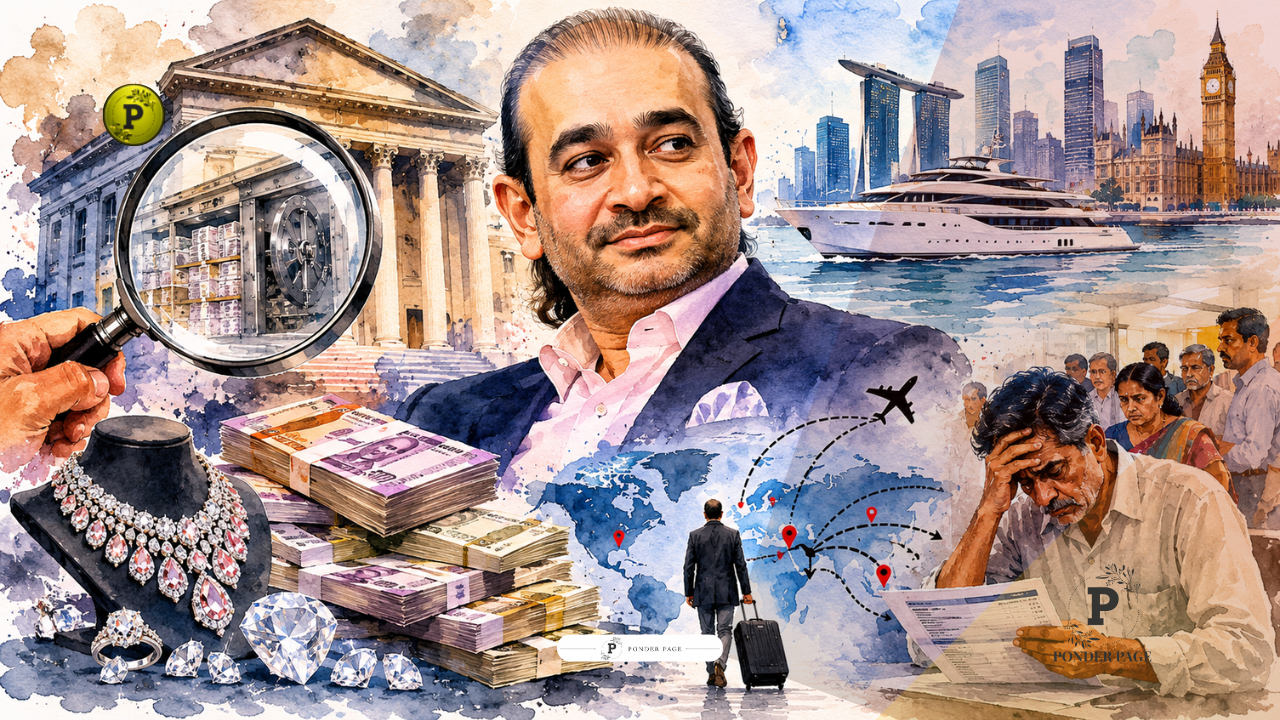
The PNB Scam: In the intricate web of India’s biggest banking fraud, a pivotal moment came on May 31, 2017. On this date, Gokulnath Shetty, the Deputy Manager at Punjab National Bank (PNB), retired. He was replaced by Dinesh Bhardwaj as the new Manager at the same branch. This transition later came under scrutiny, especially because of an unusual deviation from protocol.
According to government bank norms, staff in managerial posts are usually rotated every three years to prevent long-term control over a single branch. However, Shetty remained at the same branch for over seven years, an exception that proved to be catastrophic. Interestingly, Nirav Modi, the prime accused in the scam, dealt only with this particular PNB branch for all his transactions—raising serious suspicions.
(You can now subscribe to our Ponder Page WhatsApp channel)

Table of Contents
A New Manager, A Startling Discovery
When Dinesh Bhardwaj took over as manager, the branch seemed to function normally for about six to seven months. But everything changed when Nirav Modi, through his three companies—Stellar Diamonds, Diamond R US, and Solar Exports—applied for another Letter of Undertaking (LoU) worth ₹323 crore. Unlike his predecessor, Bhardwaj asked a basic but crucial question: what security are you offering in return for this LoU? A representative from Modi’s firm, unaware of the changed environment, casually replied that they had always received LoUs without offering any security and even suggested the manager check the bank’s system for verification. Shocked, Bhardwaj checked the records and confirmed the claim.
The Internal Inquiry and Start of Investigations
Realizing the gravity of the situation, Bhardwaj alerted higher authorities and an internal inquiry was initiated. The investigation revealed that during Shetty’s tenure, LoUs worth crores had been issued without any security collateral, making PNB an unknowing guarantor. Essentially, if Nirav Modi failed to repay, PNB would be liable for the amount. Adding to the gravity, Modi had already fled the country on January 1, 2018, along with his family.
PNB’s Attempts to Fix the Situation
PNB tried to control the damage by reaching out to Nirav Modi’s companies, asking them to clear dues and submit all import documentation. While chaos erupted within the bank, Modi was seen in Switzerland attending the World Economic Forum and posing for photographs alongside the Indian Prime Minister. By January 25, 2018, when no payment was received and no documents submitted, PNB finally reported the scam to the Reserve Bank of India (RBI) on January 29, 2018.
The Case Reaches CBI
Soon after informing RBI, PNB officials filed an FIR with the Central Bureau of Investigation (CBI) against Nirav Modi and all associated companies. Modi’s bank accounts were frozen, and suspicion fell on 10 PNB employees, who were promptly suspended. The CBI investigation revealed that Modi’s managers had illegal access to PNB’s internal systems. They manipulated SWIFT—the global system for financial messaging—to generate and verify fake LoUs themselves. Corrupt PNB officers allegedly received commissions for each transaction.

Scale of the Scam Revealed
As the investigation progressed, it became evident that this was a well-orchestrated and pre-planned scam. On February 4, 2018, the CBI issued a lookout notice for Nirav Modi. Despite multiple summons, he never appeared—often citing health issues or important meetings. Meanwhile, it was discovered that his uncle, Mehul Choksi, was also obtaining LoUs without offering any security. On February 7, 2018, the CBI registered a separate FIR against Choksi as well.
The Enforcement Directorate Steps In
On February 14, 2018, the Enforcement Directorate (ED) was brought into the case. The ED’s probe revealed a network of shell companies used to launder money. As the heat intensified, Modi, along with his brother Nihal Modi, destroyed the mobile phones of dummy directors of these shell firms and relocated them to Cairo, Egypt. This was done to prevent authorities from accessing critical evidence.
Massive Raids and Property Seizures
On February 15, the ED launched raids on 17 locations, including Nirav Modi’s residence in Kurla and his jewelry showroom in Kala Ghoda. Properties worth ₹5,100 crore were seized. However, many experts claimed that the valuation of these properties was inflated to cover up institutional failures.
Passports Cancelled and Public Outrage
Soon after, the Ministry of External Affairs was contacted, and the passports of Nirav Modi and Mehul Choksi were revoked. This sparked nationwide outrage. Panic gripped customers as queues formed outside PNB branches to withdraw funds. The stock market reacted sharply—34 out of 39 banking stocks fell. PNB alone suffered a ₹8077 crore market value loss. The diamond industry, too, faced a 10% drop, and genuine traders found it harder to secure loans as banks tightened lending norms.
Systemic Reforms and New Laws
In response to the scam, on March 13, 2018, RBI banned the issuance of LoUs altogether. The government introduced the Fugitive Economic Offenders Act, 2018, aimed at preventing such frauds in the future. Audit protocols were revamped, and the National Financial Reporting Authority was established to oversee financial reporting. Public anger was immense, putting pressure on enforcement agencies to act swiftly.
Arrests and Political Uproar
As public pressure mounted, key figures began getting arrested. Among them were Hemant Bhatt, the man handling Nirav Modi’s paperwork, PNB Manager Gokulnath Shetty, Clerk Manoj Kharat, and Vipul Ambani—the man in charge of finances at Modi’s firm. Four other employees were also arrested. The scandal soon became a political battleground with the ruling and opposition parties blaming each other.
The PNB Scam: The Hunt for Nirav Modi Goes Global
To bring Nirav Modi back to India, the CBI approached Interpol, which promptly began its investigation. On June 2, 2018, Interpol issued a Red Corner Notice against Modi in connection with the money laundering case. This global alert instructed all member nations to locate and detain him so he could be extradited to India.
As of now, Nirav Modi remains in the United Kingdom, where he is fighting extradition to India. After being arrested in London in March 2019, he has been lodged in Wandsworth Prison, one of the most overcrowded prisons in the UK.
The Indian government has been actively pursuing his extradition under the India-UK Extradition Treaty, and the Westminster Magistrates’ Court ruled in February 2021 in favour of extradition, citing a prima facie case of fraud and money laundering. Modi appealed the decision, citing mental health concerns and the risk of suicide if extradited. However, in November 2022, the UK High Court dismissed his appeal, clearing the path for his extradition.
The final decision now rests with the UK Home Secretary. Meanwhile, Indian agencies continue their efforts to recover the siphoned funds through asset seizures and legal proceedings, but full justice and recovery remain pending as the legal battle drags on internationally.


What are your thoughts on this article? Let us know in the comments below. If you enjoyed this article, be sure to subscribe for more engaging content in the future! Stay updated on the latest developments and discussions by clicking the subscribe button above. Thank you for your support!
📢 Dive into the latest discussions on social & trending topics! 🌍💬 Subscribe to Ponder Page for thought-provoking articles and interviews that dissect current issues. Don’t miss out on insightful content—hit that like & subscribe button now!




Leave a Reply