
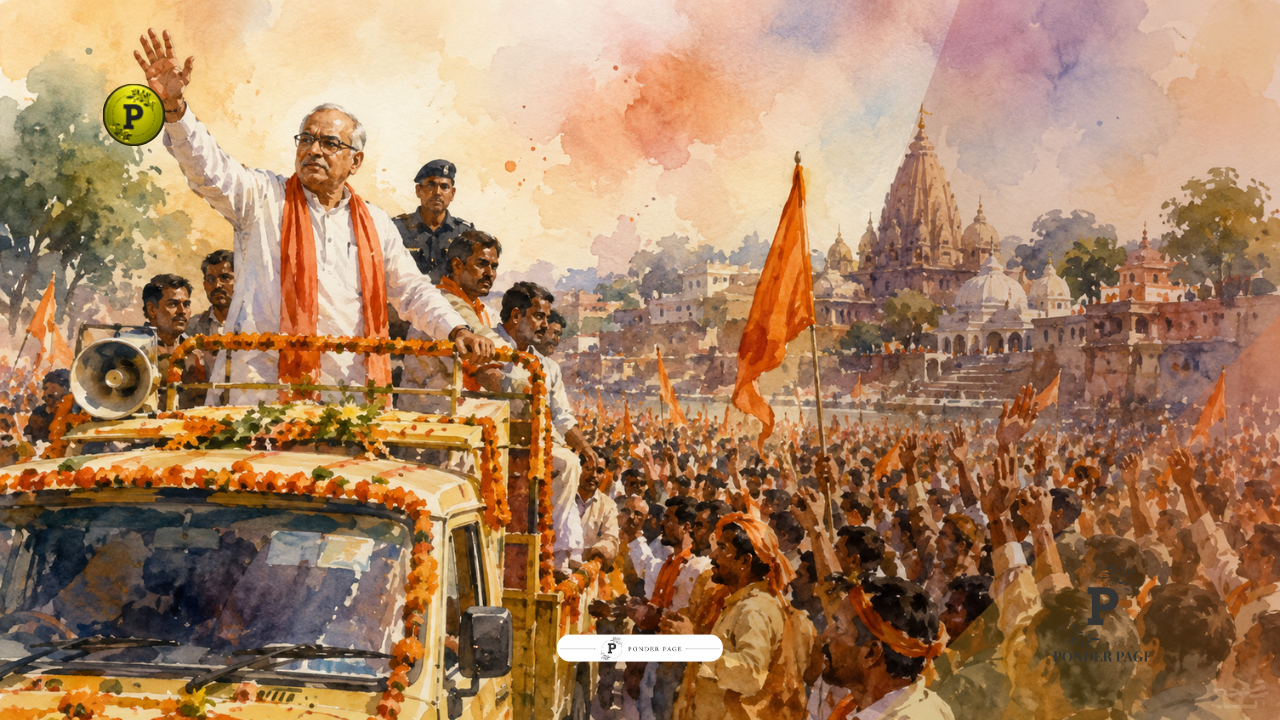
The Rath Yatra of 1990: The Ram Janmabhoomi movement entered a decisive phase at the end of the 1980s. The issue surrounding the disputed site in Ayodhya had already become a major subject of political and religious debate, but the events of 1990 transformed it into one of the most powerful political movements in modern India.
In November 1989, Bharatiya Janata Party leader Lal Krishna Advani announced his own Rath Yatra. This journey was separate from the Rath Yatra associated with the Vishwa Hindu Parishad and was designed to mobilise public support for the construction of a Ram temple at the disputed site in Ayodhya.
The journey would eventually become one of the defining political episodes of Advani’s career and a major turning point for the BJP.
(You can now subscribe to our Ponder Page WhatsApp channel)

Table of Contents
The Rath Yatra Begins from Somnath
The Rath Yatra formally began in September 1990 from the Somnath Temple in Gujarat. The choice of Somnath carried considerable historical and political symbolism. From Somnath, Advani planned to travel across different parts of India before reaching Ayodhya.
The proposed journey covered thousands of kilometres, passing through several regions and states. Its ultimate destination was Ayodhya, where supporters of the Ram Janmabhoomi movement planned to participate in kar seva.
As the Rath Yatra moved across the country, it attracted enormous crowds and generated intense political attention. The Ram temple issue, which had already been part of public discourse, was suddenly placed at the centre of national politics.
For the BJP, the mobilisation proved politically significant. The party received unprecedented attention, while Advani emerged as one of the most prominent political leaders associated with the movement.
Communal Tensions Rise
The Rath Yatra also coincided with a period of serious communal tension in several parts of India. Demonstrations, counter-demonstrations and clashes were reported in different locations as supporters and opponents of the movement confronted each other.
The situation was particularly sensitive in areas where Hindu and Muslim communities lived in close proximity and where communal relations were already fragile.
The political debate surrounding Ayodhya therefore went far beyond the question of temple construction. It became intertwined with questions of secularism, religious identity, electoral politics and the relationship between India’s different communities.
The increasing tension also placed state governments under pressure to prevent violence and maintain public order.
Advani’s Arrest in Bihar
As the Rath Yatra continued towards Ayodhya, it eventually entered Bihar.
On October 23, 1990, Advani was arrested at Samastipur in Bihar on the orders of the state government led by Chief Minister Lalu Prasad Yadav. The arrest effectively brought Advani’s Rath Yatra to an end.
The Bihar government’s position was that allowing the journey to continue could further intensify communal tensions and create serious law-and-order problems.
For supporters of the movement, however, the arrest became another symbol of the confrontation between the Ram temple campaign and governments opposed to the mobilisation.
Although Advani’s journey had been stopped, the movement itself did not stop.
The BJP’s Rapid Political Rise
The political consequences of the Ram Janmabhoomi movement were already becoming visible.
The BJP had won only two seats in the 1984 Lok Sabha election. Within five years, its performance had changed dramatically. In the 1989 Lok Sabha election, the party won 85 seats, establishing itself as a major force in national politics.
The Ram temple issue played an important role in this transformation, particularly by helping the party expand its political base in northern India.
The BJP also formed governments in several states, including Uttar Pradesh, Rajasthan, Madhya Pradesh and Himachal Pradesh, around this period. Advani’s prominence within the party grew rapidly, and the construction of a Ram temple at Ayodhya became an important part of the BJP’s political agenda.
What had once been a relatively marginal electoral force was becoming one of India’s principal political parties.
The Journey Continues Without Advani
Advani’s arrest did not prevent thousands of kar sevaks from travelling towards Ayodhya.
The plan was for them to reach the disputed site on October 30, 1990, and participate in kar seva. For many supporters, Advani’s arrest was not seen as a reason to abandon the movement. Instead, the journey continued through the participation of volunteers arriving from different parts of the country.
The situation in Uttar Pradesh was particularly tense because the state government, headed by Chief Minister Mulayam Singh Yadav, had made it clear that the disputed site would be heavily protected.
Mulayam Singh Yadav famously declared that no one would be allowed to reach the disputed structure, using the phrase that even a bird would not be able to enter the area.
The statement became famous and was subsequently repeated extensively in political discourse surrounding Ayodhya.
Kar Sevaks Reach the Disputed Site
On October 30, 1990, large numbers of kar sevaks attempted to enter the restricted area in Ayodhya.
Security forces had been deployed to prevent them from reaching the disputed structure. Despite the restrictions, groups of kar sevaks managed to move towards the site.
One of the most dramatic episodes involved a former driver who was among the kar sevaks. According to accounts of the incident, he managed to take control of a police bus and used it to transport kar sevaks closer to the disputed area.
The confrontation eventually resulted in kar sevaks reaching the structure and attempting to place a saffron flag on one of the domes.
The incident became an enduring image of the Ram Janmabhoomi movement.
Police Firing and the Deaths of Kar Sevaks
The confrontation between the kar sevaks and the Uttar Pradesh administration reached its most violent stage when police opened fire.
A number of kar sevaks were killed in the firing. Accounts of the exact number of deaths have varied, and the events remain deeply contested in political and historical discussions.
For supporters of the Ram temple movement, the deaths became a powerful symbol of sacrifice. For critics of the movement, the episode demonstrated the dangers of escalating religious mobilisation and attempts to enter a heavily protected disputed site.
The events of October 1990 consequently became an important chapter in the political history of the Ayodhya dispute.
The Story of the Monkey and the Saffron Flag
One of the most frequently repeated stories from the events of that day involves a monkey appearing on the disputed structure with what was described as a saffron flag.
The episode quickly acquired symbolic significance among supporters of the movement. For many, the image was interpreted through the religious association of Lord Hanuman with Lord Ram.
Whether viewed as coincidence, symbolism or an event that acquired significance through later retelling, the story became part of the popular memory surrounding the October 1990 events.


The Rath Yatra of 1990 | How the Rath Yatra Changed Indian Politics
The 1990 Rath Yatra was far more than a political road journey. It transformed the Ram Janmabhoomi issue into a central national political question and helped reshape the electoral fortunes of the BJP.
Advani’s mobilisation demonstrated the power of mass political campaigns built around questions of religious identity and cultural nationalism. At the same time, the violence and communal tensions surrounding the movement exposed the enormous social consequences such mobilisation could produce.
The arrest of Advani, the arrival of kar sevaks in Ayodhya, the police firing and the political confrontation between state governments all became part of a larger story that would continue for years.
The Rath Yatra of 1990 therefore stands as one of the crucial moments in understanding how the Ayodhya movement evolved from a contentious religious dispute into a defining force in Indian electoral politics.
What are your thoughts on this article? Let us know in the comments below. If you enjoyed this article, be sure to subscribe for more engaging content in the future! Stay updated on the latest developments and discussions by clicking the subscribe button above. Thank you for your support!
📢 Dive into the latest discussions on social & trending topics! 🌍💬 Subscribe to Ponder Page for thought-provoking articles and interviews that dissect current issues. Don’t miss out on insightful content—hit that like & subscribe button now!



Leave a Reply