
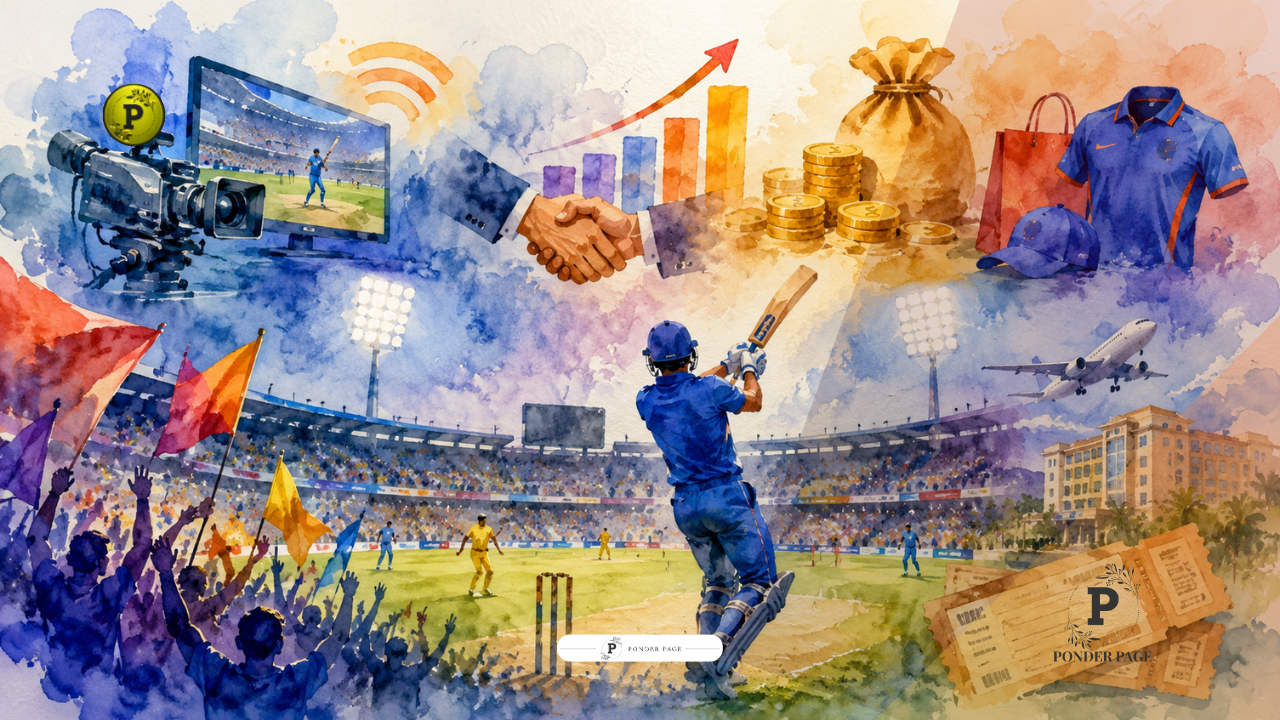
How IPL Teams Actually Make Money: The Indian Premier League, or IPL, is often viewed primarily as a cricket tournament. But behind the sixes, wickets, packed stadiums and star players lies a massive commercial ecosystem worth billions of rupees.
Owning an IPL team is not a simple business. Franchise owners have to spend enormous amounts on acquiring the team, paying players, maintaining support staff, managing operations and travelling across India for matches. Hotels, flights, training facilities, administration and marketing add significantly to the overall cost.
Yet franchise owners continue to compete aggressively for IPL teams because the real money is not in the prize money. The IPL has developed a business model in which broadcasting, sponsorships, advertising, ticket sales, merchandise and brand partnerships can generate far greater returns than simply winning the tournament.
(You can now subscribe to our Ponder Page WhatsApp channel)

Table of Contents
Buying an IPL Team Is Only the Beginning
The first major expense for a franchise owner is acquiring the team itself.
Depending on the franchise and the period in which it was acquired, this can involve an enormous investment. But buying the franchise is only the beginning.
Every season, owners have to pay player salaries and auction fees while also maintaining a large support staff consisting of coaches, trainers, physiotherapists, analysts and other professionals. Administrative expenses and operational costs add another significant layer to the bill.
Then comes the travelling.
IPL matches are played in different cities, meaning teams regularly have to arrange flights, hotels, transportation, training facilities and other logistical requirements. A season lasting several weeks can therefore become an extremely expensive operation.
This is why the IPL cannot be understood as a conventional sporting business where the winner simply takes home the biggest prize and everyone else loses money.
The prize money is important, but it is only one small part of the overall financial picture.
Prize Money Is Not the Main Source of Revenue
The IPL’s winning prize may sound enormous to an ordinary viewer, but compared with the amount of money circulating throughout the tournament, it is relatively small.
A franchise cannot build a profitable business simply by hoping to win the tournament. The economics of an IPL team are based on multiple revenue streams that operate throughout the season and, in many cases, beyond it.
The biggest of these revenue streams is broadcasting.
Broadcasting Rights: The Biggest Money Machine
Broadcasting rights have transformed the economics of the IPL. The basic concept is straightforward. A broadcaster pays the IPL enormous amounts of money for the exclusive rights to show matches to viewers.
During the first decade of the competition, Sony held the IPL broadcasting rights. Sony reportedly paid around ₹8,200 crore for the ten-year period from 2008 to 2017.
The economics changed dramatically when Star India acquired the rights for the 2018–2022 cycle for a much larger amount i.e., around ₹16,347 crore.
The extraordinary sums paid for broadcasting rights demonstrate just how valuable the IPL’s audience has become.
Millions of people watch the tournament, creating an enormous advertising market. Broadcasters can therefore charge advertisers substantial amounts for commercial spots during matches.
A short advertisement may appear on screen for only a few seconds, but when thousands of advertising spots are sold throughout an entire IPL season, the cumulative revenue becomes enormous. This is one of the fundamental reasons broadcasters are willing to spend so much money acquiring IPL rights.
They are not simply buying cricket matches. They are buying access to one of the largest concentrated television and digital audiences in Indian sport.
How Broadcasting Revenue Reaches the Teams
The broadcasting money generated by the IPL is not retained entirely by the central organisation. A significant portion is distributed among the franchises according to the league’s revenue-sharing arrangements.
Historically, the distribution formula has changed over time. In the early years, the franchises received a larger proportion of central revenues. As the league matured, the share retained by the central body increased.
This revenue-sharing system is extremely important because it provides franchises with a substantial financial foundation regardless of whether they win the tournament. It means a team can potentially remain commercially successful even without lifting the trophy.
Title Sponsorship: Why Companies Pay to Put Their Name on the IPL
Another enormous source of money is title sponsorship.
The IPL has rarely been referred to simply as “IPL” in its commercial history. Over the years, the tournament has carried the names of major corporate sponsors.
DLF, Pepsi, Vivo and Tata have all been associated with the tournament at different stages.
The concept is simple. A company pays a substantial amount for its brand name to become permanently associated with the competition. The tournament then becomes a giant marketing platform.
During the early years, DLF paid around ₹200 crore for the title sponsorship from 2008 to 2012. Pepsi subsequently paid around ₹396 crore for a three-year period.
Vivo’s agreement represented another major jump in sponsorship value, reportedly reaching around ₹2,199 crore for the 2018–2022 period.
Following the suspension of Vivo’s association amid tensions between India and China, Tata became the title sponsor.
The increase in title sponsorship prices reflects the growing commercial value of the IPL itself.
Companies are not simply paying for their names to appear on television. They are buying association with one of the biggest sporting properties in the country.
Sponsorship Revenue Is Shared Too
Title sponsorship revenue also forms part of the IPL’s broader commercial ecosystem.
A portion goes to the central organisation, while another portion is distributed among the franchises according to the applicable revenue-sharing arrangements. This is important because it creates another recurring source of income for teams.
The more commercially valuable the IPL becomes, the more valuable these central revenue distributions can become for individual franchises.
Ticket Sales: The Stadium Is Another Revenue Stream
Broadcasting may generate the biggest numbers, but stadium ticket sales remain an important source of income. The home franchise generally has considerable influence over ticket pricing for its home matches. When thousands of supporters fill a stadium, the combined ticket revenue can run into crores of rupees.
A portion of the ticket revenue goes to the home franchise, while another portion is shared with the relevant cricket association or stadium authority according to the applicable arrangement.
For a popular franchise with a loyal fan base, multiple home matches can therefore generate substantial additional income.
But tickets are only one part of what happens inside a stadium.
Every Logo You See Is a Business
Watch an IPL match carefully and you will notice that almost every visible space has commercial value.
Team jerseys carry sponsor logos. Bats carry advertisements. Helmets feature brands. Boundary boards display corporate names. The boundary ropes, wickets, dugouts and even officials’ clothing can contain commercial branding.
None of these placements happen by accident. Companies pay for visibility.
The IPL provides brands with the opportunity to place their names in front of millions of viewers repeatedly throughout a match. Even a small piece of advertising real estate can become extremely valuable when it is seen by a massive audience.
For franchises, these sponsorship agreements can therefore become another significant source of revenue.
Players Are Also Part of the Advertising Business
An IPL franchise does not only sell advertising space on a jersey. Its biggest stars can themselves become marketing assets.
Franchise owners can use players for promotional campaigns, advertisements, appearances and other commercial activities associated with the team. The popularity of a player can significantly increase the value of these opportunities.
A famous player wearing a franchise jersey in an advertisement can provide a completely different level of visibility compared with a conventional advertising campaign.
This creates a powerful connection between cricket, celebrity culture and brand marketing.
Franchise-Owned Brands Add Another Layer
Many IPL owners are already involved in large businesses outside cricket. For such owners, an IPL team can become more than just a sporting investment. The franchise provides a ready-made platform for promoting the owner’s existing businesses, products and services.
Players can appear in promotional campaigns, while matches provide enormous exposure to the team’s brand. This is one reason the value of an IPL franchise cannot always be measured simply by looking at its annual cricket-related revenue.
The team can strengthen the owner’s broader business ecosystem.
Merchandise: Turning Fans Into Customers
Another important revenue stream is merchandise. Fans don’t just watch their teams. They buy them. Official team jerseys, caps, bats, mugs, accessories and other products allow supporters to demonstrate their loyalty.
A successful franchise with a large and passionate fan base can generate substantial merchandise sales.
The business logic is straightforward: the larger the fan base and the stronger the emotional connection with the team, the greater the potential market for merchandise.
This is particularly valuable because merchandise can continue generating revenue even when the team is not playing a match.
What About the Prize Money?
After considering broadcasting rights, sponsorships, ticket sales, advertising, merchandise and commercial partnerships, the tournament prize money starts to look very different.
Winning the IPL is financially rewarding, but the trophy itself is not necessarily the main reason franchise owners want to win.
There is another, much more valuable prize: increased commercial visibility. A successful team gets more exposure, more fans and greater credibility with sponsors.
That can translate into higher sponsorship deals and stronger merchandise sales in future seasons. In other words, winning can increase the value of almost every other revenue stream.
Why Reaching the Playoffs Matters So Much
This is where qualification for the top four becomes particularly important. Teams that fail to qualify for the playoffs stop playing competitive matches for that season. The four successful teams, however, get additional matches.
More matches mean more opportunities to sell tickets, attract sponsors, generate advertising exposure and engage fans. The financial benefit therefore extends beyond the immediate prize money.
A team reaching the later stages receives additional exposure at precisely the point when public interest in the tournament is at its highest.
Success Increases Brand Value
Winning or consistently reaching the playoffs can also transform a franchise’s brand value.
Consider two teams with similar fan bases but very different recent records. The successful team is likely to command greater attention from sponsors.
A company may be willing to pay significantly more to associate itself with a highly successful franchise than with a team that regularly finishes near the bottom. This creates a virtuous cycle.
Success increases visibility. Greater visibility attracts sponsors. Better sponsorship deals increase commercial strength. Greater commercial strength can help the franchise build an even stronger brand. That is why franchise owners desperately want their teams to remain competitive.
The Early IPL Years Were Not Always Profitable
The IPL’s current financial strength can make it easy to forget that the early years were considerably more uncertain. During the first decade, several franchises faced serious financial difficulties.
The Deccan Chargers are one of the most prominent examples. The franchise struggled financially and eventually became unsustainable. The team was terminated and replaced by the Sunrisers Hyderabad franchise.
This demonstrated an important reality about the IPL: simply owning a team did not automatically guarantee profitability.
Franchises had to survive the high operating costs while the league’s commercial ecosystem was still developing.
Then Broadcasting Money Changed Everything
One of the biggest turning points came when the value of media rights increased dramatically. As broadcasters began paying much larger amounts for the IPL, the financial distribution reaching franchises also increased. At the same time, the value of title sponsorships, team sponsorships and advertising opportunities rose.
The result was a fundamental change in the economics of IPL franchises.
Teams that had once struggled to remain financially viable suddenly had access to much larger and more predictable revenue streams. This helped transform IPL franchises from expensive sporting experiments into highly valuable commercial properties.
The Controversy Around Match-Fixing
The enormous amount of money involved in the IPL has inevitably led to questions about corruption and match-fixing.
The league has faced serious controversies, including the spot-fixing scandal that resulted in Rajasthan Royals and Chennai Super Kings being suspended for two seasons.
These incidents severely damaged the league’s reputation at the time and raised questions about the relationship between cricket and enormous financial incentives.
However, claims that IPL franchises primarily make their money through spot-fixing require evidence. The existence of past corruption cases does not, by itself, establish that match-fixing is the principal source of franchise revenue.
The legitimate commercial model of the IPL is already capable of generating enormous amounts of money through broadcasting, sponsorship, advertising, ticket sales, merchandise and brand partnerships.
The debate surrounding corruption therefore remains a separate issue from the fundamental economics of the league.
The Real IPL Business Model
The biggest misconception about IPL franchises is that they make money by winning the tournament. They don’t. Winning helps, but the real business is built around the audience.
Millions of people watch the IPL. That audience attracts broadcasters. Broadcasters attract advertisers. Advertisers and corporations pay for sponsorships. Fans buy tickets and merchandise. Players become advertising personalities. Successful teams build stronger brands, which in turn allows them to demand better commercial deals.
Everything is connected.
The cricket is the product that attracts the audience, but the audience is what creates the commercial value. That is the secret behind the IPL’s extraordinary financial success.
Why IPL Teams Are Now Worth So Much
The transformation of IPL franchises over the years illustrates how a sports league can become a global commercial enterprise.
The early years involved significant financial uncertainty, expensive operations and questions about whether franchise owners could sustain their investments.
Today, the situation is very different.
Media rights are worth enormous sums. Sponsorships have become increasingly expensive. Franchise brands have millions of supporters. Merchandise has become a significant business. Players have become global marketing personalities.
Most importantly, an IPL team is no longer simply a cricket team. It is a media property, entertainment brand, advertising platform, consumer brand and commercial asset rolled into one.
How IPL Teams Actually Make Money: The Final Picture
The IPL’s financial model is built on one fundamental idea: the value of the tournament comes from the size and engagement of its audience.
The prize money may attract headlines, but it is only a fraction of the larger business.
Broadcasting rights provide the financial foundation. Title sponsorship brings in another massive stream of revenue. Ticket sales monetise stadium audiences. Jersey and ground advertising turn visibility into cash. Players create additional commercial opportunities. Merchandise converts supporters into customers. And success on the field increases the value of almost all these revenue streams.
This is why franchise owners care so deeply about reaching the playoffs and winning the IPL.
The trophy is valuable. But the brand value created by winning it can be worth far more.
The IPL ultimately demonstrates that modern professional sport is no longer just about what happens on the field. The real business is everything that happens around it.


What are your thoughts on this article? Let us know in the comments below. If you enjoyed this article, be sure to subscribe for more engaging content in the future! Stay updated on the latest developments and discussions by clicking the subscribe button above. Thank you for your support!
📢 Dive into the latest discussions on social & trending topics! 🌍💬 Subscribe to Ponder Page for thought-provoking articles and interviews that dissect current issues. Don’t miss out on insightful content—hit that like & subscribe button now!




Leave a Reply