
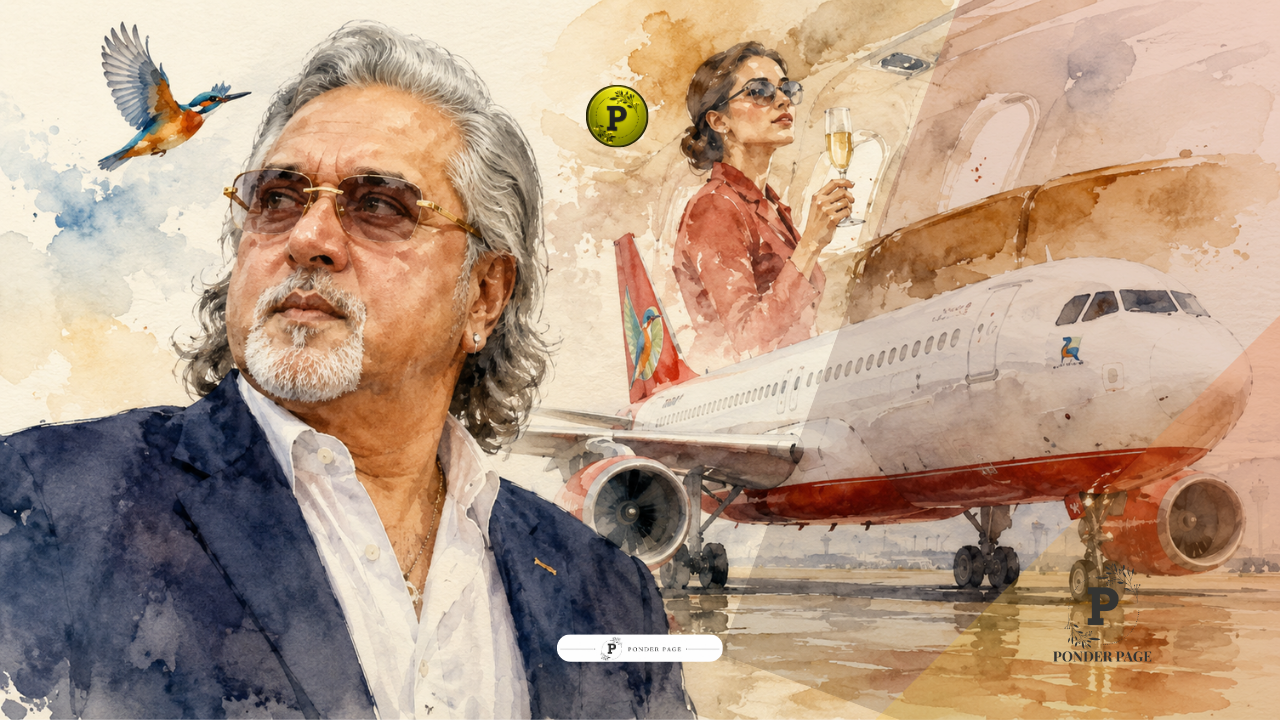
The Rise of Kingfisher: There was a time when people within the United Breweries (UB) Group began worrying about Vijay Mallya’s approach to running the business. There were concerns that some of his decisions could eventually put the group at risk.
At the time, executives such as H. P. Bhagat and M. Srinivasa Rao had established strong reputations for generating revenue during Vittal Mallya’s tenure. Their names began coming up as possible leaders who could take the company forward. Even members of the Mallya family reportedly considered whether Vijay should step aside and allow experienced executives to take greater control.
But Vijay Mallya had no intention of retreating.
Instead, he began working on a new project that would eventually transform the way his name was perceived in Indian business: Kingfisher.
(You can now subscribe to our Ponder Page WhatsApp channel)

Table of Contents
Turning an Existing Brand Into a National Powerhouse
Rather than starting an entirely new beer brand, Mallya concentrated on strengthening brands that already had recognition in the market.
One of his early challenges was the geographical imbalance in beer demand. Southern India had strong demand for beer throughout much of the year, while northern markets were significantly more seasonal. During the off-season, production at some northern facilities could be reduced or stopped.
Mallya’s approach was to make better use of that production capacity. Beer produced in northern facilities could be moved into southern markets where demand was stronger.
The strategy helped create a much more integrated distribution network. Instead of treating different regional markets as isolated businesses, production and distribution could be coordinated across the country.
That approach helped Kingfisher strengthen its position against competitors and build one of the most recognizable distribution networks in India’s beer industry.
The Bottle Problem
Another seemingly small problem had a major financial impact on breweries: bottles.
Beer was traditionally sold in glass bottles, and maintaining a bottle supply required considerable investment. Dealers would take filled bottles and were expected to return the empties.
The problem was that bottles frequently came back broken, damaged or not at all.
When pressure was placed on dealers to return the required number of bottles, some reportedly found cheaper alternatives, including sourcing bottles from scrap dealers or local manufacturers.
For the company, the consequences were expensive. It meant spending more money replacing bottles and maintaining packaging supplies, eating into margins.
Mallya’s solution was to move increasingly toward cans for certain products and markets. It was a practical change, but it also demonstrated an important characteristic of his business style: identifying operational inefficiencies and looking for ways to remove them.
The Rise of Kingfisher Strong
Kingfisher had another challenge. Its established image was associated with a relatively light beer.
For consumers looking for stronger alcohol at a similar price, spirits could appear more attractive because they offered a significantly higher alcohol content.
The answer was Kingfisher Strong.
The introduction of a stronger beer, with substantially higher alcohol content, changed the brand’s appeal. It gave consumers another reason to choose beer over competing alcoholic beverages and helped push Kingfisher into a rapidly expanding segment of the market.
By the mid-1980s, Kingfisher had overtaken established competitors and emerged as India’s largest-selling beer brand.
The transformation was significant. What had once been another beer label was becoming a national consumer brand.
From Beer to Lifestyle
Mallya understood something that went beyond the product itself.
Kingfisher could not simply be a beer. It had to become a name people associated with youth, entertainment, glamour, sport and aspiration.
This was particularly important because direct advertising of alcoholic beverages was heavily restricted in India.
Instead of allowing the Kingfisher name to disappear from public advertising, the company explored what became known as surrogate branding.
Kingfisher-branded products such as soda and bottled water could be promoted, allowing the name to remain visible even when direct beer advertising was restricted.
But the strategy went much further.
Building the Kingfisher Image Everywhere
Kingfisher events began appearing across India. These events were heavily branded, with the Kingfisher name prominently displayed.
The idea was simple but powerful. Photographs from events would appear in newspapers and magazines, and the Kingfisher branding would consequently reach audiences beyond the people who had attended the event.
The company also created Kingfisher Awards and associated the brand with entertainment and celebrity culture.
Even Mallya’s personal world became connected with the brand. His Goa property became known as Kingfisher Villa.
In 1988, the Kingfisher Derby further expanded the brand into horse racing and sporting culture.
There was no obvious connection between a horse-racing event and beer. That was precisely the point.
The objective was to make “Kingfisher” a name that existed independently of the product sitting on a supermarket or liquor-store shelf.
The Kingfisher Calendar
Perhaps the most famous example of this strategy was the Kingfisher Calendar.
Photographed by Atul Kasbekar, the swimsuit calendar became one of the most recognizable pieces of Indian lifestyle marketing.
Mallya reportedly took a personal interest in selecting models for the calendar, and appearing in it could provide models with enormous visibility.
Over time, the calendar became a cultural phenomenon in its own right.
Several models associated with the calendar went on to build major careers. Deepika Padukone and Katrina Kaif are among the names frequently associated with the Kingfisher Calendar era before their subsequent rise in mainstream Indian cinema.
The calendar was not merely a marketing exercise. It created an association between Kingfisher and glamour, fashion and celebrity.
That association became enormously valuable.
The Kingfisher Formula
Mallya’s strategy was increasingly clear.
Instead of repeatedly telling consumers to buy Kingfisher beer, he wanted consumers to recognize the Kingfisher name everywhere.
Sport, fashion, entertainment, events, celebrity culture and eventually motorsport all became platforms for the brand.
The Formula One association was another example of this approach. The brand was placed in environments that had little direct connection with beer but had strong associations with luxury, performance and international lifestyles.
Mallya’s argument was essentially that the money being spent on these initiatives might not immediately translate into conventional profits, but the long-term value of the brand would be difficult for competitors to replicate.
That calculation appeared to work.
Kingfisher stopped being merely a beer and became a lifestyle identity.
Expanding Beyond India
While Kingfisher was becoming a dominant name domestically, Mallya was also expanding the wider business empire.
Multiple companies were acquired and the group’s operations became increasingly international.
Kingfisher beer eventually reached consumers in more than 50 countries, turning a distinctly Indian beer brand into an international name.
The transformation of the UB Group was dramatic. The group, which had reportedly been valued at around ₹40 crore when Vijay Mallya became involved, grew into a business empire valued in the thousands of crores.
The people who had initially questioned whether Mallya could successfully lead the group had been given their answer.
At least during this phase, his aggressive approach had produced spectacular results.
Entering Politics
The liquor business in India has always operated in a complicated regulatory environment.
Alcohol is heavily regulated, and state governments play a crucial role in determining taxation, licensing and distribution. Rules governing the movement of alcohol between states can involve additional taxes and permissions, while liquor prices and retail licensing are also subject to state-level regulation.
For a businessman operating at the scale of the UB Group, government policy could therefore have a direct impact on business.
Mallya eventually decided that political influence would be important.
In 2002, he entered the Rajya Sabha as an independent member from Karnataka, with support from political allies including the Janata Dal and Congress.
His entry into Parliament significantly strengthened his political network and added another dimension to his already considerable influence in Indian business and social circles.
The Decision That Changed Everything
Then came one of the most consequential decisions of Mallya’s career.
On November 15, 2004, Mallya reportedly informed his trusted CFO, Nidhin Giri, that he intended to launch an airline the following year.
The reaction was reportedly far from enthusiastic.
The idea was risky. Aviation required enormous capital, and the airline industry was notoriously difficult.
Mallya nevertheless moved ahead.
A conversation was arranged with a bank to explore financing, but the bank declined to provide the loan he wanted. Rather than abandoning the idea, Mallya reportedly told his team that he would launch the airline without relying on that loan.
The next step was to approach Airbus.
Mallya discussed acquiring Airbus A320 aircraft and began moving the plan from an idea into an actual business proposal.
An Airline as a Birthday Gift
The proposed airline had a deeply personal connection.
Mallya announced that he wanted to launch the airline around the 18th birthday of his son, Siddharth Mallya, on May 7, 2005.
The airline would be called Kingfisher Airlines.
The proposal reportedly met strong resistance inside the company.
Kalyan Ganguly, then associated with the leadership of UB, questioned whether entering the airline business made commercial sense. Mallya had previously experimented with UB Air, but that venture had failed to develop into a major commercial airline and eventually focused largely on corporate charter operations.
This time, however, Mallya was determined.
He instructed the organization to prepare for the launch and reportedly committed around ₹400 crore of his own money toward the new airline.
The deadline was May 7.
The actual launch came two days later.
On May 9, 2005, Kingfisher Airlines took to the skies.
Kingfisher Airlines Changes the Passenger Experience
From the beginning, Kingfisher Airlines attempted to distinguish itself from established Indian carriers through experience rather than simply price.
The aircraft were presented as premium, modern and glamorous.
Passengers could expect features such as in-flight entertainment screens, headphones and better-quality food. The airline placed considerable emphasis on its cabin crew and overall presentation.
The airline’s branding was unmistakably Kingfisher.
The experience was designed to feel less like simply getting from one city to another and more like entering the world that Mallya had spent years building around the Kingfisher name.
The strategy generated enormous attention.
Television channels covered the launch. Newspapers wrote about it. Page-three publications turned the airline into a regular subject.
Kingfisher Airlines quickly became one of India’s most talked-about new businesses.
A Successful Brand, But a Difficult Business
There was, however, a crucial difference between building a powerful brand and building a profitable airline.
Kingfisher had mastered branding.
Kingfisher Airlines had created excitement.
But the enormous cost of operating an airline meant that popularity alone could not guarantee profitability.
The company spent heavily on aircraft, service, employees, branding and passenger experience. The result was an airline that quickly became famous but faced the fundamental economics of an extremely capital-intensive industry.
This distinction would eventually become central to the Kingfisher story.
The same philosophy that had transformed Kingfisher beer into a lifestyle brand: spending aggressively today to create a dominant brand tomorrow, was now being applied to aviation.
But airlines operate under very different economic pressures from consumer brands.


The Rise of Kingfisher | The Beginning of a New Chapter
The early story of Vijay Mallya and Kingfisher is therefore more complicated than a simple tale of success or failure.
Mallya demonstrated an extraordinary ability to build brands, identify consumer trends and turn a product into a cultural identity.
He understood distribution, packaging, positioning and marketing. He understood the value of celebrity, sport and lifestyle associations. Most importantly, he understood that consumers could be persuaded to buy into an identity rather than merely a product.
Kingfisher became the perfect example of that philosophy.
But the decision to take the Kingfisher name into aviation would expose the limits of the model.
The airline inherited the glamour, ambition and extravagant branding associated with the Kingfisher empire. What it could not escape were the harsh financial realities of the aviation business.
And that is where the story of Vijay Mallya begins to move from the spectacular rise of a businessman and brand-builder toward one of the most controversial corporate stories in modern Indian business.
What are your thoughts on this article? Let us know in the comments below. If you enjoyed this article, be sure to subscribe for more engaging content in the future! Stay updated on the latest developments and discussions by clicking the subscribe button above. Thank you for your support!
📢 Dive into the latest discussions on social & trending topics! 🌍💬 Subscribe to Ponder Page for thought-provoking articles and interviews that dissect current issues. Don’t miss out on insightful content—hit that like & subscribe button now!


Leave a Reply