
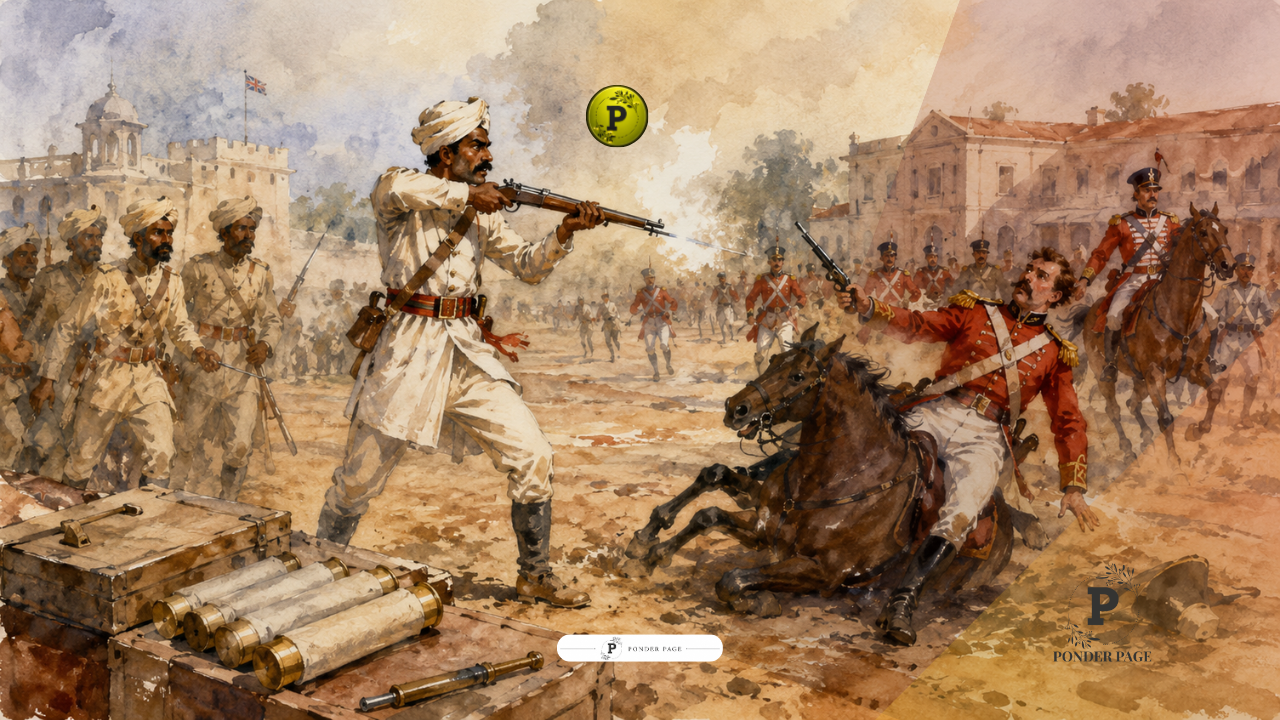
The True Story That Sparked the Revolt of 1857: The Revolt of 1857 did not begin overnight. It was the result of years of growing resentment among Indian soldiers serving under the British East India Company. Political expansion, economic exploitation, social interference, and religious concerns had already created deep dissatisfaction. However, one incident involving the newly introduced Enfield rifle cartridges transformed suspicion into open resistance.
The controversy surrounding the greased cartridges became one of the most significant triggers of the uprising. At the center of this story stood Mangal Pandey, a soldier whose actions at Barrackpore became a defining moment in India’s struggle against British rule.
(You can now subscribe to our Ponder Page WhatsApp channel)

Table of Contents
A Chance Encounter at Dum Dum
In January 1857, an incident took place at Dum Dum, located about eight kilometers from Calcutta (now Kolkata). At that time, Dum Dum was an important military center where cartridges for the British army were being manufactured.
One day, a Brahmin sepoy was walking with a brass water pot. During this period, the caste system was deeply entrenched in Indian society, and strict social customs governed everyday interactions.
As the soldier walked along the road, he met a khalasi, a laborer employed at the Dum Dum arsenal. The laborer requested some water. The Brahmin sepoy refused because sharing water with someone he considered to be of a lower caste would, according to prevailing customs, require him to ritually cleanse his water vessel before using it again. Since the nearest place to wash the pot was far away, he declined the request.
The refusal angered the khalasi. In response, he made a remark that would soon spread across the Bengal Army. He questioned why the sepoy was so concerned about ritual purity when soldiers serving the British were already biting cartridges allegedly coated with the fat of cows and pigs. If that was true, he asked, where had their religious principles gone?
The Growing Fear of Greased Cartridges
The khalasi’s words deeply disturbed the Brahmin soldier. Since the cartridges were being manufactured at Dum Dum and the laborer worked in that area, his statement appeared credible.
After returning to his regiment, the sepoy shared what he had heard with his fellow soldiers. The news spread rapidly through the ranks.
The Enfield rifle required soldiers to bite open the paper cartridge before loading the weapon. Rumors claimed that these cartridges were greased with cow fat and pig fat.
For Hindu soldiers, the cow was sacred, making the use of cow fat a serious religious violation. For Muslim soldiers, contact with pig fat was equally unacceptable because pigs were considered unclean under Islamic law.
If these rumors proved true, soldiers feared not only violating their religious beliefs but also facing social ostracism from their families and communities.
Religious Anxiety Turns Into Collective Resistance
The growing suspicion united soldiers from different religious backgrounds. Despite their differences, both Hindu and Muslim sepoys believed that using such cartridges would dishonor their faith.
At the time, the 34th Bengal Native Infantry was stationed at Barrackpore, approximately twenty-four kilometers from Dum Dum. The soldiers expressed their concerns to their commanding officers, and reports of increasing unrest reached senior British authorities.
Recognizing the seriousness of the situation, British officers discussed possible solutions. They believed that allowing soldiers to grease the cartridges themselves would remove any doubts about their composition.
On 27 January 1857, this arrangement was introduced within the regiment. The authorities expected the controversy to subside.
Instead, the suspicion only grew stronger.

Why the Soldiers Still Refused
Although the soldiers were instructed to apply grease themselves and even received training on the procedure, many remained unconvinced.
Some observed that the cartridge paper appeared unusually polished. Others reportedly burned the paper and claimed it emitted an unusual smell. These observations reinforced their belief that animal fat might still have been used during the manufacturing process.
British officers then suggested that soldiers tear open the cartridges with their hands instead of biting them with their teeth.
However, this proposal also failed to reassure the sepoys. Years of distrust had already damaged their confidence in British intentions. Many believed that the government was gradually attempting to interfere with their religious traditions. Even if they accepted the cartridges, they feared they could still lose their social standing within their own communities.
As a result, opposition continued to grow.
The Barrackpore Incident of 29 March 1857
The tension reached its peak on 29 March 1857 at the Barrackpore cantonment.
On that day, Mangal Pandey, a soldier of the 34th Bengal Native Infantry, openly challenged British authority. He called upon his fellow soldiers to join him, urging them to defend their religion and resist what he saw as injustice.
Despite his repeated appeals, none of the sepoys immediately came forward to support him.
Mangal Pandey then declared that he would attack the next British officer who came before him.
Soon afterward, Lieutenant Henry Baugh, the regiment’s Adjutant, approached on horseback.
Mangal Pandey fired his musket. The shot struck Baugh’s horse, throwing the officer to the ground. Lieutenant Baugh returned fire but failed to stop him. Mangal Pandey then attacked with his sword, injuring the officer during the confrontation.
As the disturbance continued, additional British officers arrived and ordered the Indian soldiers to arrest Mangal Pandey. The sepoys hesitated and initially refused to obey the command, despite repeated orders and threats.
When Mangal Pandey realized that capture was becoming inevitable, he attempted to shoot himself. The attempt failed, and he was overpowered, arrested, treated for his injuries, and later imprisoned.
Trial and Execution
Mangal Pandey was brought before a military court and found guilty of attacking British officers and inciting rebellion.
He was executed by hanging on 8 April 1857 at Barrackpore.
Following the incident, British authorities took strict disciplinary action against the 34th Bengal Native Infantry. Since many soldiers had refused to carry out orders during the confrontation, the regiment faced severe consequences and was eventually disbanded.
British Interpretation of the Incident
British officials sought to portray the Barrackpore incident as an isolated act rather than the beginning of organized resistance. Some official accounts suggested that Mangal Pandey had acted under the influence of intoxicants and that his behavior was the result of personal instability rather than political or religious motivation.
This interpretation attempted to prevent wider unrest by dismissing the event as the actions of a single individual rather than acknowledging the widespread dissatisfaction among Indian soldiers.


The True Story That Sparked the Revolt of 1857 | Historical Significance
The events at Dum Dum and Barrackpore revealed the deep mistrust that had developed between Indian sepoys and the British East India Company. Whether or not every rumor surrounding the cartridges was accurate, the belief that the British were willing to disregard Indian religious traditions had already taken root.
Mangal Pandey’s actions became one of the earliest and most visible acts of armed resistance against British authority in 1857. Within weeks of his execution, the uprising spread across northern and central India, developing into the Revolt of 1857, a conflict that profoundly altered the course of Indian history.
Today, Mangal Pandey is remembered as one of the prominent figures associated with the events that preceded the Revolt of 1857. While historians continue to debate certain aspects of his actions and motivations, his role in bringing the growing discontent of Indian soldiers into the open remains an important chapter in the history of India’s resistance to British rule.
What are your thoughts on this article? Let us know in the comments below. If you enjoyed this article, be sure to subscribe for more engaging content in the future! Stay updated on the latest developments and discussions by clicking the subscribe button above. Thank you for your support!
📢 Dive into the latest discussions on social & trending topics! 🌍💬 Subscribe to Ponder Page for thought-provoking articles and interviews that dissect current issues. Don’t miss out on insightful content—hit that like & subscribe button now!



Leave a Reply