
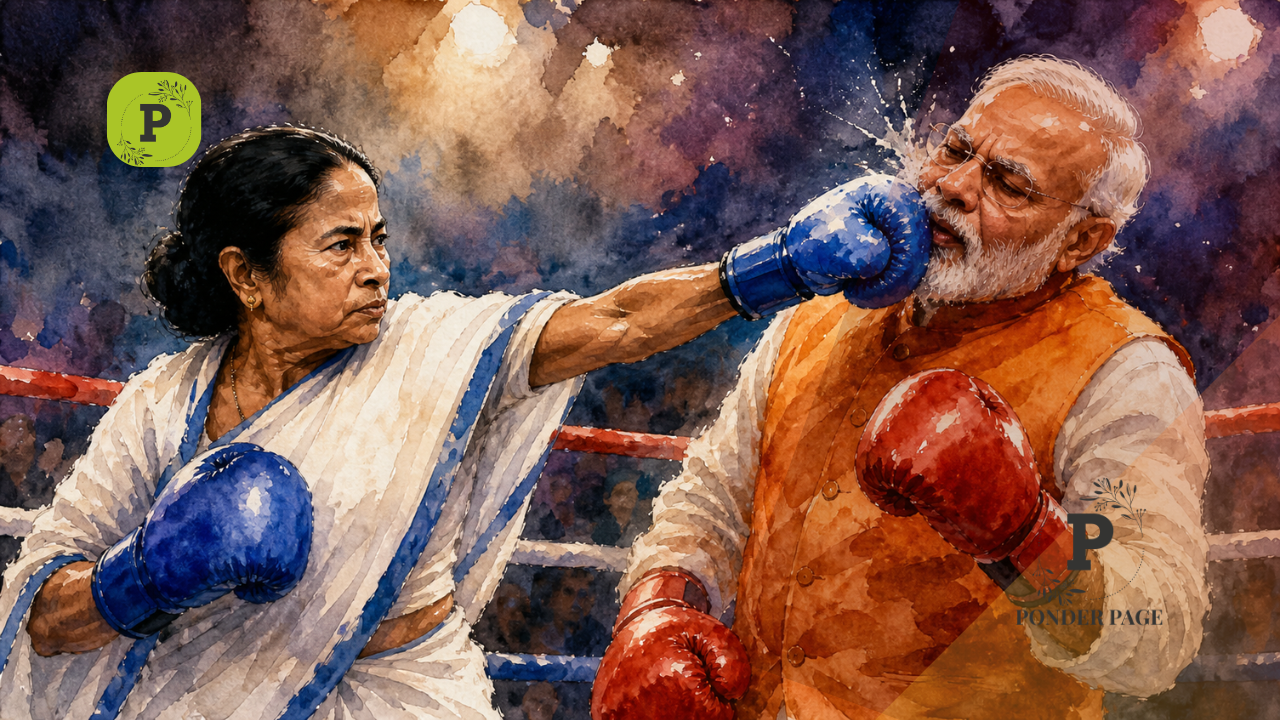
The Political Earthquake in West Bengal & Other States: Assembly elections in India are frequent, often intense, and sometimes unpredictable. Yet, every once in a while, an election comes along that does more than just change a government; it reshapes the entire political order. The recent wave of elections appears to fall into that rare category, where long-standing strongholds have crumbled and new forces have emerged with surprising speed.
(You can now subscribe to our Ponder Page WhatsApp channel)

Table of Contents
The Fall of Fortresses: Bengal’s Dramatic Shift
For years, West Bengal was widely regarded as the unshakeable stronghold of Mamata Banerjee. Her rise to power in 2011, after dismantling decades of Left Front dominance following movements like Singur and Nandigram, was itself seen as historic. However, politics has come full circle.
The same kind of disruption that once brought her to power now seems to be working against her. The growing influence of Narendra Modi and the expansion strategy of the Bharatiya Janata Party have significantly eroded the dominance of the All India Trinamool Congress. What was once considered a political fortress has now been breached, leading to one of the biggest upsets in the state’s recent history.
This shift is not merely electoral, it reflects deeper changes in voter sentiment, organizational strength, and ideological alignment.
Tamil Nadu’s Shock: Breaking the Duopoly
If Bengal delivered a shock, Tamil Nadu produced something even more extraordinary. For decades, politics in the state revolved around two dominant forces: the Dravida Munnetra Kazhagam and the All India Anna Dravida Munnetra Kazhagam. This duopoly seemed unbreakable.
That assumption has now been shattered.
A new political force led by Joseph Vijay has disrupted the established order in an unprecedented manner. Within a remarkably short span, his party Tamilaga Vettri Kazhagam has managed to challenge, and in many areas surpass, heavyweights. His journey from a celebrated film career to a political leader highlights the power of grassroots organization combined with mass appeal.
What makes this shift particularly significant is that it signals a weakening of entrenched political structures and possibly even dynastic politics, which has long been a feature of regional parties.
Assam and the Collapse of Opposition Hopes
In Assam, the elections have highlighted a different trend; the continued consolidation of power by the ruling establishment. The Indian National Congress faced a significant setback, failing once again to dislodge the leadership of Himanta Biswa Sarma.
Despite focused efforts, the opposition could not overcome organizational weaknesses or present a compelling alternative narrative. The repeated losses point toward deeper structural issues within the party, including leadership challenges and strategic missteps.
Kerala: The End of a Left Era
Kerala has long been known for its alternating pattern of governance between the Left and Congress-led alliances. However, this election cycle marks a historic turning point. The Communist Party of India (Marxist)-led Left Front, which had extended its rule beyond the usual cycle, has now lost power.
This development carries national significance. For the first time in decades, India may find itself without a Left-led government in any major state. While the Congress-led alliance has returned to power, this victory appears more a result of cyclical anti-incumbency than a decisive ideological shift.

The Rise of a National Force
One of the most striking aspects of these elections is the growing footprint of the Bharatiya Janata Party across multiple states. Its long-standing ambition to become a truly pan-India political force is steadily materializing.
This expansion is not driven by a single factor. While debates around electoral rolls, governance issues, and campaign narratives continue, the broader picture suggests a combination of ideological clarity, organizational depth, and strategic execution.
In contrast, the opposition appears fragmented. Alliances have struggled to maintain cohesion, and the lack of a unified vision has weakened their ability to counter a well-structured political machine.
Decline of Regional Parties
Another key takeaway is the gradual decline of regional political dominance. Leaders who once commanded unquestioned authority within their states are now facing serious challenges. This trend suggests a structural transformation in Indian politics, where national narratives and centralized strategies are beginning to outweigh regional strongholds.
The weakening of regional parties also raises questions about representation and diversity in political discourse. As these parties lose ground, the space for localized issues may shrink, altering the nature of governance.
The Role of Strategy and Organization
Elections are rarely decided by a single issue. They are shaped by a combination of factors: grassroots mobilization, candidate selection, voter outreach, and narrative building.
One clear lesson from these elections is the importance of meticulous planning at the booth level. Effective coordination, targeted messaging, and sustained engagement with voters have proven to be decisive advantages. Parties that treated elections as long-term campaigns rather than short-term events have clearly outperformed others.
A Crisis of Opposition
Perhaps the most significant story is not just the victory of one party, but the decline of the opposition as a whole. The inability to present a coherent alternative, coupled with internal divisions, has led to a situation where electoral contests are becoming increasingly one-sided.
This raises an important question for the future of Indian democracy: can a political system function effectively without a strong and credible opposition?
Democracy thrives on accountability, debate, and balance. Without a robust opposition, these essential elements risk being weakened.


The Political Earthquake in West Bengal & Other States: A Turning Point in Indian Politics
The recent assembly elections mark a decisive moment in India’s political journey. Established powers have been challenged, new players have emerged, and the balance of power is undergoing a significant shift.
While the rise of a dominant political force is evident, the parallel decline of opposition parties presents a complex challenge. The future will depend not just on electoral victories, but on how effectively political actors adapt to this changing landscape.
In the end, these elections are not just about who won or lost, they are about the transformation of the political system itself.
What are your thoughts on this article? Let us know in the comments below. If you enjoyed this article, be sure to subscribe for more engaging content in the future! Stay updated on the latest developments and discussions by clicking the subscribe button above. Thank you for your support!
📢 Dive into the latest discussions on social & trending topics! 🌍💬 Subscribe to Ponder Page for thought-provoking articles and interviews that dissect current issues. Don’t miss out on insightful content—hit that like & subscribe button now!



Leave a Reply