
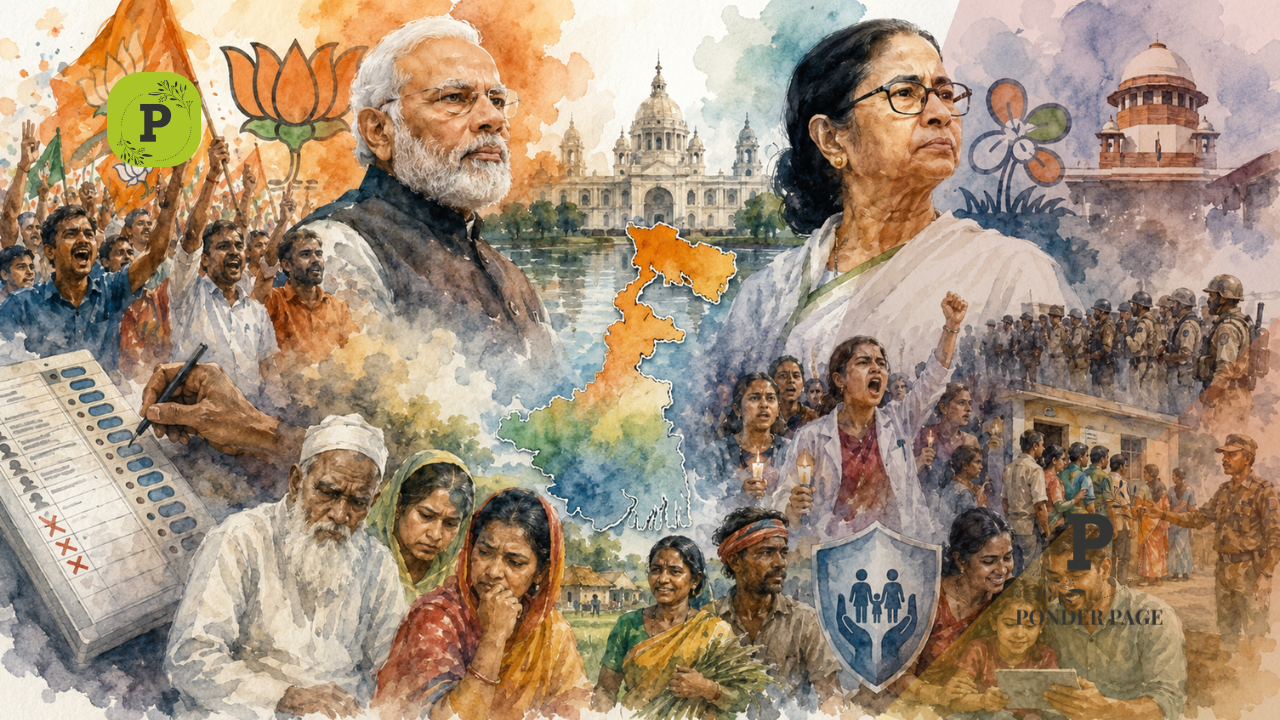
How the BJP Shocked Indian Politics: In politics, there are moments that completely rewrite public assumptions. The 2026 West Bengal Assembly election appears to be one such moment. Just two years ago, the idea that the BJP could cross the 200-seat mark in Bengal would have sounded unrealistic to most observers. Yet on May 4, the party achieved exactly that, winning 207 seats in the 294-member Assembly and delivering one of the biggest political upsets in recent Indian history.
The defeat was devastating for the Trinamool Congress. Mamata Banerjee lost her own Bhabanipur seat by around 15,000 votes. Several senior ministers in her cabinet were defeated as well. But the political battle did not end with the declaration of results. Instead, it opened a new and deeply controversial debate about democracy, voter deletions, electoral transparency, and the changing political landscape of Bengal.
The central question now is not simply how the BJP won. The real question is whether this victory was driven mainly by electoral manipulation allegations surrounding the Special Intensive Revision process, or whether Bengal was already undergoing a deeper political transformation that finally exploded in 2026.
(You can now subscribe to our Ponder Page WhatsApp channel)

Table of Contents
The Immediate Political Storm After the Results
Soon after the results were announced, Mamata Banerjee alleged that the BJP had effectively “stolen” around 100 seats through fraudulent means. Opposition leaders across the country echoed similar concerns. Questions were raised about how the BJP could achieve such a sweeping victory in Bengal at a time when many believed the party’s political momentum had weakened nationally.
The controversy centered around the voter revision exercise known as SIR. According to allegations, lakhs of genuine voters were either deleted from the rolls or placed under “adjudication,” making them unable to vote. Reports suggested that around 27 lakh voters were affected. Critics argued that the exercise was conducted hastily and without sufficient safeguards.
The matter even reached the Supreme Court. While the court did not immediately intervene, it remarked that if voter deletions exceeded victory margins in a significant number of constituencies, serious questions could arise.
This triggered intense speculation. Could some election results eventually be challenged? Could fresh elections ever be ordered in constituencies where deleted voters outnumbered victory margins? These questions quickly became part of the national political discourse.
Why the Debate Cannot Be Understood Emotionally
The Bengal election debate became highly emotional almost instantly. Supporters of the TMC argued that democracy itself had been compromised. BJP supporters claimed the results reflected genuine public anger against Mamata Banerjee’s government.
But emotional narratives alone cannot explain a mandate of this scale. A party does not cross 200 seats in a politically complex state like Bengal through a single factor alone. To understand what happened, one has to examine the data carefully.
When the numbers are studied closely, a more complicated picture emerges. The data suggests that while SIR and voter deletions may have influenced some constituencies, they do not fully explain the scale of the BJP’s victory.
The SIR Controversy and Questions Around Transparency
There is little doubt that the SIR process generated serious concerns. Critics pointed out inconsistencies in implementation, allegations of arbitrary deletions, and lack of transparency in the addition of new voters.
Several unusual incidents added fuel to the controversy. In one case, the name of a Congress candidate himself was reportedly removed from the electoral roll before he approached the courts and eventually contested the election successfully.
Questions were also raised about why large-scale voter deletions appeared concentrated in states such as Bengal, Kerala, and Tamil Nadu, while Assam reportedly did not witness a similar process on the same scale.
At the same time, reports emerged that nearly seven lakh new voters had been added shortly before the elections. Critics demanded greater transparency regarding who these voters were, their demographic profile, and how they were verified.
All of this created a perception that the electoral playing field was not entirely fair or transparent. Even many neutral observers acknowledged that the process damaged public trust.
Yet the crucial issue remains this: even if the process was flawed, can it alone explain a 207-seat landslide?
Why the Numbers Suggest Something Bigger Happened
When analysts compared constituencies where voter deletions exceeded BJP victory margins, they found that the numbers simply did not add up to a statewide sweep.
In several minority-heavy constituencies, deleted voters did exceed victory margins. Seats like Jangipur and Karandighi became major talking points because the number of deleted voters was significantly larger than the BJP’s margin of victory.
These examples indicate that SIR may indeed have influenced outcomes in some areas, especially in closely contested constituencies with large minority populations.
However, another reality also emerged from the data. In many constituencies with extremely high voter deletions, the TMC still won comfortably. Among the twenty seats with the highest deletions, the BJP reportedly won only six, while the TMC and others won the majority.
This weakens the argument that voter deletion alone caused the collapse of the TMC.
The Collapse of TMC Strongholds
Perhaps the most significant indicator of political change lies in the breakdown of traditional strongholds.
Between 2011 and 2021, the TMC consistently dominated Bengal politics. There were 124 constituencies where the party and its allies repeatedly won election after election. These seats represented the party’s political foundation.
In 2026, however, the TMC lost 78 of those strongholds.
This is politically devastating because it indicates not just anti-incumbency, but structural erosion of support. Strongholds do not collapse merely because of technical irregularities. They collapse when voter sentiment changes fundamentally.
The BJP, meanwhile, not only retained its own core areas but expanded aggressively into new territory. The party reportedly increased its vote share by more than 5.5 million votes compared to previous elections.
That kind of expansion points toward a broad political realignment rather than a narrowly engineered result.
The Fragmentation of the Muslim Vote
For years, it was assumed that the Muslim vote in Bengal remained firmly behind the TMC. The 2026 election challenged that assumption.
In constituencies with very high Muslim populations, the TMC still performed strongly overall, but its dominance weakened significantly. In several seats where Muslims formed over half the electorate, voter turnout increased, yet the TMC’s vote share declined sharply.
This suggests that Muslim voters did not uniformly shift toward the BJP. Instead, a portion of the vote fragmented toward the Congress, Left parties, and the Indian Secular Front.
This fragmentation became politically decisive. In many constituencies, the division of anti-BJP votes benefited the BJP even without a dramatic increase in minority support.
The reasons behind this shift appear complex. Some sections of voters reportedly felt disappointed with governance, economic stagnation, lack of industrial development, and limited employment opportunities in minority-dominated regions.
There was also frustration that despite years of welfare-oriented rhetoric, deeper structural changes had not materialized.
Scheduled Castes and Rural Bengal Shifted Dramatically
One of the biggest revelations from the election data was the BJP’s performance among Scheduled Caste communities and rural voters.
In constituencies where Scheduled Castes formed over 30 percent of the population, the BJP reportedly dominated overwhelmingly. This represented a major transformation because rural Bengal had traditionally been one of the TMC’s strongest zones.
The BJP also performed exceptionally well in urban constituencies, but the more surprising story was its expansion into semi-rural and rural regions.
This matters politically because when a ruling party begins losing both urban and rural support simultaneously, electoral recovery becomes extremely difficult.
The BJP’s ability to penetrate rural Bengal indicates years of organizational groundwork rather than a sudden electoral accident.
The Women Voter Shift That Changed Everything
Perhaps the most politically significant development was the apparent shift among women voters.
For over a decade, women were considered Mamata Banerjee’s most reliable support base. Welfare schemes and direct financial assistance programs had helped the TMC build a strong emotional connection with women across Bengal.
Yet reports from the election suggest that even a modest swing of around five percent among women voters may have had enormous consequences because of the scale of female voter participation in the state.
Several factors may have contributed to this shift. Incidents involving women’s safety became emotionally charged political issues during the campaign. Cases such as Sandeshkhali and the RG Kar controversy generated strong public reactions.
The opposition successfully transformed these incidents into larger narratives about accountability, governance, and security.
At the same time, the BJP aggressively targeted women voters through welfare promises, grassroots outreach, and localized campaigning.
The result appears to have been a quiet but powerful political movement away from the TMC among sections of women voters.
BJP’s Booth-Level Strategy and Organizational Expansion
Another major factor behind the BJP’s success was its extraordinary organizational expansion.
Reports indicate that the party significantly increased its active ground workforce between 2021 and 2026. Detailed booth-level strategies were implemented with remarkable precision.
The BJP reportedly identified thousands of strategically important booths, categorized them based on vote margins, and deployed workers accordingly. Urban apartment outreach, NGO engagement, community networking, and local cultural adaptation became central parts of the campaign.
Importantly, the party also worked to soften its “outsider” image in Bengal politics. Cultural symbolism, local language messaging, and Bengali identity outreach were heavily emphasized.
This level of political preparation cannot be built overnight. It suggests that the BJP treated Bengal as a long-term project rather than a single election.

Why Mamata Banerjee’s Campaign May Have Failed
The TMC’s biggest strategic mistake may have been over-focusing on the Election Commission and SIR while underestimating deeper voter dissatisfaction.
Many voters appeared more concerned about jobs, corruption, extortion allegations, industrial decline, and governance fatigue than procedural election controversies.
The BJP, meanwhile, focused relentlessly on direct voter engagement, welfare messaging, women’s outreach, and grassroots mobilization.
In politics, emotional connection matters enormously. The BJP appears to have built that connection more effectively in 2026.
What the Bengal Election Means for India
The 2026 Bengal election is not just a state-level story. It has national implications.
Regional parties across India will now study Bengal carefully because the election demonstrated that even deeply entrenched political systems can collapse rapidly under the right conditions.
The result also sends a message about the importance of organizational discipline, booth-level management, coalition unity, and voter outreach.
At the same time, the election raises serious questions about electoral transparency and institutional credibility. Concerns around voter deletions and administrative neutrality are unlikely to disappear. Those debates will continue both politically and legally.
But the data also shows that blaming institutional unfairness alone may not be enough for the opposition. The Bengal result suggests that political disconnect, organizational weakness, fragmented alliances, and governance fatigue played equally important roles.
How the BJP Shocked Indian Politics and What the Numbers Really Reveal
In 2026, Bengal delivered a verdict that combined all of these forces together. The result was one of the most dramatic political upheavals modern India has seen.


What are your thoughts on this article? Let us know in the comments below. If you enjoyed this article, be sure to subscribe for more engaging content in the future! Stay updated on the latest developments and discussions by clicking the subscribe button above. Thank you for your support!
📢 Dive into the latest discussions on social & trending topics! 🌍💬 Subscribe to Ponder Page for thought-provoking articles and interviews that dissect current issues. Don’t miss out on insightful content—hit that like & subscribe button now!






Leave a Reply