
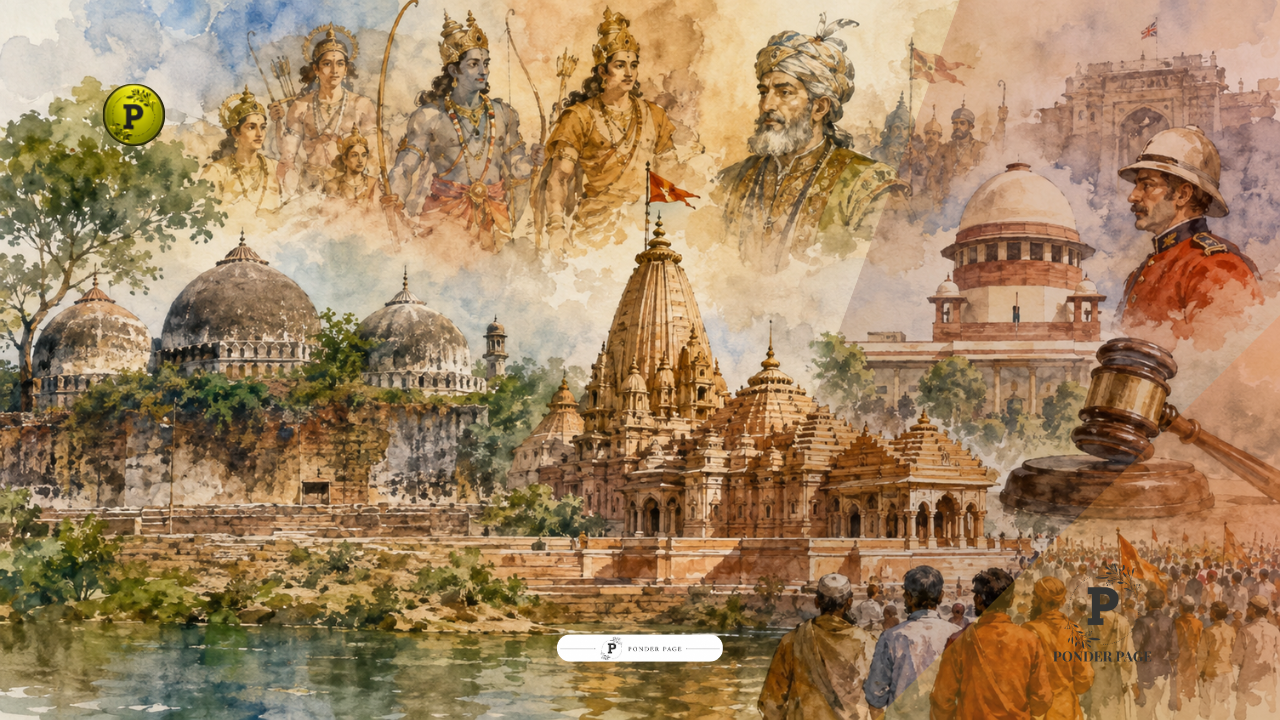
The Ram Janmabhoomi Dispute: The Ram Janmabhoomi dispute is one of the oldest, most complicated and emotionally sensitive issues in modern Indian history. For centuries, the site in Ayodhya has been associated with competing religious claims, political developments, legal battles and periods of communal tension.
The dispute did not remain confined to Ayodhya. At different points in history, conflicts surrounding the site contributed to wider Hindu-Muslim tensions and communal violence in several parts of India.
At the heart of the controversy was a relatively small piece of land in Ayodhya that eventually became the subject of one of India’s most closely watched legal battles. The Supreme Court’s final judgment ran into 1,045 pages and examined historical records, archaeological evidence, religious texts, travel accounts, administrative documents and the claims made by different parties over several centuries.
Today, the site is home to the Ram Temple. But understanding how the dispute developed requires going back many centuries.
(You can now subscribe to our Ponder Page WhatsApp channel)

Table of Contents
Ayodhya and the Religious Importance of Ram Janmabhoomi
Ayodhya occupies an important place in Hindu religious tradition. Ancient texts, particularly the Ramayana and other later religious literature, associate the city with Lord Rama and describe it as the capital of the ancient kingdom of Kosala.
According to Hindu tradition, Ayodhya is the birthplace of Lord Rama. The belief that the disputed site represented Ram’s birthplace became the central religious claim behind the movement for the construction of a temple there.
Traditional accounts also connect the site with Kush, the son of Lord Rama. According to these traditions, Kush is believed to have established a temple at the birthplace of his father.
Over generations, Ayodhya remained an important religious centre. Traditional accounts describe successive rulers belonging to Rama’s lineage as ruling the region.
However, it is important to distinguish between religious tradition and independently verifiable historical evidence. The stories surrounding the ancient temple form an important part of Hindu belief and tradition, while historians and courts have separately examined what documentary, archaeological and other historical evidence can establish about the physical structures that existed at the site.
From Ancient Tradition to the Medieval Period
The historical development of Ayodhya was complex. Over centuries, political control of the region changed, while its religious significance continued.
Traditional narratives describe the ancient city and its temples as declining over time. Another important figure associated with the later reconstruction of Ayodhya is Vikramaditya, traditionally identified with the legendary or historical ruler associated with the Vikram Samvat era.
Some traditional accounts claim that Vikramaditya visited Ayodhya, learned about its association with Lord Rama and subsequently restored important structures in the city.
The Supreme Court’s judgment examined historical references concerning Ayodhya and the existence of religious activity at the site. However, claims concerning specific ancient constructions have to be understood carefully because literary traditions, historical records and archaeological evidence do not always provide the same level of certainty.
The Mughal Era and the Construction of the Babri Masjid
A major turning point came in the sixteenth century.
In 1526, Babur defeated Ibrahim Lodi in the First Battle of Panipat and established Mughal rule in northern India. Two years later, in 1528, a mosque was constructed at the disputed site in Ayodhya. It subsequently became widely known as the Babri Masjid.
The mosque was traditionally associated with Mir Baqi, a commander serving under Babur.
The central historical controversy concerns what existed at the location before the mosque was constructed.
The Hindu side maintained that a temple dedicated to Lord Rama had existed at the site and that the mosque was constructed after the temple was demolished. The Muslim side disputed this claim and maintained its own legal and historical position regarding the site.
This question eventually became one of the most important issues examined by Indian courts.
The location itself was particularly significant. The disputed property was commonly associated with the area identified in historical and legal records as the Ram Janmabhoomi-Babri Masjid site.
Early European Accounts of Ayodhya
One of the important categories of historical material considered in the dispute was the collection of accounts written by European travellers who visited India during the early modern period.
Travellers recorded observations about Ayodhya, its religious sites and the practices of local communities. Some accounts referred to Hindu worship associated with the birthplace of Rama.
Historical writers and researchers have examined travel accounts attributed to figures such as William Finch and Joseph Tiefenthaler. These accounts became relevant in later discussions because they provided written descriptions of Ayodhya from periods long before the twentieth-century dispute.
However, travel accounts also have limitations. They were based on observations, conversations and information available to the individual traveller, and therefore historians must examine them in the context of the period in which they were written.
Nevertheless, such records became part of the larger body of evidence examined during the legal proceedings.
The Rise of the Ram Chabutra
The history of the site became even more complicated as Hindu religious activity continued around the mosque.
A particularly important structure was the Ram Chabutra, a raised platform located outside the main mosque structure. Hindu devotees used the area for worship and associated it with the birthplace of Lord Rama.
This created an unusual situation in which religious practices associated with two communities took place in close proximity.
The mosque occupied the inner portion of the disputed complex, while Hindu worship was carried out in areas outside it.
This physical arrangement later became extremely important because it demonstrated that competing religious practices had developed around the same site.
Historical maps and administrative records from the colonial period also documented various structures and locations within the complex, including references to places such as Sita Rasoi and Ram Chabutra.
British Rule and the Growing Dispute
By the nineteenth century, Mughal political power had significantly declined and British authority had expanded across large parts of India.
During this period, disputes concerning the religious character of the site became increasingly visible.
British administrators and European observers recorded information about Ayodhya and its religious institutions. Administrative surveys and historical descriptions attempted to document the structures and practices associated with the disputed property.
One such nineteenth-century account was associated with Robert Montgomery Martin, whose writings concerning India included descriptions of religious sites and historical traditions.
The question of whether the mosque stood on the remains of an earlier temple became increasingly contentious.
Some accounts stated that a temple had existed at the location, while uncertainty remained over precisely how the mosque had been constructed and whether an earlier structure had actually been demolished to make way for it.
That distinction is important because the historical debate was not simply about whether Hindus regarded the location as sacred. It also involved the much more specific question of what physical structure existed at the site before the mosque was built.
Communal Conflict in the 1850s
Tensions around Ayodhya intensified during the 1850s. The area surrounding Hanumangarhi, a prominent religious site associated with Hindu ascetics, became the centre of a serious confrontation between Hindu and Muslim groups.
Accounts of the period describe conflict between Hindu ascetics and Muslim groups over competing claims regarding religious structures. The violence contributed to an increasingly tense atmosphere in Ayodhya. Communal confrontations continued and eventually forced the colonial administration to intervene.
The events of this period became an important part of the later historical record because they demonstrated that competing religious claims over sacred sites were already producing serious conflict in Ayodhya during the nineteenth century.
The British Divide the Disputed Area
The British administration attempted to manage the situation by physically separating the areas used by the two communities.
Around 1857, a physical barrier was constructed between the inner and outer portions of the disputed complex. Contemporary descriptions refer to the use of railings and masonry structures to separate the areas. The arrangement effectively divided religious activity.
Hindu devotees continued worship in the outer portion, while Muslims used the inner portion associated with the mosque for prayers.
The arrangement did not resolve the underlying dispute. Instead, it created a physical division that lasted for decades. Neither side regarded the arrangement as a satisfactory solution to its claim over the site.
For the British administration, however, separating the two areas was a practical attempt to prevent further clashes and maintain public order.
Why the Dispute Survived for Generations
The significance of the Ram Janmabhoomi dispute cannot be understood simply as a disagreement over a piece of land. For Hindu devotees, the location was regarded as the birthplace of Lord Rama and therefore possessed an extraordinary religious significance.
For Muslims, the Babri Masjid had been a place of worship for centuries and was regarded as a mosque associated with their religious history in Ayodhya.
As the two claims developed, the physical site acquired meanings far beyond its geographical boundaries. Historical documents, religious traditions, colonial records, maps, travel accounts and later legal proceedings all became part of the debate.
The British attempt to physically divide the area did not settle the fundamental question of ownership or religious title. Instead, it preserved a situation in which both communities continued to maintain their claims.
That unresolved arrangement eventually became the foundation for decades of litigation.
From a Local Dispute to a National Issue
What began as a dispute surrounding a particular site in Ayodhya eventually became one of the most consequential religious and political issues in independent India.
The controversy intensified dramatically during the twentieth century, leading to prolonged litigation, political mobilisation, communal tensions and ultimately the demolition of the Babri Masjid in 1992.
The events surrounding the site contributed to some of the most serious communal violence in modern India’s history. The legal battle continued for years after the demolition.
Eventually, the dispute reached the Supreme Court of India, where a Constitution Bench examined an enormous body of historical, legal, archaeological and documentary material.
The Supreme Court and the Final Legal Battle
The Supreme Court’s judgment became the definitive legal milestone in the dispute. The Court examined evidence relating to the history of the site, patterns of worship, documentary records, archaeological findings and the competing claims of the parties.
The judgment also considered evidence concerning the existence of structures beneath the disputed mosque and the nature of religious activity at the site over different periods.
The Court ultimately awarded the disputed land for the construction of a temple and directed that an alternative five-acre parcel of land be provided to the Sunni Central Waqf Board for the construction of a mosque.
The decision brought the decades-long title dispute to a legal conclusion. It did not, however, erase the complex history or the deep emotions that had developed around the site.
The Ram Temple at Ayodhya
The site that had remained at the centre of the dispute for centuries subsequently became the location of the Ram Temple. The temple represents the culmination of a long religious, political and legal movement centred on the belief that Ayodhya is the birthplace of Lord Rama.
At the same time, the history of the site remains a reminder of how questions of faith, historical memory, property rights and politics can become deeply intertwined.


The Ram Janmabhoomi Dispute: A Dispute That Changed Modern India
Few land disputes in India’s history have had an impact comparable to the Ram Janmabhoomi-Babri Masjid controversy.
From the religious traditions surrounding ancient Ayodhya to the medieval construction of the Babri Masjid, from nineteenth-century conflicts to British attempts at separation, and from twentieth-century political mobilisation to the Supreme Court’s final judgment, the dispute evolved over several centuries.
Understanding this history requires separating religious belief from historical evidence while also recognising the enormous importance that faith has played in the story.
The final chapter of the legal dispute was written by the Supreme Court, but the historical journey that brought the country to that point is much older. Ayodhya’s story is ultimately a story of faith, memory, conflict, law and a place whose significance has extended far beyond its physical boundaries.
What are your thoughts on this article? Let us know in the comments below. If you enjoyed this article, be sure to subscribe for more engaging content in the future! Stay updated on the latest developments and discussions by clicking the subscribe button above. Thank you for your support!
📢 Dive into the latest discussions on social & trending topics! 🌍💬 Subscribe to Ponder Page for thought-provoking articles and interviews that dissect current issues. Don’t miss out on insightful content—hit that like & subscribe button now!



Leave a Reply