
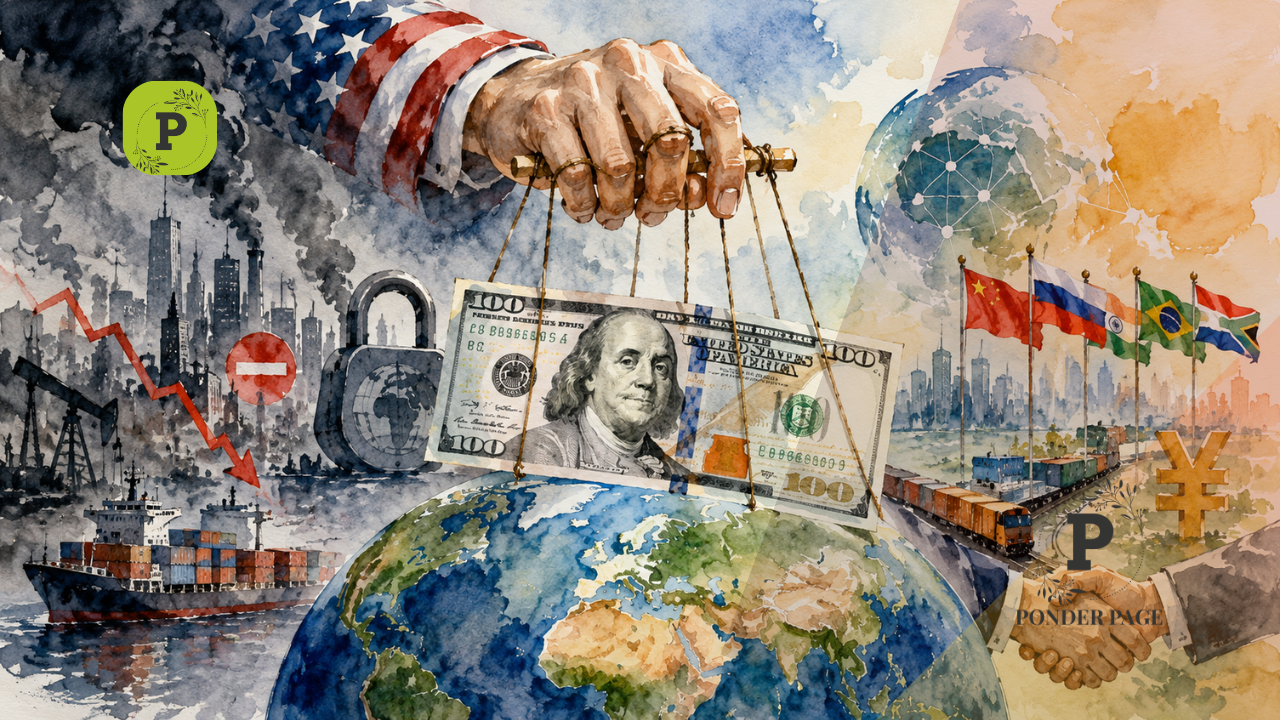
How the US Dollar Controls the World Economy and Why Countries Want an Alternative: The United States does not rely only on military strength to maintain its global influence. In many ways, its biggest source of power is economic, and at the center of that power stands the US dollar. Over the decades, the dollar has become deeply embedded in global trade, banking, investments, and international finance. Because of this dominance, the United States enjoys a level of geopolitical influence that very few nations in history have possessed.
Today, countries across the world depend on the dollar for oil purchases, international transactions, foreign reserves, and global trade settlements. This dependence gives the United States an extraordinary ability to pressure, isolate, and economically weaken countries that do not align with its strategic interests.
The most effective tool through which this influence operates is sanctions.
(You can now subscribe to our Ponder Page WhatsApp channel)

Table of Contents
Understanding How US Sanctions Work
Whenever tensions rise between the United States and another country, one of the first actions often taken by Washington is the imposition of sanctions. These sanctions are economic restrictions designed to damage a country financially without engaging in direct military conflict.
The United States generally uses two types of sanctions: primary sanctions and secondary sanctions.
Primary sanctions prevent American companies, institutions, and citizens from doing business with a targeted country. Once these restrictions are announced, major US corporations immediately withdraw their investments and operations from that nation. Since American businesses hold enormous influence in the global economy, their exit creates panic in financial markets.
As confidence collapses, stock markets decline, foreign investment slows down, and businesses begin to struggle. The situation becomes even more serious because European companies and multinational corporations often follow the same path. Many international firms avoid sanctioned countries simply because they fear future restrictions or financial risks associated with dealing with them.
This creates a chain reaction where the targeted nation gradually becomes isolated from the global economy.
The Fear of Being Cut Off From the Global Financial System
One of the most powerful weapons in America’s economic arsenal is the ability to restrict access to the global banking network.
A major example of this was seen during the Russia-Ukraine conflict, when several Russian banks were removed from the SWIFT network.
SWIFT is a crucial international financial messaging system used by banks worldwide to transfer money securely across borders. Once a country loses access to this network, international trade becomes extremely difficult. Even if businesses manage to sell goods, receiving payments becomes a massive challenge.
This is why sanctions can severely damage an economy in a very short period of time. Companies struggle to export products, imports become expensive, foreign reserves shrink, and investor confidence collapses.
Economic pressure of this kind can sometimes hurt a country more effectively than military confrontation.
What Are Secondary Sanctions?
While primary sanctions target the country directly, secondary sanctions go even further.
Under secondary sanctions, the United States warns other nations and businesses that they too may face penalties if they continue trading with the sanctioned country. This creates fear throughout the international market.
As a result, many countries stop doing business with the sanctioned nation even if the trade benefits them economically.
Iran provides one of the clearest examples of this strategy.
This demonstrates how American sanctions often affect not only the targeted nation but also unrelated countries connected through trade and energy markets.

How Global Economies Suffer From US Sanctions
Sanctions imposed by the United States frequently create ripple effects across the world economy. Oil prices rise, inflation increases, and supply chains become unstable. Countries that have no direct involvement in a geopolitical conflict often end up facing economic consequences.
This is possible because the global economy remains heavily dependent on the dollar-based financial system.
If another country attempts to impose sanctions, the impact is usually far smaller. For example, India could theoretically announce sanctions against Pakistan, but the global influence of the Indian rupee is still limited compared to the US dollar.
Similarly, India currently does not possess a global financial infrastructure comparable to SWIFT, although systems like UPI are growing rapidly and gaining international recognition.
This is why American sanctions carry enormous weight in global affairs.
Why India Was Treated Differently During Russian Sanctions
When the United States imposed sanctions on Russia after the Ukraine conflict, many countries reduced or stopped trade with Moscow. However, India continued purchasing Russian oil despite Western pressure.
One reason experts point to is America’s strategic interest in strengthening India as a counterbalance to China.
Because of this geopolitical calculation, the United States adopted a relatively flexible approach toward India’s Russian oil imports. Analysts believe that another country in a similar situation might have faced far greater diplomatic and economic pressure.
This highlights how sanctions are not always applied uniformly. Strategic alliances and geopolitical priorities often influence how strictly economic restrictions are enforced.
America’s Economic Power Often Exceeds Its Military Power
The influence of the United States extends far beyond military bases and defense alliances. Its real strength lies in the global acceptance of the dollar and the central role America plays in international finance.
Whenever countries attempt to challenge this economic dominance, tensions often rise quickly. Critics argue that America’s military strength acts as a protective shield for its financial supremacy.
At the same time, some experts believe that excessive use of sanctions could eventually weaken the dominance of the dollar itself. The sanctions against Russia, especially the SWIFT restrictions, triggered concerns across many countries about overdependence on the American financial system.
As a result, several nations have started searching for alternatives.
The Rise of De-Dollarization
In recent years, a growing number of countries have begun efforts to reduce their dependence on the US dollar. This global trend is widely referred to as “de-dollarization.”
Countries such as China, Russia, Brazil, South Africa, Argentina, and others have started exploring trade settlements in local currencies rather than dollars.
China has reduced portions of its US bond holdings and promoted the international use of the Chinese yuan. Iraq has also shown interest in conducting oil trade using currencies other than the dollar.
In another significant development, Saudi Arabia and China reportedly conducted energy transactions in yuan, a move that attracted global attention because oil trade has traditionally been dominated by the dollar.
Russia has also announced plans to hold some energy reserves in yuan instead of dollars.
These developments indicate that many nations want greater financial independence and reduced exposure to American sanctions.
Can BRICS Create an Alternative to the Dollar?
One of the most discussed ideas in global finance today is the possibility of a common BRICS currency.
BRICS originally consisted of Brazil, Russia, India, China, and South Africa. The bloc has expanded its global influence significantly, and more countries are expressing interest in joining.
The idea behind a BRICS currency is to create a shared financial system that could eventually reduce reliance on the US dollar in international trade. Some proposals suggest a currency model based on the weighted strength of member nations’ economies and currencies, somewhat similar to the IMF’s Special Drawing Rights system.
Supporters believe such a system could provide emerging economies with greater financial flexibility and protection from unilateral sanctions.
However, creating a true alternative to the dollar remains extremely difficult.
Why Replacing the Dollar Is So Challenging
Despite increasing conversations around de-dollarization, experts believe that replacing the US dollar entirely is not easy.
The dollar remains deeply trusted across global markets because of America’s economic size, financial institutions, liquidity, and international influence. Most global reserves are still held in dollars, and a large percentage of international trade continues to be conducted using the American currency.
Even countries trying to reduce dependence on the dollar continue to rely on it heavily for trade, investments, and reserves.
For now, de-dollarization appears to be more about reducing risk and diversifying financial systems rather than completely replacing the dollar.


How the US Dollar Controls the World Economy | Most Powerful Geopolitical Weapon
The dominance of the US dollar has given America unparalleled economic influence over the global system. Through sanctions, financial restrictions, and control over international banking mechanisms, the United States can exert pressure on countries in ways that few nations can counter.
At the same time, the aggressive use of these tools has encouraged many countries to search for alternatives and reduce their dependence on the dollar-based system.
Whether de-dollarization succeeds in the long term remains uncertain. For now, the US dollar continues to hold a central position in global finance, and no clear replacement has yet emerged strong enough to challenge its dominance completely.
What are your thoughts on this article? Let us know in the comments below. If you enjoyed this article, be sure to subscribe for more engaging content in the future! Stay updated on the latest developments and discussions by clicking the subscribe button above. Thank you for your support!
📢 Dive into the latest discussions on social & trending topics! 🌍💬 Subscribe to Ponder Page for thought-provoking articles and interviews that dissect current issues. Don’t miss out on insightful content—hit that like & subscribe button now!






Leave a Reply