
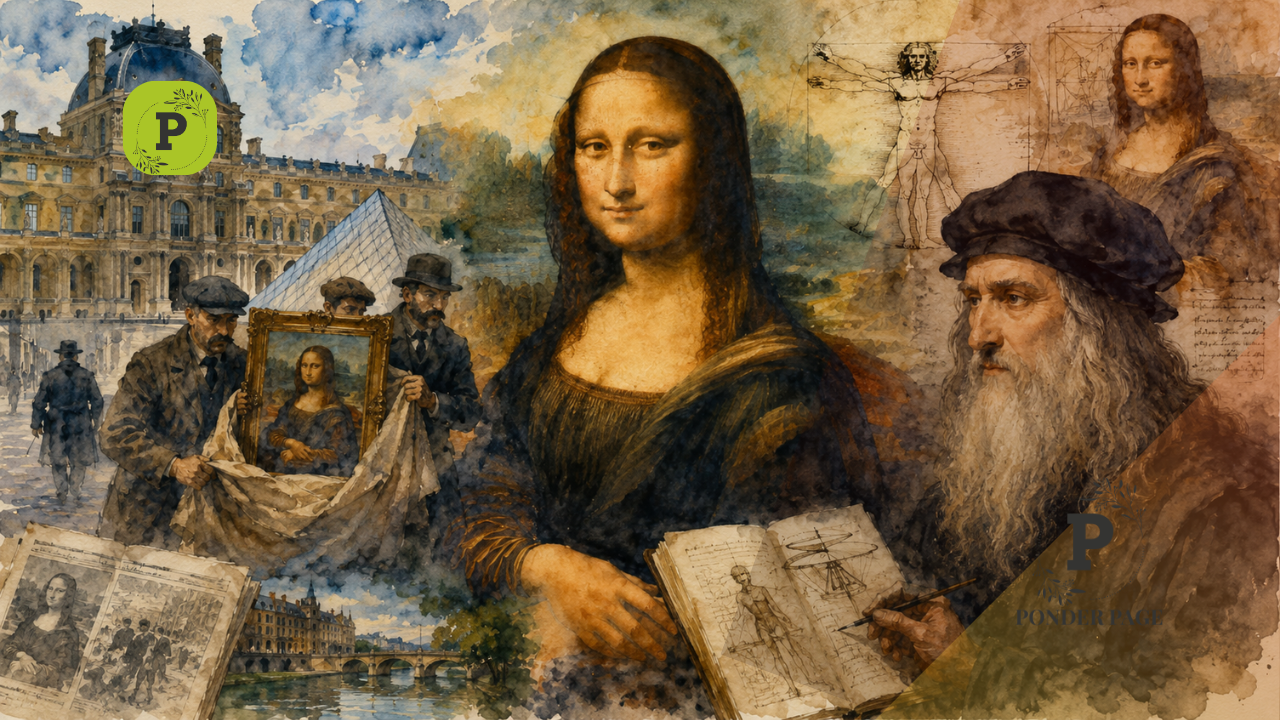
The Untold Story of the Mona Lisa: In the early years of the twentieth century, Paris awoke to what seemed like an ordinary Monday morning. The streets were calm, the city moved at its usual pace, and visitors wandered through the grand corridors of the Louvre Museum without the slightest suspicion that one of the greatest art crimes in history had just taken place. Hidden beneath a blanket and carried out of the museum by determined thieves was a painting that would soon become the most famous artwork in the world: the Mona Lisa.
The theft stunned France and quickly became an international sensation. The disappearance of Leonardo da Vinci’s masterpiece transformed the painting from a respected Renaissance portrait into a global phenomenon. Newspapers across continents published headlines about the missing artwork, while theories, rumors, and speculation spread rapidly among the public.
The thieves had executed their plan with remarkable precision. Their boldness fascinated people as much as the crime itself. The Mona Lisa’s absence from the Louvre created an unusual paradox: the painting became more famous while it was missing than it had ever been while hanging safely on the museum wall. Crowds gathered at the Louvre simply to stare at the empty space where the portrait once hung.
As investigators searched desperately for clues, the mystery surrounding the missing masterpiece only deepened. Questions emerged about who had stolen the painting, how they managed to remove it so easily, and what their ultimate motive could have been. During the years the painting remained hidden, the Mona Lisa developed an almost mythical status. She was no longer merely a work of art; she became a symbol of mystery, intrigue, and obsession.
Eventually, the painting was recovered and returned to the Louvre. The perpetrators faced justice, but the theft permanently altered the legacy of the artwork. The Mona Lisa emerged from the incident more celebrated than ever before, securing an immortal place not only in art history but also in popular culture.
(You can now subscribe to our Ponder Page WhatsApp channel)

Table of Contents
Leonardo da Vinci and the Birth of a Masterpiece
The story of the Mona Lisa cannot be told without understanding the extraordinary mind behind it. Leonardo da Vinci began painting the masterpiece around 1503 during the height of the Renaissance. Unlike most artists of his time, da Vinci was far more than a painter. He was a visionary whose talents extended into engineering, anatomy, architecture, science, sculpture, and philosophy.
His notebooks reveal a man endlessly fascinated by the mechanics of the human body, the movement of water, the flight of birds, and the mysteries of nature itself. This unique combination of scientific curiosity and artistic brilliance allowed him to create works that felt astonishingly alive.
The Mona Lisa reflects this rare fusion of intellect and creativity. Every detail within the painting demonstrates da Vinci’s meticulous observation of the world around him. From the delicate textures of the skin to the atmospheric landscape in the background, the painting reveals an artist deeply committed to realism while simultaneously embracing mystery.
What makes the portrait particularly captivating is its emotional ambiguity. The subject’s expression appears to shift constantly depending on the viewer’s perspective. At one moment she seems calm and serene; at another, her smile appears playful, secretive, or even melancholic. This elusive quality has fascinated audiences for centuries.
Who Was the Woman Behind the Smile?
One of the greatest mysteries surrounding the Mona Lisa concerns the identity of the woman portrayed in the painting. Historians and scholars have debated this question for generations, though one theory has remained the most widely accepted.
According to historical accounts, the woman is believed to be Lisa Gherardini, a Florentine woman married to a wealthy silk merchant named Francesco del Giocondo. This connection was notably mentioned by Giorgio Vasari, an Italian historian and contemporary of Leonardo da Vinci, in his influential writings about Renaissance artists.
The association with Francesco del Giocondo is also believed to be the origin of another name for the painting, “La Gioconda.” Over time, Lisa Gherardini’s identity became inseparable from one of the most celebrated portraits ever created.
Yet the mystery has never fully disappeared. Some researchers have proposed that da Vinci embedded aspects of his own appearance into the portrait, suggesting the Mona Lisa may contain elements of a disguised self-portrait. Others believe the painting was intended to symbolize ideal beauty rather than depict a single individual.
These theories continue to fuel fascination with the painting. The uncertainty surrounding the subject’s identity has become part of the artwork’s enduring appeal, inviting each generation to interpret the portrait in its own way.
The Meaning Behind the Name “Mona Lisa”
The title “Mona Lisa” carries its own historical significance. The word “Mona” is derived from the Italian phrase “Madonna,” meaning “my lady” or “madam.” It was a respectful form of address commonly used during the Renaissance period.
Over the centuries, the name evolved beyond a simple title and became one of the most recognizable names in the history of art. Today, the phrase “Mona Lisa” evokes not just a painting, but an entire legacy of artistic brilliance, mystery, and cultural influence.
The Revolutionary Technique That Made the Mona Lisa Eternal
One of Leonardo da Vinci’s greatest contributions to art was his mastery of the Sfumato technique. The word “Sfumato” originates from the Italian term “sfumare,” which roughly translates to “to evaporate like smoke.” The technique involves blending colors and tones so subtly that sharp outlines disappear, creating smooth transitions between light and shadow.
This approach was revolutionary during the Renaissance. Instead of relying on harsh lines and rigid forms, da Vinci created softness and depth that made his subjects appear almost lifelike.
The Mona Lisa is perhaps the greatest example of Sfumato ever achieved. Da Vinci carefully studied facial muscles, light, and human perception to produce an expression that seems constantly in motion. The transitions around the eyes and mouth are so delicate that viewers struggle to determine the exact nature of her smile.
This uncertainty is precisely what gives the painting its hypnotic quality. Depending on lighting, distance, and perspective, the Mona Lisa’s expression appears to change. At times she seems joyful; at others, distant and introspective.
The technique also enhanced the realism of the portrait. Da Vinci’s understanding of anatomy and optics allowed him to create subtle shadows and contours that gave the face remarkable depth. Rather than appearing flat or static, the painting feels alive.
The influence of Sfumato extended far beyond the Mona Lisa. Da Vinci’s innovations transformed portrait painting and inspired generations of artists who sought to capture emotional complexity and realism in their work.
The Mystery of the Second Mona Lisa
Among the many controversies surrounding Leonardo da Vinci’s masterpiece is the theory that he may have painted two versions of the Mona Lisa. This belief centers on a painting known as the Isleworth Mona Lisa, named after the London suburb where it was discovered.

Supporters of the theory argue that the Isleworth version displays characteristics suggesting it may have been created by da Vinci himself. Differences in the positioning of the hands, the background landscape, and the subject’s expression have led some experts to believe the artist may have worked on both paintings simultaneously.
According to this theory, the two portraits may represent different stages of da Vinci’s artistic experimentation or separate commissions altogether. Some scholars suggest the Isleworth version could be an earlier interpretation of the famous Louvre painting.
However, the debate remains deeply controversial. Critics argue that the Isleworth Mona Lisa lacks definitive historical documentation proving it was painted by Leonardo da Vinci. Many believe it may simply be a later copy created by another artist influenced by the original masterpiece.
Modern technology has added new dimensions to the discussion. High-resolution imaging, pigment analysis, and scientific examinations continue to be used in attempts to uncover the truth behind the alleged second Mona Lisa. Despite extensive research, the mystery remains unresolved.
Protecting the World’s Most Famous Painting
Today, the Mona Lisa stands not only as a masterpiece of Renaissance art but also as one of the most carefully protected cultural treasures on Earth. Millions of visitors travel to the Louvre Museum every year for the chance to witness the legendary portrait in person.
To preserve the painting, the Louvre has implemented extraordinary conservation measures. The artwork is housed within a climate-controlled enclosure that carefully regulates temperature and humidity. These conditions help prevent deterioration caused by environmental fluctuations.
The painting is also shielded behind specially designed bulletproof glass. This protective barrier safeguards the artwork from physical damage while shielding it from pollutants, dust, and accidental contact.
Security surrounding the Mona Lisa is equally advanced. Surveillance systems monitor the painting continuously, while dedicated security personnel remain vigilant at all times. These precautions reflect the immense cultural and historical value attached to the masterpiece.
Managing crowds has become another major challenge for the museum. The Mona Lisa attracts enormous numbers of visitors daily, making crowd control essential for both visitor safety and the painting’s preservation. Designated viewing areas and protective barriers ensure that admirers can experience the artwork without endangering it.
Technological advancements have also allowed the Louvre to expand access to the painting without increasing physical strain on the artwork itself. High-resolution digital reproductions and virtual tours enable people around the world to examine intricate details of the masterpiece from afar.
Conservation experts continue to study the Mona Lisa regularly, employing modern scientific techniques to monitor its condition and preserve it for future generations. Their efforts ensure that one of humanity’s greatest artistic achievements remains protected against the passage of time.
The Untold Story of the Mona Lisa! Why the Mona Lisa Continues to Fascinate the World
Centuries after it was painted, the Mona Lisa remains one of the most recognizable images in human history. Her fame is not rooted solely in artistic brilliance but in the layers of mystery that surround her existence.
The unanswered questions continue to captivate audiences. Who was the woman in the portrait? What emotions hide behind her smile? Did Leonardo da Vinci intentionally create ambiguity, or was it simply a byproduct of his genius? Could there truly be another version of the painting hidden within history?
The theft of the Mona Lisa added another chapter to this enduring legend. What began as a Renaissance portrait evolved into a symbol of intrigue, resilience, and timeless beauty.
Leonardo da Vinci’s masterpiece transcends the boundaries of art. It represents the intersection of creativity, science, mystery, and human emotion. Generations have stared into the eyes of the Mona Lisa searching for answers, yet the painting continues to guard its secrets.
That enduring mystery may ultimately be the true reason why the Mona Lisa remains immortal.


What are your thoughts on this article? Let us know in the comments below. If you enjoyed this article, be sure to subscribe for more engaging content in the future! Stay updated on the latest developments and discussions by clicking the subscribe button above. Thank you for your support!
📢 Dive into the latest discussions on social & trending topics! 🌍💬 Subscribe to Ponder Page for thought-provoking articles and interviews that dissect current issues. Don’t miss out on insightful content—hit that like & subscribe button now!






Leave a Reply