
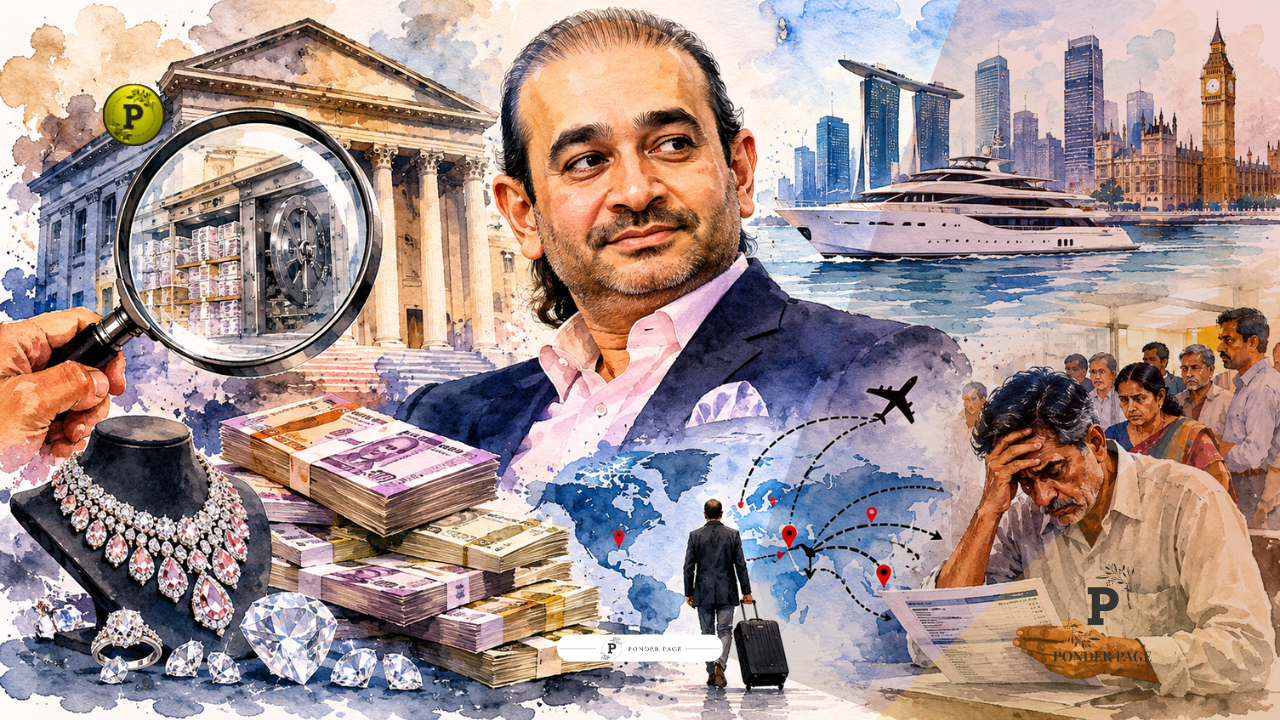
Nirav Modi Scam Explained: The Nirav Modi case is one of the most infamous financial scandals in modern Indian banking history. What initially appeared to be a problem involving letters of undertaking, bank officials and overseas transactions eventually developed into a massive investigation involving banks, jewellery companies, shell entities, regulatory failures and allegations of collusion.
The case became particularly shocking because the alleged fraud was not built around one complicated transaction. It depended on weaknesses in the banking system, repeated issuance of guarantees, inadequate oversight and the misuse of banking procedures.
At the centre of the controversy was billionaire jeweller Nirav Modi and a group of companies associated with him. The scandal involving Punjab National Bank, or PNB, eventually came to light in 2018 and was estimated to involve fraudulent transactions worth thousands of crores of rupees.
But how did the alleged scheme work?
(You can now subscribe to our Ponder Page WhatsApp channel)

Table of Contents
The PNB Connection
To understand the scandal, it is important to understand the relationship between Nirav Modi’s companies and the Brady House branch of Punjab National Bank in Mumbai.
One of the key figures investigated in the case was Gokulnath Shetty, a former deputy manager at PNB’s Brady House branch. Manoj Kharat, another bank employee, was also investigated in connection with the transactions.
According to investigative agencies and the prosecution’s case, fraudulent Letters of Undertaking, commonly known as LoUs, were issued through the branch for companies associated with Nirav Modi.
An LoU is essentially a bank guarantee issued in favour of another bank. In international trade finance, it can allow an importer to obtain short-term credit from another bank based on the guarantee provided by the issuing bank.
This mechanism becomes extremely risky when guarantees are issued without adequate security, proper authorization or accurate entries in the bank’s core banking system.
That is where the alleged PNB fraud became particularly significant.
What Was an LoU and Why Was It So Important?
An LoU was not simply a direct cash loan handed over by PNB to Nirav Modi.
Instead, PNB would provide a guarantee to another bank. The overseas bank could then provide credit to the companies associated with Nirav Modi.
The crucial problem alleged by investigators was that LoUs were issued without the required collateral and were not properly recorded in PNB’s core banking system.
This meant that transactions could take place through the international banking network without the corresponding entries appearing properly within the bank’s internal system.
In practical terms, PNB was exposing itself to enormous financial liability without having the security that should normally accompany such transactions.
If the borrower failed to repay the overseas bank, PNB could ultimately be required to honour the guarantee.
The Alleged Role of Bank Officials
The investigation focused heavily on the role of certain PNB employees.
Gokulnath Shetty was accused of facilitating the issuance of LoUs for companies connected with Nirav Modi. Investigators alleged that the transactions were carried out without the necessary collateral and that the bank’s internal systems were bypassed.
The prosecution’s case was that the fraudulent LoUs continued to be issued over a period of several years.
This is one of the most important aspects of the scandal. A fraud of this scale could not have been accomplished through a single transaction.
It required repeated transactions, multiple companies and continued access to the banking system.
The alleged involvement of insiders therefore became a central part of the investigation.
How the Fraudulent Transactions Were Allegedly Structured
The companies associated with Nirav Modi were involved in the diamond and jewellery business, which naturally involved international trade.
The alleged scheme involved obtaining credit from overseas branches of Indian banks and other financial institutions against LoUs issued by PNB.
Companies associated with the Modi group would approach PNB for guarantees. The overseas bank could then extend credit based on those guarantees.
The borrowed money could subsequently be used for business transactions and payments involving other companies.
The major problem arose when fresh LoUs were allegedly used to meet earlier financial obligations.
This created a cycle in which new liabilities could effectively support existing liabilities.
As long as new guarantees continued to be issued and the system remained undiscovered, the structure could continue operating.
The Role of Overseas Companies
Another important element of the case involved companies operating outside India.
Investigators examined a network of companies and transactions in jurisdictions including Hong Kong and other international financial centres.
The existence of multiple entities made the movement of money considerably more complicated to track.
Companies could conduct transactions with one another, purchase or sell goods and transfer funds across borders. On paper, these transactions could appear to be ordinary international business dealings.
But investigators alleged that some of the transactions were part of a larger financial structure designed to obtain bank credit and move funds through associated entities.
This is one reason financial fraud involving international trade can become extremely difficult to detect.
The Diamond Trade and the Problem of Valuation
The diamond business also created another layer of complexity.
Diamonds are not commodities with one simple market price. Their value can vary enormously depending on factors such as cut, colour, clarity, carat and certification.
This makes the valuation of diamonds particularly important in financial transactions.
Investigators examined allegations involving inflated invoices, related-party transactions and the movement of diamonds between associated companies.
The allegations surrounding these transactions became an important part of the broader investigation into how the companies obtained and utilized credit.
However, it is important to distinguish between allegations made during the investigation and facts finally established through judicial proceedings. Claims about particular diamonds being deliberately overvalued or transactions being entirely fictitious should therefore be understood in that context.
How the Debt Continued Growing
One of the striking features of the PNB scandal was the enormous scale of the outstanding liabilities.
According to the investigative case, companies associated with Nirav Modi continued obtaining credit through LoUs over several years.
Instead of one massive withdrawal occurring overnight, the exposure accumulated through a large number of transactions.
That made the situation considerably harder to detect.
The financial system essentially relied on information being properly entered, communicated and reconciled between different branches and banks.
When those safeguards failed, the same underlying business structure could continue generating new financial exposure.
The Discovery of the Scam
The scandal finally became public in early 2018.
Employees of Nirav Modi-associated companies approached PNB’s Brady House branch seeking fresh LoUs.
According to the bank’s subsequent account, the branch discovered that the companies had previously obtained LoUs without providing the required collateral.
The bank then began examining earlier transactions.
What initially looked like a relatively limited irregularity quickly expanded into a much larger investigation.
PNB informed authorities about the suspected fraud, and investigative agencies began examining the transactions, companies and individuals connected with the case.
The estimated amount involved also grew dramatically as investigators examined the full network of transactions.
From Billionaire Jeweller to Fugitive Businessman
The contrast between Nirav Modi’s public image before the scandal and his status after it was extraordinary.
Before the controversy, the Nirav Modi brand had become internationally recognizable. His jewellery boutiques were associated with luxury, celebrity endorsements and high-profile clientele. The brand expanded beyond India, including stores in major international locations. His jewellery was showcased at prestigious events and auctions, while celebrities were associated with the brand’s advertising campaigns.
At one point, Forbes listed Nirav Modi among India’s wealthiest individuals.
Then the PNB scandal emerged.
Within a matter of weeks, his name was no longer primarily associated with luxury jewellery. It had become synonymous with one of India’s biggest alleged banking frauds.
The Celebrity Connection
The Nirav Modi brand had invested heavily in building a glamorous international image.
The company used celebrities and prominent personalities as part of its marketing strategy. Priyanka Chopra, for example, was associated with the brand as a global ambassador.
International models and celebrities also appeared in the brand’s campaigns and events.
This marketing strategy was important because it helped create an image of Nirav Modi as a successful international luxury entrepreneur.
The brand’s public image, however, stood in stark contrast to the allegations that emerged in 2018.
The PNB Scam Changed Banking Regulations
The scandal did not remain limited to Nirav Modi and PNB. It exposed weaknesses in India’s banking and trade-finance systems.
Following the revelations, the Reserve Bank of India took steps affecting the issuance of LoUs and related trade-finance instruments.
The scandal also triggered greater scrutiny of bank employees, internal controls, audit mechanisms and the communication between branches and banking systems.
The incident demonstrated how a weakness in one part of a financial institution can become a major systemic risk when it continues unchecked for years.
Why Did the Fraud Continue for So Long?
The most disturbing question surrounding the case is not simply how money could be obtained through fraudulent LoUs. It is how the alleged transactions continued for years without being detected.
Banks have multiple layers of control. Transactions are expected to be recorded, reconciled and audited. Large financial exposures should normally attract scrutiny. Yet the PNB case revealed gaps between these safeguards.
The alleged involvement of insiders was particularly important because employees with access to banking systems could potentially exploit weaknesses that an outsider would find difficult to manipulate. The case therefore became a lesson in why internal controls cannot depend solely on individual employees following procedures.
The Human Cost Behind a Banking Scam
The numbers involved in the PNB case are enormous, but the underlying money ultimately came from the banking system. Banks operate largely on deposits and financial capital entrusted to them by customers, institutions and investors. When a major fraud occurs, the consequences are not confined to the people directly involved. A banking scandal can affect the bank’s balance sheet, shareholders, employees and ultimately public confidence in the financial system. That is why the Nirav Modi case generated such widespread public anger.
For an ordinary bank customer, even a relatively small default can lead to intense recovery action. The idea that enormous liabilities could accumulate over several years without adequate security therefore became a symbol of unequal treatment within the financial system.
The International Escape and Legal Battle
After the scandal became public, Nirav Modi left India. He was subsequently arrested in the United Kingdom in 2019 following an extradition request from Indian authorities. Indian agencies sought his extradition to face criminal proceedings in India. The legal proceedings in Britain became a major international chapter of the case.
In 2021, the UK government approved his extradition to India following the British court process. However, his legal battle continued through further proceedings.
The case therefore moved far beyond India’s banking system and became an international extradition matter.
The Larger Lesson of the Nirav Modi Case
The Nirav Modi scandal is not merely the story of a famous jeweller whose business empire collapsed. It is a case study in how financial systems can be exploited when internal controls, technological safeguards and human oversight fail simultaneously.
The alleged fraud depended on several vulnerabilities working together: the misuse of banking guarantees, inadequate recording of transactions, international financial networks, multiple corporate entities and alleged collusion by individuals inside the banking system.
The case also demonstrated that a sophisticated public image does not necessarily reveal what is happening underneath a business empire.
For years, Nirav Modi was presented as the face of modern Indian luxury jewellery. His stores were located in prestigious areas, his jewellery was worn by celebrities and his brand operated internationally.
Behind that image, however, investigators uncovered a complicated financial structure that ultimately triggered one of India’s most significant banking scandals.
Nirav Modi Scam Explained: The Collapse of the Empire
The most dramatic part of the story is perhaps how quickly the image of success disappeared.
A businessman once associated with luxury boutiques, international expansion and billion-dollar valuations became the central figure in a massive criminal investigation. Companies were investigated, assets were pursued, bank officials faced legal action and India’s banking regulations came under renewed scrutiny.
The PNB scandal ultimately showed that the greatest danger to a financial institution does not always come from a sophisticated external hacker or an unknown criminal. Sometimes, the greatest vulnerability can be a combination of weak controls, institutional failures and trusted insiders. That is what made the Nirav Modi case so significant.
It was not simply about one businessman, one bank or one fraudulent transaction. It exposed weaknesses in the way India’s banking and trade-finance system operated at the time, and forced the financial sector to reconsider how such a large exposure could remain hidden for so long.
The story of Nirav Modi therefore remains a powerful reminder that financial credibility is built slowly but can collapse almost overnight when trust, transparency and accountability fail.


What are your thoughts on this article? Let us know in the comments below. If you enjoyed this article, be sure to subscribe for more engaging content in the future! Stay updated on the latest developments and discussions by clicking the subscribe button above. Thank you for your support!
📢 Dive into the latest discussions on social & trending topics! 🌍💬 Subscribe to Ponder Page for thought-provoking articles and interviews that dissect current issues. Don’t miss out on insightful content—hit that like & subscribe button now!


Leave a Reply