
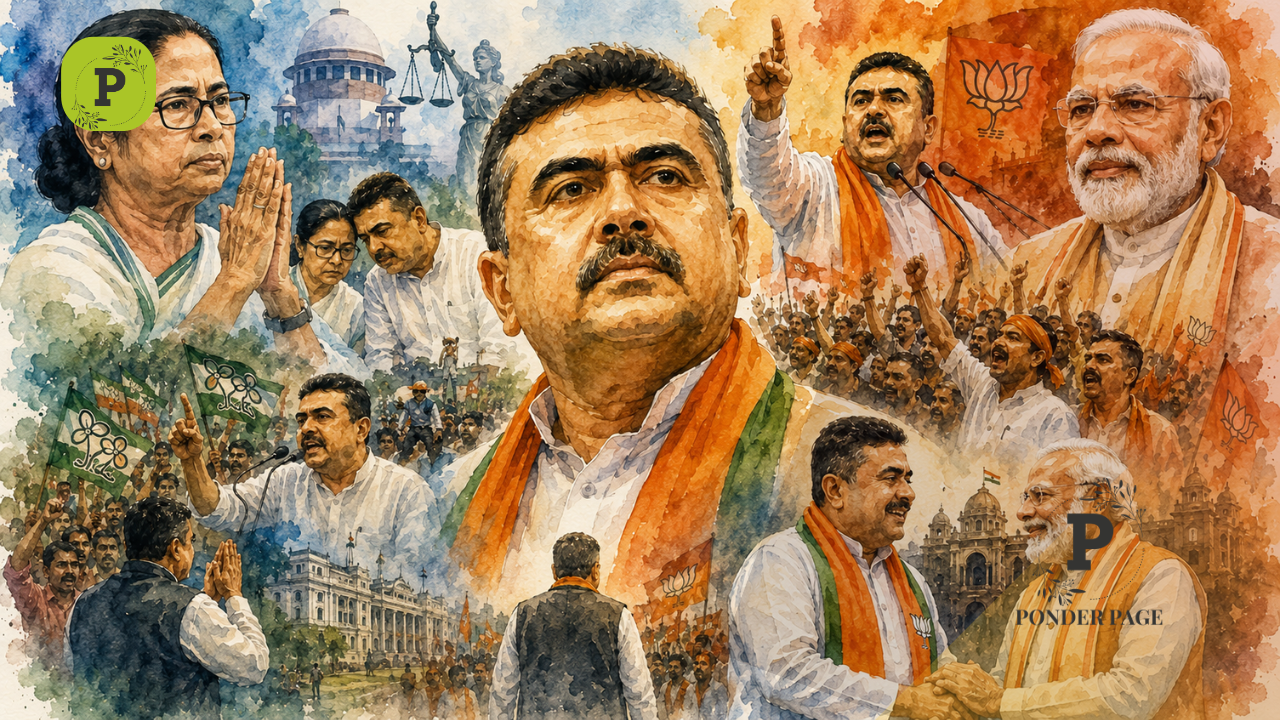
Suvendu Adhikari and his Political Journey: Indian politics has always been a landscape of dramatic transformations, shifting alliances, and powerful personalities. Few leaders embody this reality as vividly as Suvendu Adhikari. His rise from a grassroots political worker in Bengal to becoming one of the most influential faces of contemporary state politics reflects not only his personal ambition, but also the changing nature of political culture in India.
His journey is not simply the story of a politician changing parties. It is a larger narrative about ideology, political survival, electoral strategy, and the growing importance of identity-driven politics in modern India.
Over three decades, Suvendu Adhikari has moved through multiple political camps, faced serious allegations and controversies, emerged stronger after setbacks, and ultimately positioned himself at the center of Bengal’s political transformation.
Today, his political career stands as both a symbol of political adaptability and a reflection of the intense polarization shaping Indian democracy.
(You can now subscribe to our Ponder Page WhatsApp channel)

Table of Contents
The Rise of a Political Strategist
Suvendu Adhikari was born on December 15, 1970, in Karkuli, East Medinipur, into one of Bengal’s most influential political families. The Adhikari family has long exercised substantial influence over the politics of East Medinipur, and politics was deeply embedded in his upbringing.
His father, Sisir Kumar Adhikari, served as a Union Minister during the government led by Manmohan Singh. His brothers, Dibyendu and Soumendu Adhikari, have also remained active in politics, making the family one of the strongest political networks in the region.
Suvendu began his political journey through the youth wing of the Indian National Congress during the late 1980s. In 1995, he formally entered electoral politics and became a municipal councillor. However, the defining turn in his career came in 1998 when Mamata Banerjee broke away from Congress and formed the All India Trinamool Congress.
Recognizing the shifting political winds in Bengal, the Adhikari family aligned itself with the newly formed Trinamool Congress. This decision would reshape Suvendu’s future.
Nandigram and the Making of a Political Force
The turning point in Suvendu Adhikari’s political career arrived during the Nandigram land movement of 2007. At the time, the Left Front government in Bengal was attempting to acquire land for industrial development, triggering widespread protests.
The agitation transformed Bengal’s political landscape. While Mamata Banerjee emerged as the face of the movement at the state level, Suvendu Adhikari became one of its most powerful organizers on the ground. He coordinated cadres, mobilized villagers, and built a network of resistance that significantly weakened the decades-old Left Front government.
The Nandigram movement played a major role in the eventual rise of the Trinamool Congress to power in Bengal. It also elevated Suvendu Adhikari from a regional leader to a state-level political heavyweight.
Over the following years, his influence within the party grew steadily. He became known as a strategist with strong organizational abilities, a street-fighter image, and a deep understanding of Bengal’s electoral dynamics.
From Trusted Lieutenant to Political Rival
For years, Suvendu Adhikari remained one of the closest and most trusted associates of Mamata Banerjee. After the departure of Mukul Roy from the Trinamool Congress in 2017, Suvendu emerged as one of the party’s most important leaders.
However, political equations within the party gradually began to shift. As the influence of Abhishek Banerjee increased within the Trinamool Congress, Suvendu reportedly found his own political space shrinking.
By late 2020, tensions had reached a breaking point. In November 2020, he resigned from the Transport and Irrigation ministries in the Bengal government. Within weeks, he joined the Bharatiya Janata Party.
This move dramatically changed Bengal’s political landscape.
Reinventing Himself Through Hindutva Politics
Suvendu Adhikari’s shift to the BJP was not merely a change of party affiliation. It marked a complete political transformation.
For most of his political life, he had opposed the BJP and its ideological framework. Yet after joining the party, he rapidly emerged as one of the strongest proponents of Hindu nationalist politics in Bengal.
His speeches became increasingly aggressive and polarizing. He openly criticized what he described as appeasement politics in Bengal and accused the state government of enabling illegal infiltration and communal favoritism. His rhetoric often centered around religious identity and polarization, positioning him as one of the BJP’s most vocal leaders in eastern India.
This transformation drew comparisons with Himanta Biswa Sarma, another leader who spent years in the Congress before joining the BJP and later becoming a major face of aggressive nationalist politics.
For critics, this ideological shift symbolized opportunism. For supporters, it reflected political realism and strategic adaptation.

The 2021 Bengal Elections and the Nandigram Battle
The 2021 West Bengal Assembly elections became one of the most closely watched political contests in the country. The BJP aggressively challenged the Trinamool Congress, hoping to capture power in a state where it had historically remained weak.
At the center of this battle stood Suvendu Adhikari.
He contested directly against Mamata Banerjee in Nandigram, turning the constituency into the symbolic heart of the election. The contest carried enormous political significance because Nandigram was not just a constituency; it was the birthplace of the movement that had originally brought the Trinamool Congress to power.
Suvendu Adhikari eventually defeated Mamata Banerjee in Nandigram, a victory that dramatically elevated his stature within the BJP. Although the Trinamool Congress retained power in Bengal, Suvendu emerged as the Leader of Opposition and became one of the BJP’s strongest regional faces.
A Career Surrounded by Controversy
Suvendu Adhikari’s political journey has also been shadowed by numerous controversies, allegations, and criminal cases.
One of the most discussed controversies was the Narada sting operation, in which several Trinamool Congress leaders were allegedly seen accepting cash on camera in exchange for favors. Suvendu Adhikari’s name was among those linked to the controversy. Political opponents repeatedly used the sting operation to question his integrity.
His name has also surfaced in connection with the Saradha chit fund scam, one of Bengal’s biggest financial scandals. Investigative agencies reportedly questioned him during the probe, although no conviction has emerged from the allegations.
Another major controversy involves allegations related to Maoist links during the Nandigram movement. A CID report from 2010 allegedly claimed that ammunition had been supplied to Maoist cadres during the agitation. Adhikari denied these accusations and described them as politically motivated.
Over time, the number of cases registered against him reportedly increased significantly. In 2022, he approached the Calcutta High Court seeking protection from what he argued were politically motivated cases filed after his departure from the Trinamool Congress.
The court granted him interim protection, leading to intense political debate across Bengal.
The Politics of Defection and Survival
Suvendu Adhikari’s career reflects a larger reality of Indian politics where ideology often becomes secondary to political relevance and electoral utility.
Throughout his career, he has moved from Congress to Trinamool Congress and eventually to the BJP. Each transition coincided with major political shifts in Bengal.
Critics argue that these changes demonstrate the decline of ideological commitment in politics. Supporters, however, see him as a practical leader capable of adapting to evolving political realities.
His journey also highlights the growing trend in Indian politics where parties increasingly prioritize electoral strength over ideological consistency. Leaders once considered political enemies frequently become allies when electoral equations demand it.
The Rise of Polarized Politics in Bengal
The emergence of Suvendu Adhikari as a central BJP figure also reflects the broader transformation of Bengal’s political culture.
For decades, Bengal politics was dominated by class-based mobilization and ideological debates rooted in Left politics. Today, identity politics and religious polarization have become increasingly prominent.
Suvendu Adhikari’s speeches and political messaging have often focused on Hindu identity, communal polarization, and sharp criticism of Muslim political representation. His statements have repeatedly sparked controversy, with opponents accusing him of deepening social divisions.
Supporters argue that he is articulating concerns ignored by traditional political parties. Critics believe such politics risks damaging Bengal’s historically pluralistic social fabric.
This ideological battle is now central to Bengal’s future political direction.
Questions About Governance and the Future
The biggest question surrounding Suvendu Adhikari’s political future is not merely about electoral success, but about governance.
Bengal faces multiple challenges, including unemployment, industrial stagnation, infrastructure concerns, and political violence. The state also continues to experience intense political polarization.
The debate surrounding Suvendu Adhikari ultimately comes down to whether his politics will focus on governance and development or continue to revolve around identity-based mobilization.
His supporters see him as a decisive and fearless leader capable of breaking old political monopolies. His critics view him as a symbol of opportunistic politics and deepening communal division.
Suvendu Adhikari and his Political Journey: A Mirror of Contemporary Indian Politics
Suvendu Adhikari’s political story is larger than the journey of one individual. It reflects the changing nature of Indian politics itself.
His career demonstrates how power, strategy, adaptability, and political survival increasingly shape modern electoral politics. It also raises uncomfortable questions about ideology, accountability, political morality, and the growing acceptance of aggressive polarization as an electoral strategy.
Whether history ultimately remembers him as a transformative leader or a controversial political opportunist will depend not only on electoral victories, but on the long-term impact of his politics on Bengal and its people.
For now, Suvendu Adhikari remains one of the most influential and debated figures in contemporary Indian politics – a politician whose journey captures both the ambition and contradictions of the democratic process in modern India.


What are your thoughts on this article? Let us know in the comments below. If you enjoyed this article, be sure to subscribe for more engaging content in the future! Stay updated on the latest developments and discussions by clicking the subscribe button above. Thank you for your support!
📢 Dive into the latest discussions on social & trending topics! 🌍💬 Subscribe to Ponder Page for thought-provoking articles and interviews that dissect current issues. Don’t miss out on insightful content—hit that like & subscribe button now!



Leave a Reply