
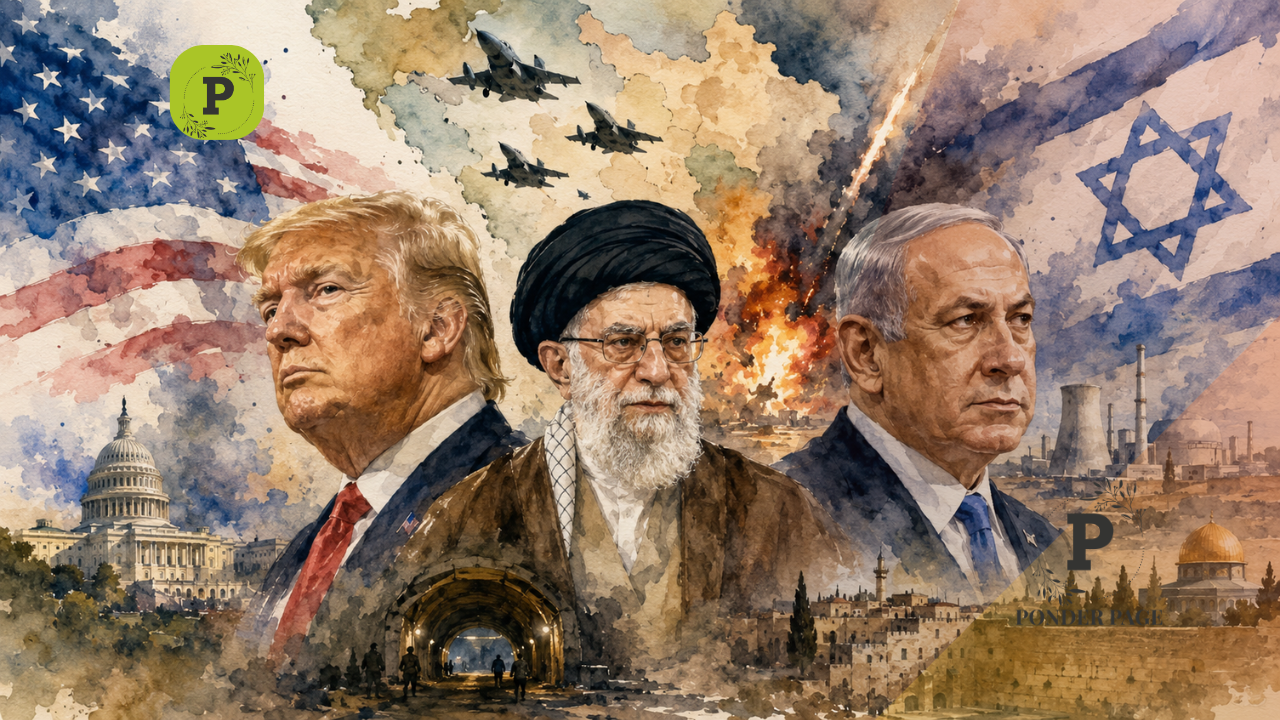
Secret Operation Against Khamenei Revealed: The political landscape of the Middle East witnessed another dramatic turn after the 2024 United States presidential election. As global powers repositioned themselves and regional rivalries intensified, a series of events unfolded that significantly escalated tensions between Israel and Iran. From political funding in Washington to underground bunkers in Tehran, the developments reflected how deeply interconnected international politics and military strategy have become.
(You can now subscribe to our Ponder Page WhatsApp channel)

Table of Contents
Trump’s 2024 Election Victory and the Pro-Israel Lobby
On November 5, 2024, Donald Trump secured victory in the U.S. presidential election. While the election itself attracted global attention, another important dimension also emerged alongside it. One of Trump’s largest individual donors during the campaign was billionaire Miriam Adelson, who reportedly contributed massive financial support to his election efforts.
Soon after the election results were announced, geopolitical analysts and international observers began discussing the implications of such strong pro-Israel backing. Many experts predicted that influential pro-Israel donors would expect a much tougher American stance against Iran under Trump’s leadership. According to these discussions, distancing himself from such expectations would have carried serious political risks for Trump.
Over time, events appeared to validate those predictions.
Operation Rising Lion and the Joint Strikes on Iran
Within months of Trump returning to power, tensions escalated dramatically. On June 13, 2025, Israel launched a military campaign against Iran known as “Operation Rising Lion.” The United States openly supported the operation and reportedly participated through coordinated airstrikes targeting multiple Iranian sites.
The attacks marked one of the most serious direct confrontations involving Iran and Israel in recent years. Military analysts noted that the strikes were not symbolic in nature; instead, they were designed to weaken critical Iranian infrastructure and send a strategic warning to Tehran.
As bombs and missiles targeted Iranian positions, Iran’s Supreme Leader Ayatollah Ali Khamenei reportedly relocated from his usual residence at the Pasteur Street compound to a heavily fortified underground bunker in the Lavizan area of northeastern Tehran.

Inside the Lavizan Underground Bunker
The Lavizan bunker was reportedly no ordinary shelter. According to various accounts, the underground complex was equipped with advanced anti-bomb and anti-aircraft protection systems. Reports suggested that the structure was designed to withstand even heavy bunker-buster weapons such as the GBU-57.
Similar to other secure Iranian military facilities, the bunker allegedly featured interconnected underground routes and multiple hidden exits leading to different locations. Such infrastructure was intended to ensure survival and mobility during wartime conditions.
During the height of the airstrikes, Khamenei reportedly recorded a nine-minute video message from inside the bunker. Observers quickly noticed an unusual detail: the video quality was intentionally poor, with blurred visuals, low bitrate, and distorted audio.
Why Iran Released a Low-Quality Video
Iran’s decision to release a degraded version of the video was reportedly linked to security concerns. Intelligence agencies such as the CIA and Mossad are known for analyzing ambient sounds, ventilation systems, generator frequencies, and other environmental clues from recordings in order to determine the location and structure of hidden facilities.
By reducing the video’s audio and visual clarity, Iranian authorities likely aimed to prevent foreign intelligence services from estimating the bunker’s depth, layout, or technical systems. It reflected the growing sophistication of modern intelligence warfare, where even minor digital details can reveal critical military information.
Israel’s Alleged Knowledge of Khamenei’s Location
Despite the precautions taken by Iran, reports suggested that Israeli intelligence already knew Khamenei’s exact location. Multiple international reports claimed that Israel possessed the operational capability to strike the Iranian leader whenever it chose.
At the same time, several reports indicated that Israeli officials attempted to persuade Trump to authorize an operation targeting Khamenei directly during the ongoing strikes. The argument reportedly presented was that eliminating Iran’s top leadership at that moment could permanently weaken the country’s strategic ambitions.
However, according to these reports, Trump refused to approve such an action at that stage.
Trump’s Public Warning on Social Media
Although Trump reportedly rejected the proposal to assassinate Khamenei, his public messaging remained aggressive. On June 17, 2025, Trump posted on his social media platform, Truth Social, stating that the United States knew exactly where Khamenei was located but would not target him “for now.”
The statement immediately attracted global attention. It was interpreted by many as both a warning and a demonstration of American intelligence reach.
Interestingly, only days after the statement, the airstrikes gradually stopped and negotiations with Iran reportedly resumed. Yet despite the temporary pause in military operations, concerns within Israel only intensified.
Iran’s Nuclear Program Remained a Major Concern
One of the most significant outcomes of the strikes was that several critical Iranian nuclear facilities reportedly survived with either minimal damage or no major destruction at all. Even after intense military action, Iran’s nuclear infrastructure remained operational to a large extent.
Reports also indicated that Iran had already achieved uranium enrichment levels approaching 60 percent before the attacks. This raised serious alarm within Israeli strategic circles.
From Israel’s perspective, the situation had become increasingly dangerous. Analysts believed that unless Iran’s leadership and command structure were disrupted quickly, stopping the nuclear program could soon become nearly impossible.
Every passing day appeared to strengthen Iran’s nuclear capabilities while simultaneously reducing the time available for Israel to act decisively.
Attempts to Trigger Internal Unrest in Iran
During the same period, efforts were also reportedly made to encourage protests and internal instability within Iran. The apparent objective was to create domestic pressure strong enough to weaken or remove Khamenei without requiring direct military assassination.
However, these efforts reportedly failed to gain the momentum necessary to threaten the Iranian leadership in a meaningful way. Iran’s political system remained intact despite the external pressure and ongoing military tensions.
Netanyahu’s Secret Meeting and the Alleged Final Plan
A particularly important development reportedly took place in November 2025. According to claims circulating in geopolitical discussions, Israeli Prime Minister Benjamin Netanyahu held a high-level meeting involving the defense minister, Mossad chief, and senior intelligence officials.
During this meeting, it was allegedly decided that the final plan and timeline for targeting Khamenei would be set. Reports claimed that the first quarter of 2026 was identified as the intended period for carrying out the operation.
Although such reports remain part of broader geopolitical speculation and intelligence-based narratives, they highlight the extent to which tensions between Israel and Iran had escalated behind closed doors.


Secret Operation Against Khamenei Revealed: A Region Standing on the Edge
The developments surrounding Israel, Iran, and the United States illustrate how quickly regional conflicts can evolve into global geopolitical crises. Political donations, election outcomes, intelligence warfare, underground military infrastructure, nuclear fears, and strategic assassinations all became interconnected elements of a larger power struggle.
Whether these events ultimately lead to diplomacy or further escalation remains uncertain. However, one thing is clear: the Middle East continues to remain one of the world’s most volatile geopolitical arenas, where every decision made in Washington, Tehran, or Tel Aviv can reshape the balance of power across the region.
What are your thoughts on this article? Let us know in the comments below. If you enjoyed this article, be sure to subscribe for more engaging content in the future! Stay updated on the latest developments and discussions by clicking the subscribe button above. Thank you for your support!
📢 Dive into the latest discussions on social & trending topics! 🌍💬 Subscribe to Ponder Page for thought-provoking articles and interviews that dissect current issues. Don’t miss out on insightful content—hit that like & subscribe button now!




Leave a Reply