
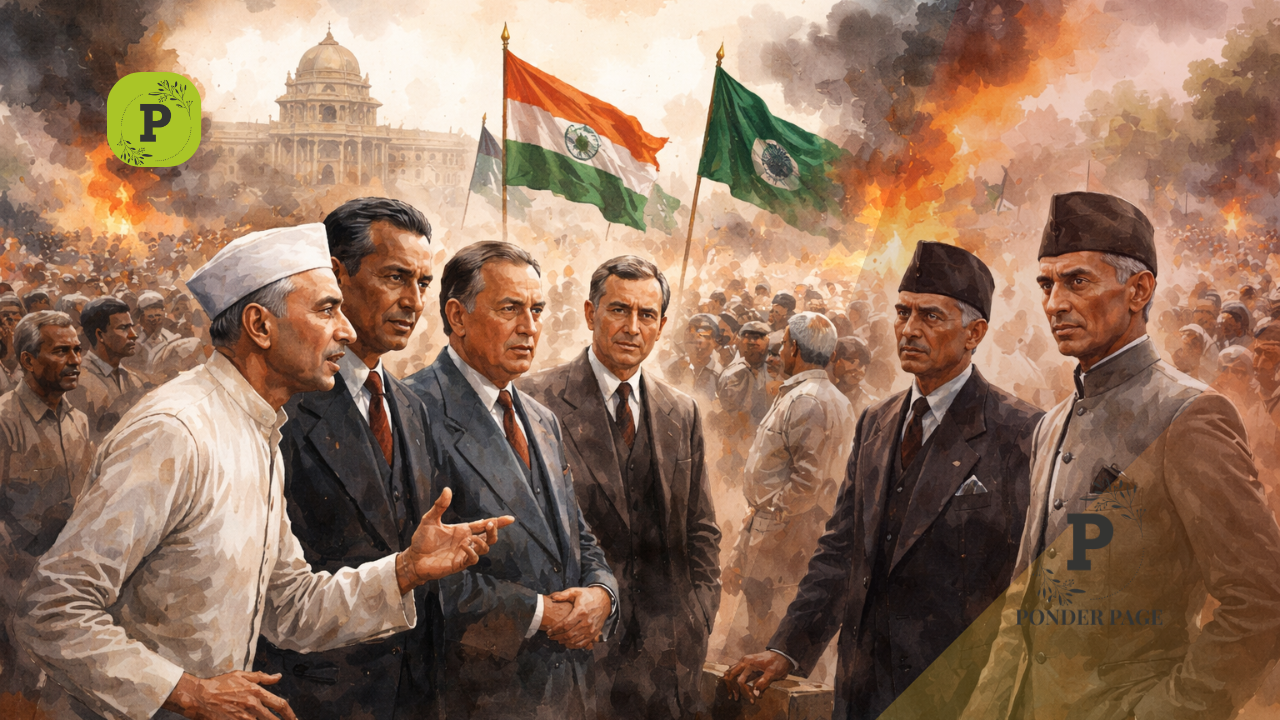
The Cabinet Mission Plan of 1946: As India moved closer to independence in the mid-1940s, political tensions between major groups reached a critical point. The demand for a separate nation, strongly advocated by Muhammad Ali Jinnah and the Muslim League, had intensified. At the same time, the British government was eager to exit India quickly, but without leaving behind chaos. The challenge was enormous: how to transfer power while keeping the country stable.
(You can now subscribe to our Ponder Page WhatsApp channel)

Table of Contents
Why the Cabinet Mission Was Sent to India
By early 1946, it had become clear that negotiations between the Indian National Congress and the Muslim League were not producing any concrete solution. The British government, facing pressure at home and unrest in India, decided to intervene directly.
To resolve the deadlock, the United Kingdom sent three cabinet ministers to India. This group came to be known as the Cabinet Mission. They arrived on March 24, 1946, with the goal of finding a political framework acceptable to all major parties.
Over the next several weeks, the mission held multiple meetings with Congress leaders, Muslim League representatives, and other political figures. Despite extensive discussions, no agreement could be reached.
The Announcement of the Cabinet Mission Plan
Frustrated by the lack of consensus, the Cabinet Mission took matters into its own hands. On May 16, 1946, it announced a detailed plan for India’s independence, bypassing the need for mutual agreement between Indian leaders.
The plan was significant for several reasons. First, it clearly rejected the idea of partitioning India into separate nations. Second, it proposed the end of separate electorates based on religion, which had long been a source of division.
However, the most important part of the plan was its structural framework for governing India.
The Three-Tier Federal Structure
The Cabinet Mission proposed a unique three-tier system of governance. Instead of a strong centralized government, power would be distributed across three levels: the central government, groups of provinces, and individual provinces.
At the top, the central government would handle only three key areas: foreign affairs, defense (through finance), and communications. This meant that the center would be relatively weak compared to the provinces.
Below the center, provinces were grouped into three clusters:
Group A included provinces like the United Provinces, Bombay, Madras, Central Provinces, Bihar, and Orissa. These were largely Hindu-majority regions.
Group B consisted of Punjab, Sindh, North-West Frontier Province, and Balochistan, which had significant Muslim populations.
Group C included Bengal and Assam, also with substantial Muslim-majority areas.
Each group would have the authority to create its own constitution, and later all groups together would participate in framing a national constitution.
This arrangement effectively decentralized power, giving provinces significant autonomy.
Flexibility and Future Possibilities
One of the most controversial aspects of the plan was the provision allowing provinces to reconsider their group membership after five years. A province could choose to leave its group and join another.
Additionally, princely states were given the option to either join the Indian Union or remain independent.
This flexibility created uncertainty about the long-term unity of the country.
Formation of the Constituent Assembly
The plan also outlined how India’s constitution would be drafted. A Constituent Assembly would be formed with representation based on population. Each community would have proportional representation, ensuring that all voices were included in the constitution-making process.
This idea aimed to create a balanced and inclusive framework for the future nation.
Why Jinnah Initially Accepted the Plan
Interestingly, despite rejecting partition in principle, Muhammad Ali Jinnah initially agreed to the Cabinet Mission Plan.
His reasoning was strategic. The weak central government and strong provincial autonomy suggested that Muslim-majority regions could eventually consolidate power. The provision allowing provinces to change groups after five years hinted at the possibility of forming a larger, more unified Muslim state in the future.
In other words, even without immediate partition, the plan seemed to offer a pathway toward his long-term vision.
Congress Raises Objections
The Indian National Congress, while broadly supportive of a united India, raised two major objections to the plan.
First, it opposed the compulsory grouping of provinces. Congress argued that provinces should have the freedom to choose whether or not to join any group.
Second, it demanded a stronger central government. Congress leaders believed that a weak center would eventually lead to fragmentation, as provinces might act independently and weaken national unity.
These concerns were rooted in the fear that the proposed structure could indirectly lead to division.
Collapse of the Plan
The British showed some willingness to accommodate Congress’s concerns. However, these potential changes threatened the strategic advantage that Muhammad Ali Jinnah saw in the plan.
As a result, Jinnah withdrew his earlier acceptance. With the Muslim League stepping back and Congress unwilling to fully accept the original terms, the Cabinet Mission Plan began to fall apart.
Rising Tensions and the Call for Direct Action
Even as the British encouraged participation in the Constituent Assembly, the political divide deepened. Congress agreed to join the assembly and began working on the constitution.
The Muslim League, however, chose a different path.
On July 29, 1946, Jinnah convened a crucial meeting of the Muslim League’s working committee. He accused Congress of ignoring the legitimate demands of Muslims and imposing its will.
In response, he announced that if their demands were not met, the Muslim League would resort to “Direct Action” starting August 16, 1946.
This declaration marked a turning point, escalating tensions and setting the stage for events that would soon reshape the subcontinent.


The Cabinet Mission Plan of 1946: Conclusion
The Cabinet Mission Plan was one of the last major attempts to keep India united before independence. It offered a complex compromise, balancing unity with autonomy. However, deep mistrust between political groups and conflicting visions for the future made its success impossible.
What followed would be a series of events that ultimately led to partition, changing the course of history forever.
What are your thoughts on this article? Let us know in the comments below. If you enjoyed this article, be sure to subscribe for more engaging content in the future! Stay updated on the latest developments and discussions by clicking the subscribe button above. Thank you for your support!
📢 Dive into the latest discussions on social & trending topics! 🌍💬 Subscribe to Ponder Page for thought-provoking articles and interviews that dissect current issues. Don’t miss out on insightful content—hit that like & subscribe button now!




Leave a Reply