
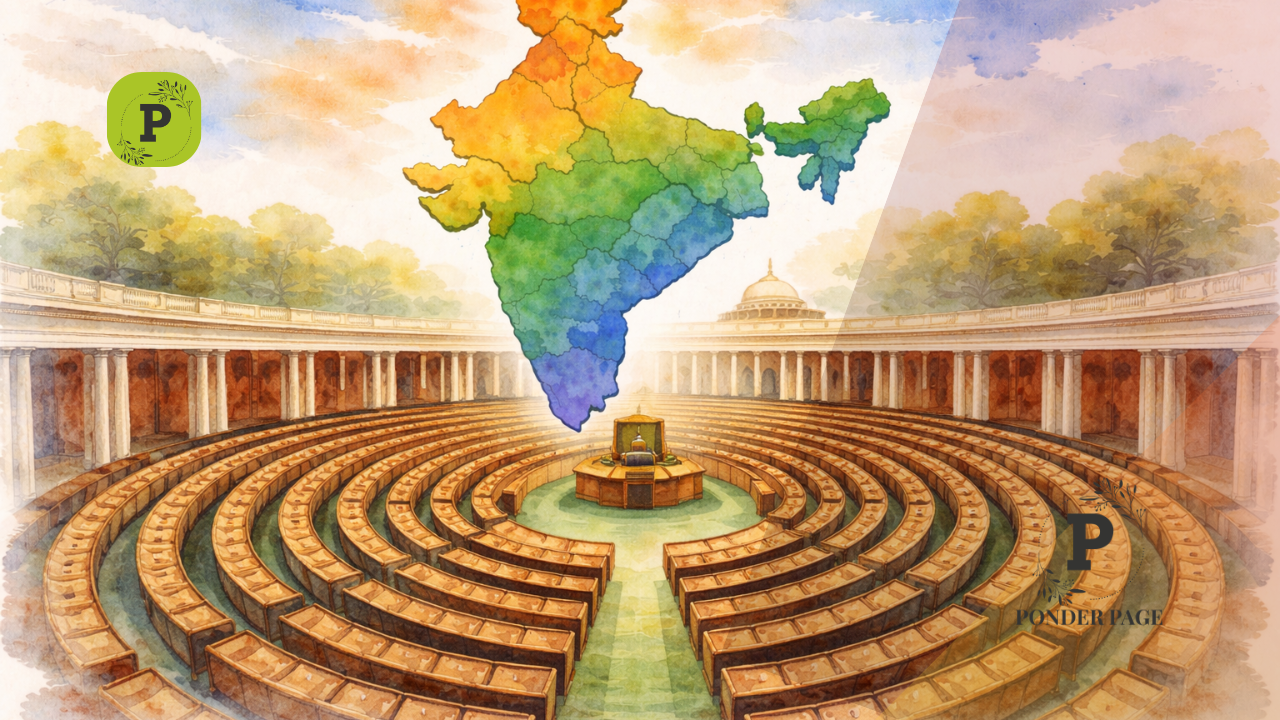
The Delimitation Plan That Could Redefine Power: In the history of any nation, certain decisions leave a lasting imprint, shaping both its direction and destiny. India has witnessed many such moments, some that strengthened its foundation and others that sparked intense debate. From the Emergency imposed by Indira Gandhi to economic liberalisation under Manmohan Singh, from nuclear tests during Atal Bihari Vajpayee’s tenure to demonetisation in recent years, each move altered the national landscape in profound ways.
Now, another decision appears to be on the horizon. One that, according to critics, could fundamentally reshape India’s democratic and federal structure.
(You can now subscribe to our Ponder Page WhatsApp channel)

Table of Contents
A Controversial Proposal in the Making
At a time when the country is already navigating political divisions and electoral battles across multiple states, the central government is reportedly preparing to introduce significant constitutional changes. These include amendments that could increase the number of Lok Sabha seats from 543 to around 850.
The stated objective is to implement the long-pending Women’s Reservation Bill, ensuring one-third representation for women in Parliament. However, questions are being raised about the urgency and the method being adopted to achieve this goal.
A key concern is whether such a major restructuring should proceed without an updated census. The last census was conducted in 2011, and critics argue that relying on outdated data for seat allocation could distort representation.
The Core Issue: Delimitation
At the heart of this debate lies the concept of delimitation, the process of redrawing the boundaries of parliamentary constituencies and reallocating seats based on population changes.
The Constitution mandates that constituencies should ideally have roughly equal populations, ensuring that each vote carries similar weight. This principle, often described as “one vote, one value,” is central to a fair democratic system.
Historically, delimitation exercises were conducted every decade following the census. However, this process was frozen in 1976 during the Emergency and later extended until 2026. The rationale was to encourage population control across states, ensuring that those who successfully managed population growth were not penalised.

Population vs Performance: A Growing Divide
The Delimitation Plan That Could Redefine Power: Its Impact on Democracy
The proposed changes have reignited a long-standing tension between states that have controlled their population growth and those that have not.
If seat allocation is based purely on population, northern states such as Uttar Pradesh and Bihar stand to gain significantly due to their larger populations. In contrast, southern states like Tamil Nadu, Kerala, Karnataka, Andhra Pradesh, and Telangana (known for better population control and stronger social indicators) may see their relative representation decline.
While the total number of seats in southern states might increase in absolute terms, their share in Parliament could shrink. This shift could tilt political influence toward the Hindi heartland, raising concerns about regional imbalance.
Federalism Under Strain
India’s federal structure is built on a delicate balance between states and the central government. Critics argue that altering parliamentary representation in a way that disproportionately benefits certain regions could weaken this balance.
Leaders from southern states have voiced strong objections, describing the move as unfair and potentially divisive. They argue that states which invested heavily in education, healthcare, and population control should not be disadvantaged in national representation.
Some have even warned that such changes could deepen regional tensions, reviving debates around identity and autonomy.
Questions Around Process and Transparency
Another major point of contention is the manner in which these changes are being introduced. Critics highlight the absence of widespread consultation, public debate, or a detailed policy framework explaining the rationale.
There are also concerns about the Delimitation Commission, which would be responsible for implementing these changes. Once its decisions are finalised, they cannot be challenged in court, making the process largely irreversible.
This has led to calls for greater transparency, including the release of a white paper and the convening of an all-party meeting to build consensus.
Alternative Approaches
Several alternative solutions have been suggested to address the issue more equitably. One approach is to increase the number of seats proportionally, maintaining the existing balance between states rather than relying solely on population.
Another idea is to strengthen the Rajya Sabha, giving it a more prominent role in representing state interests. This could act as a counterbalance to any dominance in the Lok Sabha.
Some experts have also proposed incorporating economic performance into the formula, rewarding states that contribute more significantly to the national economy.
Political Timing and Strategy
The timing of these proposed changes has also raised eyebrows. Introducing such a significant constitutional amendment in the middle of election cycles has led to speculation about political strategy.
By linking delimitation with women’s reservation, the government may be placing opposition parties in a difficult position. Supporting the bill could mean accepting the new seat distribution, while opposing it could be portrayed as विरोध to women’s representation.
This strategic bundling has intensified the political stakes, making the debate even more complex.
The Road Ahead
Passing a constitutional amendment requires a two-thirds majority in Parliament, meaning the government will need support beyond its own ranks. Regional parties and opposition groups will play a crucial role in determining the outcome.
The larger question, however, goes beyond political calculations. It touches upon the very nature of India’s democracy and federal structure.
Is the country ready for such a transformation after decades of postponement? Or does the issue require more deliberation, consensus, and careful planning?


The Delimitation Plan That Could Redefine Power: A Turning Point in India’s Democratic Journey
India stands at a critical juncture. Decisions taken now could shape its political landscape for generations to come.
Balancing representation, fairness, and unity in a diverse nation is no easy task. Any attempt to redraw that balance must be handled with sensitivity, transparency, and a commitment to democratic principles.
The debate around delimitation is not just about numbers or seats, it is about the future of representation, the strength of federalism, and the voice of every citizen in the world’s largest democracy.
What are your thoughts on this article? Let us know in the comments below. If you enjoyed this article, be sure to subscribe for more engaging content in the future! Stay updated on the latest developments and discussions by clicking the subscribe button above. Thank you for your support!
📢 Dive into the latest discussions on social & trending topics! 🌍💬 Subscribe to Ponder Page for thought-provoking articles and interviews that dissect current issues. Don’t miss out on insightful content—hit that like & subscribe button now!



Leave a Reply