
The Story of Jallianwala Bagh: In the early months of 1919, Punjab became a center of growing resistance against British rule. Two prominent leaders, Dr. Saifuddin Kitchlew and Dr. Satyapal, were leading peaceful protests against oppressive colonial laws. Their influence was spreading rapidly, and people from different walks of life were joining the movement with hope and determination.
On April 9, 1919, British officer General Dyer summoned both leaders under the pretense of holding discussions. However, instead of dialogue, they were deceitfully arrested and imprisoned. This act of betrayal ignited anger among the local population. Ordinary citizens, who had placed their trust in peaceful protest, now felt deeply wronged.
(You can now subscribe to our Ponder Page WhatsApp channel)

Table of Contents
The Gathering at Jallianwala Bagh
As outrage spread, people decided to gather on April 13, 1919, a day that coincided with the festival of Baisakhi. The chosen location was Jallianwala Bagh, a ground enclosed by walls with limited entry and exit points.
A day before the gathering, Dyer had imposed a ban on public assemblies. However, due to the absence of fast communication systems, many people remained unaware of the restrictions. On April 13, more than 10,000 men, women, and children assembled peacefully at Jallianwala Bagh, some to protest and others simply to celebrate the festival.
The Tragedy Unfolds
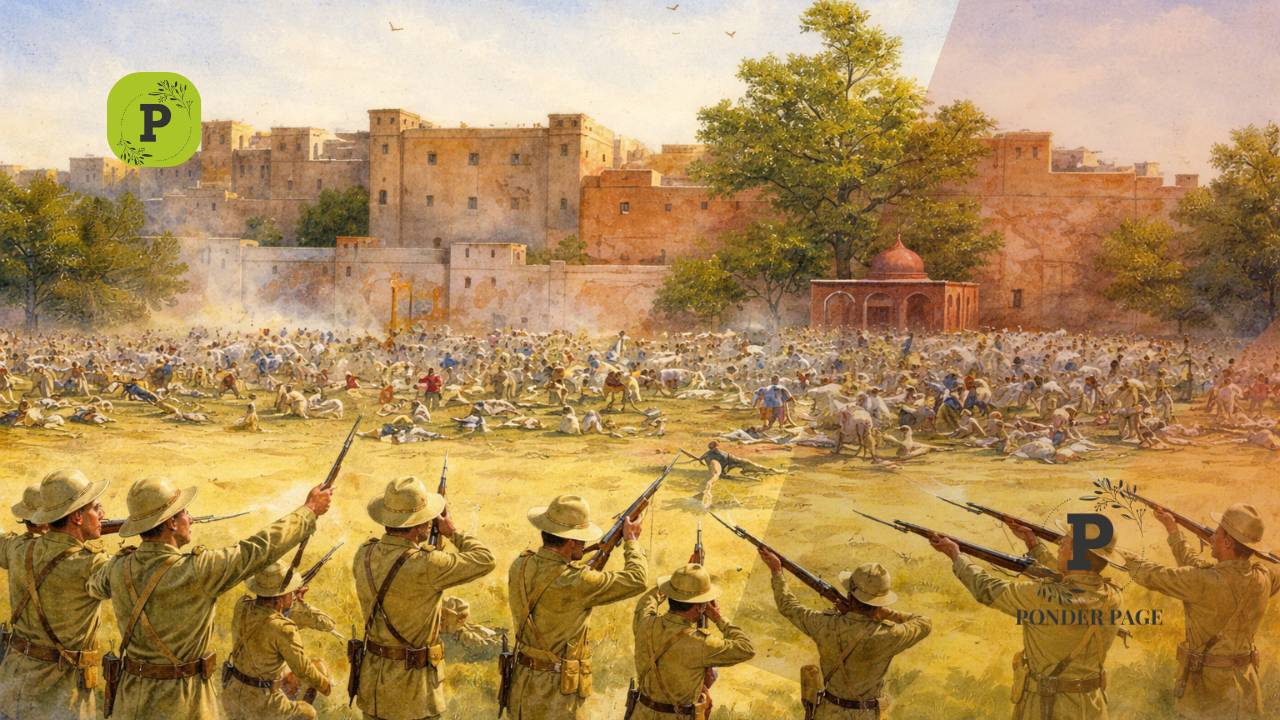
When Dyer learned about the gathering, he marched to the site with armed troops. Without issuing any warning, he positioned his soldiers at the only main entrance, effectively blocking any escape route. What followed was one of the darkest chapters in Indian history.
The troops opened fire on the unarmed crowd. Panic spread instantly, but there was nowhere to run. People were trapped within the enclosed space. According to British records, around 400 people lost their lives, but Indian accounts suggest the number was far higher. Many victims even jumped into a well inside the garden in a desperate attempt to escape the bullets.

Shockwaves Across India and Beyond
The massacre sent shockwaves across India and the world. Mahatma Gandhi was deeply shaken by the brutality of the incident. In response, he called off the ongoing Satyagraha movement on April 18, 1919.
The British government set up the Hunter Commission to investigate the incident. However, the inquiry failed to deliver justice. No meaningful punishment was given to Dyer. Instead, he was defended in British circles and even received public support in the United Kingdom, where funds were raised in his honor.
This lack of accountability intensified resentment across India. People began to realize that peaceful appeals alone might not be enough to secure justice.
The Rise of the Non-Cooperation Movement
In the wake of these events, Gandhi shifted strategy. He called for unity among Indians and reached out to different communities, including Muslim groups, urging them to join a broader struggle against British rule. This led to the launch of the Non-Cooperation Movement.
The movement demanded self-rule, or Swaraj, and justice for the victims of Jallianwala Bagh. Indians were urged to withdraw their support from British institutions. Educational institutions, courts, and councils were boycotted. People began building their own systems, including national schools such as Jamia Millia Islamia and Kashi Vidyapith.
Prominent leaders like Jawaharlal Nehru, Motilal Nehru, and Vallabhbhai Patel gave up their professional careers to support the cause. The movement gained widespread momentum, uniting moderates and extremists under a common goal.
However, not everyone agreed with this approach. Muhammad Ali Jinnah expressed dissatisfaction and eventually resigned from the Congress.
A Sudden Halt: The Chauri Chaura Incident
By late 1921, British authorities began imposing strict bans on public meetings and press activities. Tensions escalated further. On February 4, 1922, in a small town called Chauri Chaura, a protest turned violent.
After a clash between protesters and police, an enraged mob set a police station on fire, resulting in the deaths of 22 policemen. This incident deeply disturbed Gandhi, who had always emphasized non-violence as the foundation of the movement.
Disheartened by the turn of events, Gandhi called off the Non-Cooperation Movement on February 12, 1922. Soon after, he was arrested by the British and sentenced to six years in prison.
The Shift Toward Revolutionary Action
The suspension of the movement left many Indians frustrated. Some began to doubt whether non-violent resistance alone could achieve independence. A new wave of young revolutionaries emerged, believing that armed struggle was necessary.
Leaders like Ram Prasad Bismil, Sachindra Nath Bakshi, and Jogesh Chandra Chatterjee came together to form the Hindustan Republican Association in Kanpur.
This organization aimed to inspire youth across India to rise against British rule through more direct and aggressive means. Over time, it evolved into the Hindustan Socialist Republican Association, reflecting a broader ideological vision.


The Story of Jallianwala Bagh: A Defining Chapter in India’s Freedom Struggle
The events surrounding Jallianwala Bagh marked a turning point in India’s struggle for independence. What began as a peaceful protest transformed into a nationwide awakening. The brutality of the massacre exposed the true nature of colonial rule and pushed Indians toward stronger, more united resistance.
From non-cooperation to revolutionary movements, this period reshaped the course of history. It revealed both the power and the limits of different forms of resistance, ultimately bringing India closer to its goal of self-rule.
What are your thoughts on this article? Let us know in the comments below. If you enjoyed this article, be sure to subscribe for more engaging content in the future! Stay updated on the latest developments and discussions by clicking the subscribe button above. Thank you for your support!
📢 Dive into the latest discussions on social & trending topics! 🌍💬 Subscribe to Ponder Page for thought-provoking articles and interviews that dissect current issues. Don’t miss out on insightful content—hit that like & subscribe button now!



Leave a Reply