
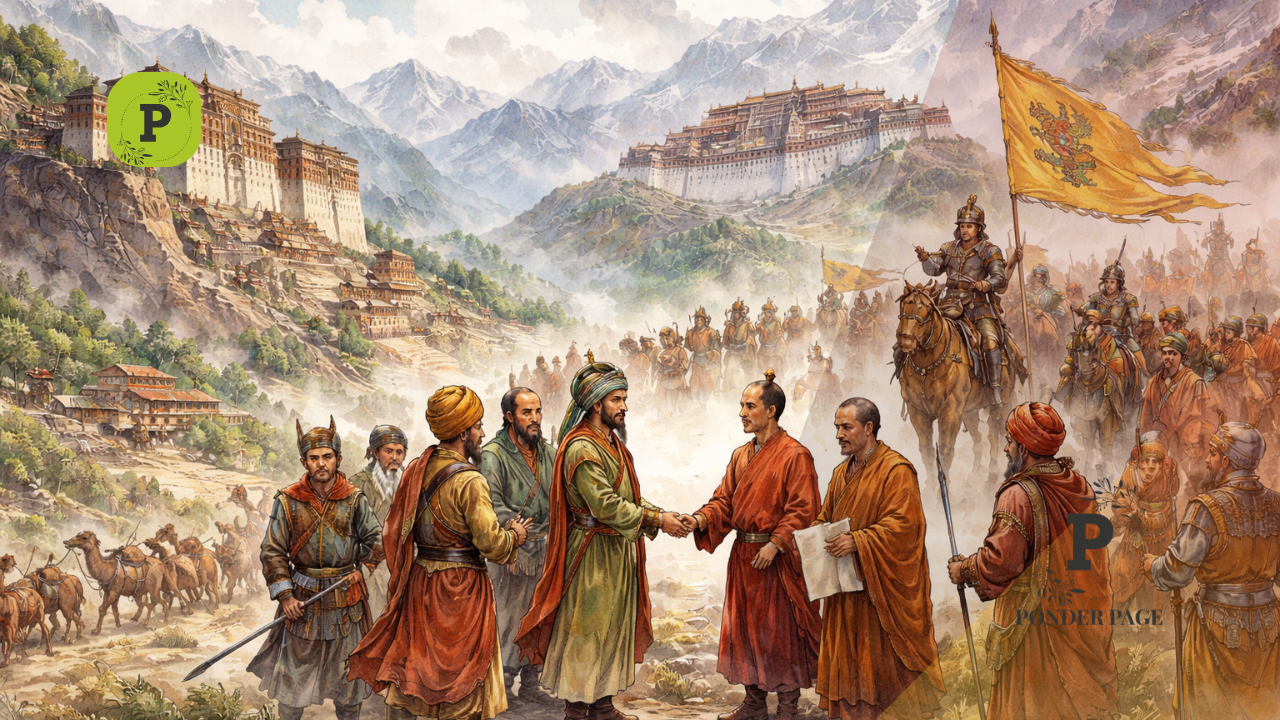
The Roots of the India China Border in Ladakh: The modern boundary dispute between India and China, particularly in the western sector around Ladakh and Aksai Chin, is deeply rooted in centuries of political shifts, regional conflicts, and evolving empires. To understand today’s tensions, it is essential to trace the historical developments that shaped this region.
(You can now subscribe to our Ponder Page WhatsApp channel)

Table of Contents
A Fragmented Landscape in the 7th Century
Around the year 625, the Indian subcontinent was not a unified nation but a mosaic of multiple kingdoms and empires. To the north of these Indian territories lay a powerful Tibetan Empire, which extended far beyond present-day Tibet. Its influence reached areas that today include Ladakh and parts of Arunachal Pradesh. This empire played a crucial role in shaping the political dynamics of the Himalayan region.
The Decline of the Tibetan Empire
Centuries later, the Tibetan Empire faced internal instability following the death of King Langdarma. His demise triggered a succession crisis among his relatives, leading to prolonged internal conflict. Amid this chaos, one of his descendants, Nyima-Gon, chose a different path. Instead of competing for control over the entire empire, he moved westward to a relatively remote and neglected region.
There, Nyima-Gon established his own Kingdom, forming what came to be known as the Ngari Kingdom. This region, though initially isolated, holds immense importance today because it overlaps significantly with what is now a disputed zone between India and China.
From Ngari to Maryul: The Rise of Ladakh
After Nyima-Gon’s death, his son Lhachen Palgyigon expanded the territory further and established the Maryul Kingdom. Historical accounts, particularly the Chronicles of Ladakh, suggest that this kingdom grew significantly in size and influence.
By around 1460, this region began to be widely known as the Kingdom of Ladakh. Over time, Ladakh emerged as a distinct political and cultural entity in the western Himalayas.
The Namgyal Dynasty and Expansion
Following the early rulers, the Namgyal dynasty came to power in Ladakh. Under their rule, Ladakh expanded rapidly, both in terms of territory and influence. This growth did not go unnoticed by neighboring powers.
The Tibetan authorities, viewing Ladakh’s expansion as a potential threat, eventually decided to act. Under the leadership of the Fifth Dalai Lama, Tibet launched a military campaign against Ladakh.

Conflict Between Ladakh and Tibet
The war between Ladakh and Tibet proved costly for Ladakh, which lost a significant portion of its territory. Facing mounting pressure, Ladakh sought assistance from the Mughal Empire in India. This intervention helped bring the conflict to a halt.
In 1684, a significant agreement known as the Treaty of Tingmosgang was signed between Ladakh and Tibet. This treaty marked a turning point, as it formally defined boundaries between the two regions for the first time. It was one of the earliest attempts to establish a documented border in this region, reducing the likelihood of future conflicts.
The Qing Empire’s Entry into Tibet
In the early 18th century, another major power entered the scene, the Qing Empire of China. In 1720, instead of launching a direct invasion, the Qing Empire intervened in Tibetan affairs by installing the Seventh Dalai Lama and asserting indirect control over Tibet.
From this point onward, Tibet functioned under significant Chinese influence, with the Qing Empire taking responsibility for its defense and political stability. This development would later become a key factor in China’s claims over Tibetan territories.
The Rise of the Sikh and Dogra Powers
Meanwhile, in the Indian subcontinent, the Sikh Empire was expanding under its own ambitions. In 1819, it took control of the Jammu region. Although local rulers like Maharaja Gulab Singh continued to govern, they did so under the authority of the Sikh Empire.
Soon after consolidating Jammu, the Dogra rulers, aligned with the Sikh Empire, turned their attention toward Ladakh. Through military campaigns, they brought Ladakh under their control, further altering the region’s political landscape.
Division of Tibetan Influence
By this time, the once-unified Tibetan Empire had effectively split into two spheres. The western part, including Ladakh, came under Dogra-Sikh control, while the remaining Tibetan region was under the indirect influence of the Qing Empire.
This division laid the groundwork for future territorial disagreements involving India, Tibet, and China.
The Treaty of Chushul (1842)
In 1842, tensions escalated once again as the Dogra rulers sought to expand further eastward to control important trade routes. This brought them into conflict with Tibetan forces, which were under Chinese influence.
After prolonged fighting and significant losses on both sides, peace was restored through the Treaty of Chushul, signed on September 17, 1842. This agreement included representatives from the Dogra Rule, Tibet, and the Qing Empire of China.
The treaty addressed multiple aspects such as trade and movement, but its most critical feature was the reaffirmation of boundaries. It stated that both sides would respect the “old established frontiers,” essentially restoring the borders defined earlier in the Treaty of Tingmosgang.
Why the Treaty Still Matters Today
The importance of the Treaty of Chushul lies in the fact that China was a signatory to it. By agreeing to the restoration of earlier boundaries, the Qing Empire effectively acknowledged that regions like Aksai Chin were part of Ladakh at that time.
This historical agreement is often cited in modern discussions about the India–China border dispute. It strengthens India’s claim by showing that even China had once formally accepted these territorial boundaries.


The Roots of the India China Border in Ladakh and Aksai Chin
The present-day tensions in Ladakh and Aksai Chin are not sudden developments but the result of a long and complex history involving multiple empires, treaties, and shifting allegiances. From the fragmentation of the Tibetan Empire to the rise of Ladakh, and from Qing intervention to Dogra expansion, each phase has contributed to shaping the borders we debate today.
Understanding this historical context provides valuable insight into why the dispute persists and why agreements signed centuries ago continue to influence modern geopolitics.
What are your thoughts on this article? Let us know in the comments below. If you enjoyed this article, be sure to subscribe for more engaging content in the future! Stay updated on the latest developments and discussions by clicking the subscribe button above. Thank you for your support!
📢 Dive into the latest discussions on social & trending topics! 🌍💬 Subscribe to Ponder Page for thought-provoking articles and interviews that dissect current issues. Don’t miss out on insightful content—hit that like & subscribe button now!


Leave a Reply