
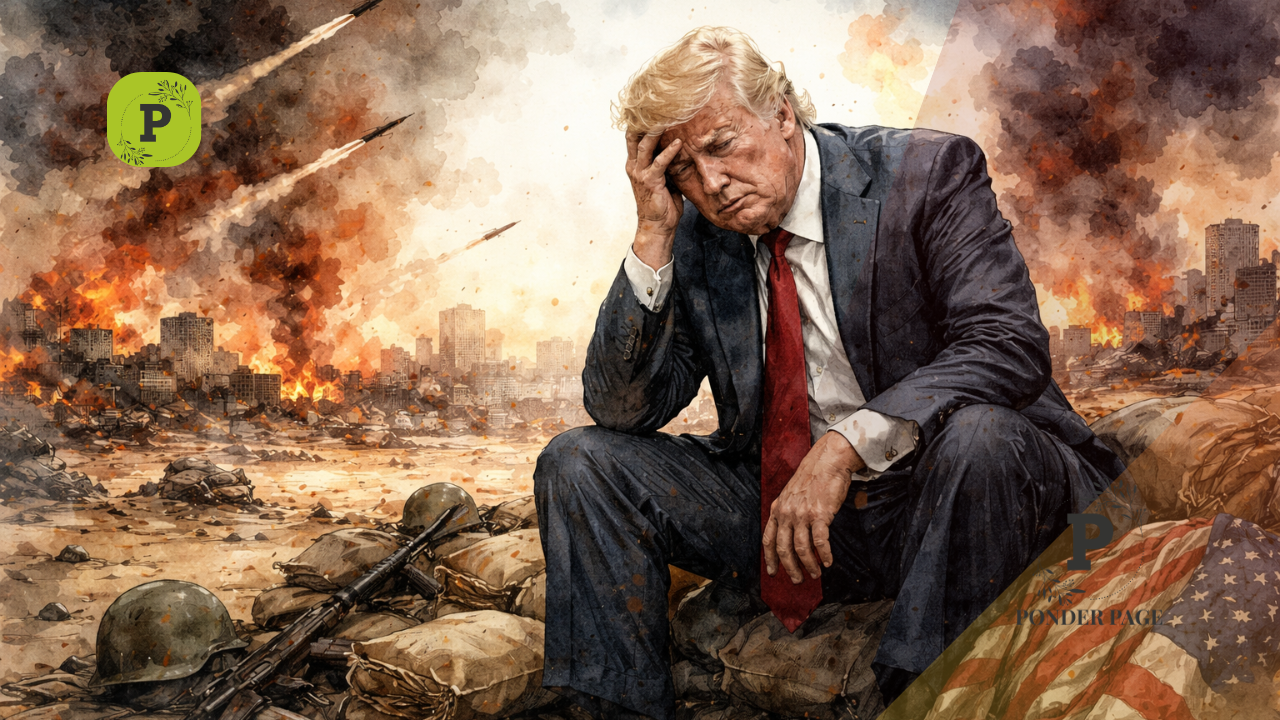
Did Donald Trump Make the Biggest Mistake of His Career? When the United States launched military action inside Iran under the leadership of Donald Trump, it was projected as decisive, bold, and necessary. But only days into the conflict, the larger question loomed: was this a calculated masterstroke, or a catastrophic miscalculation?
Wars are often justified in clear moral language at the outset. Yet as events unfolded across the Middle East, clarity gave way to confusion. Bombs fell on Tehran. Missiles streaked across the skies of Tel Aviv and Haifa. Oil infrastructure trembled. Global markets reacted. And the world began asking whether Washington had fully understood the fire it had ignited.
This is not a slow-moving conflict. It is fast, volatile, and spiraling.
(You can now subscribe to our Ponder Page WhatsApp channel)

Table of Contents
A Region in Flames
Tehran, once spoken of in the language of liberation and democracy, now finds itself under sustained bombardment. The United States and Israel have intensified airstrikes on Iranian targets, but the fallout has not been limited to military infrastructure. Civilian casualties have mounted, including a devastating strike on a girls’ school that claimed over 160 lives. Streets in Iran are filled not with protestors demanding regime change, but mourners grieving the dead.
In retaliation, Iran has responded forcefully. Missiles have targeted Israeli cities including Tel Aviv, Haifa, and Jerusalem. Gulf states have reported strikes and attempted interceptions. American missions in Riyadh and Kuwait were attacked, prompting embassy closures. Washington has urged its citizens to leave the Middle East immediately, though clear evacuation pathways remain uncertain.
The message from the world’s most powerful military was stark: while it possesses unmatched firepower and aircraft carriers, it cannot guarantee individual safety in an expanding war zone.
Casualty numbers continue to rise. Six American soldiers have already been confirmed dead. Iranian warships have been sunk. Tehran claims it has destroyed a major American radar installation in the region. Each side projects strength. Neither shows signs of retreat.
The Leadership Vacuum in Iran
One of the most destabilizing developments was the killing of Iran’s Supreme Leader, Ali Khamenei. With his death, Iran’s centralized command structure fractured. Analysts had long discussed Tehran’s “mosaic defense” doctrine: a decentralized military system designed to continue functioning even if top leadership were eliminated.
That doctrine now appears to be in action.
Iran’s foreign minister has acknowledged that several military units are operating without direct central command. In practical terms, this creates a dangerous paradox. Even if Washington were to declare a ceasefire tomorrow, there may be no unified Iranian authority capable of enforcing it. By decapitating the leadership, the path to negotiation has grown murkier.
This has transformed what might have been a short-term campaign into a potentially prolonged war of attrition.
What Is America Fighting For?
In Washington, confusion surrounds the fundamental objective of the war. On the first day, officials declared the goal was to end Iran’s nuclear program. On the second, rhetoric shifted toward regime change and the promotion of democracy. Soon after, the focus moved to degrading Iran’s missile capabilities. Then came claims of neutralizing an imminent threat.
Statements from senior officials, including Marco Rubio and JD Vance, have offered varying justifications. At one point, the argument suggested that the United States acted preemptively because Israel was preparing to strike Iran, and Washington sought to control the escalation.
This shifting narrative has fueled skepticism within Congress and beyond. Lawmakers from both parties have questioned the intelligence basis for the war. Public opinion reflects the unease. A poll reported by CNN found that nearly 60 percent of Americans disapprove of the attack on Iran. Surveys by Reuters and Ipsos suggest approval ratings hovering near 30 percent.
Without a clearly articulated objective, the administration risks being trapped in a conflict without a defined exit strategy.

Did Israel Pull America Into the Conflict?
Critics argue that Washington’s hand was forced by Israeli calculations. The perception that Israel heavily influences American Middle East policy is not new. But in this crisis, that perception has intensified.
Voices within Trump’s own political base have expressed anger. Even staunch allies such as Marjorie Taylor Greene have publicly criticized the administration’s handling of the conflict. Commentators have questioned how a president who campaigned against “endless wars” now presides over a rapidly expanding one.
The belief that America entered the war primarily to shield Israel from retaliation has gained traction internationally. Whether fair or not, that perception complicates diplomacy and fuels domestic backlash.
Was the United States Prepared?
Before the war began, billions were spent positioning aircraft carriers, fighter jets, and naval vessels in the region under what was described as Operation Epic Fury. Yet early incidents have raised doubts about readiness. Reports emerged of multiple F-15 fighter jets going down, with conflicting explanations ranging from friendly fire to Iranian air defenses.
The conflict has quickly evolved into a missile-for-missile contest. Iran’s stockpile of ballistic missiles is being tested against American and allied interceptor systems such as the Patriot batteries. Interceptor missiles are expensive and limited in supply. Analysts warn that at the current firing rate, defensive systems in Gulf states could be depleted within days or weeks.
Iran, meanwhile, claims it possesses months’ worth of missile capacity and has yet to deploy its most advanced systems. If this becomes a prolonged exchange, sustainability will matter more than spectacle.
The Saudi Factor and a Dangerous Mystery
Another destabilizing element involves the attack on Saudi oil infrastructure. Initial reports blamed Iran. Later assessments suggested Tehran may not have been responsible. If confirmed, this raises alarming possibilities.
Was it a rogue action? An accident? Or a deliberate attempt by another actor to widen the war and draw Riyadh in?
Saudi Arabia now faces a strategic crossroads. If it concludes that it has been manipulated, its regional posture could shift dramatically. If it chooses sides openly, the coalition dynamics of the war will transform overnight.
The Strait of Hormuz and the Global Shockwave
Perhaps the most consequential development is the near closure of the Strait of Hormuz. Roughly 20 to 21 million barrels of oil pass through this narrow waterway each day. Iran’s Revolutionary Guard has warned that any attempt to bypass restrictions could result in ships being targeted.
Brent crude prices have already surged past 80 dollars per barrel, with analysts warning of potential spikes to 120 or even 150 dollars. European gas prices have risen sharply. Qatar has curtailed some export operations. Energy markets are bracing for sustained disruption.
For countries like India, which import more than half of their crude from the Middle East, the consequences could be severe. Higher oil and LNG prices translate directly into inflation, currency pressure, and trade imbalances. The economic ripple effects of this war extend far beyond the battlefield.
How Does This War End?
There are only a few conceivable paths forward.
One option is overwhelming force: a sustained campaign to destroy Iran’s missile launchers, military infrastructure, and economic assets within weeks. Such a strategy would be extraordinarily costly and would not guarantee regime collapse. Even then, decentralized resistance could persist.
The second option is negotiation. But negotiation requires a counterpart. With Iran’s leadership fragmented and its command structure dispersed, identifying a credible negotiating authority becomes difficult.
History offers cautionary tales. Air campaigns alone rarely produce clean resolutions. From Iraq to Libya to Afghanistan, regime destabilization has often led to prolonged instability rather than swift peace.
For Iran, battered yet defiant, there is little immediate incentive to surrender while it retains the ability to inflict damage through asymmetric warfare. For the United States, prolonged escalation risks further casualties, domestic political fallout, and global economic upheaval.


Did Donald Trump Make the Biggest Mistake of His Career? A War Without an Off-Ramp?
Pressure is mounting behind the scenes. Gulf states such as the United Arab Emirates and Qatar are reportedly urging de-escalation. China, which purchases a large share of Iranian oil, has called for keeping maritime routes open, though it has refrained from direct involvement.
At its core, the crisis exposes a fundamental dilemma. If the objectives are unclear and the chain of command on the opposing side is fractured, how does one declare victory? How does one negotiate peace?
The United States may have believed this would be a swift operation, a decisive strike followed by strategic advantage. Instead, it faces a grinding confrontation with no obvious endpoint.
Whether this conflict becomes a defining triumph or a historic misjudgment will depend not only on battlefield outcomes, but on political clarity, diplomatic creativity, and the willingness of all sides to step back from escalation.
For now, the war continues. And the world waits.
What are your thoughts on this article? Let us know in the comments below. If you enjoyed this article, be sure to subscribe for more engaging content in the future! Stay updated on the latest developments and discussions by clicking the subscribe button above. Thank you for your support!
📢 Dive into the latest discussions on social & trending topics! 🌍💬 Subscribe to Ponder Page for thought-provoking articles and interviews that dissect current issues. Don’t miss out on insightful content—hit that like & subscribe button now!






Leave a Reply