
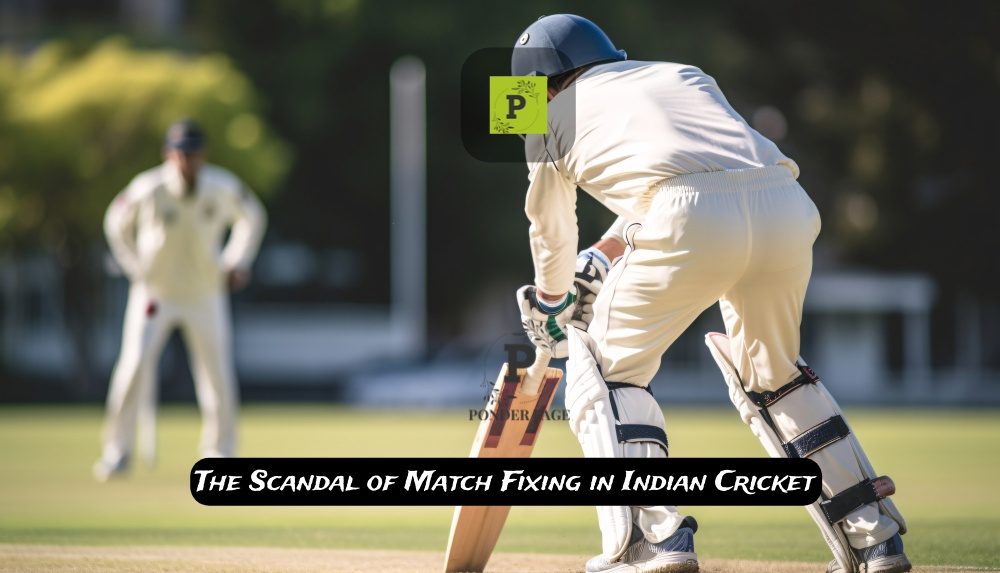
The Scandal of Match Fixing: The Indian cricketing world was shaken to its core with revelations of match-fixing that involved some of the sport’s most prominent figures. This scandal not only tarnished the image of Indian cricket but also exposed the dark underbelly of sports betting and corruption. This article delves into the intricate details of the investigation, key players involved, and the repercussions that followed.
(You can now subscribe to our Ponder Page WhatsApp channel)

Table of Contents
The Revelation
In the early 2000s, the Central Bureau of Investigation (CBI) began a thorough investigation into allegations of match-fixing in Indian cricket. The investigation was sparked by allegations that former Indian cricket captain Mohammad Azharuddin was involved in match-fixing.
Sachin Tendulkar was also called for questioning, where he reportedly stated that Azharuddin was not giving his 100% on the field. Tendulkar further mentioned that Manoj Prabhakar and Nayan Mongia played unusually slow without any team instructions, which led to Tendulkar being upset with them.

Azharuddin’s Confession
Initially, Azharuddin denied any involvement in match-fixing. However, the CBI presented him with evidence, including property papers and lists of cars, and mentioned that bookie MK Gupta was ready to confirm the allegations. Faced with this evidence, Azharuddin admitted to his involvement.
Further investigations revealed that Azharuddin’s calls were frequently made to bookies, and cash transactions were traced back to a locker at the Taj Palace Hotel. These findings were corroborated by hotel staff and bookie MK Gupta.

The Network
The investigation uncovered a widespread network involving several cricketers and bookies. Ajay Sharma was found to have made numerous calls to Azharuddin during critical matches. For instance, during the Sharjah Cup on March 21, 2000, Sharma made five calls to Azharuddin. Similar patterns were observed in subsequent matches. Ajay Jadeja was also implicated, having shared match information with a Chennai-based bookie named Uttam Chand Jain, known as Topi.
-
 Story Behind China and Taiwan: China vs Taiwan Explained
 -
 How India Integrated Junagadh and Hyderabad After Partition in 1947 | Operation Polo | Indian Independence Act of 1947 | Sardar Patel
 -
 How Jammu and Kashmir Joined India in 1947
 -
 Inside the Secret CIA Hunt for Osama bin Laden in Abbottabad | How the CIA Tracked the Mysterious Abbottabad Compound Linked to Osama bin Laden
 -
 How the US Dollar Controls the World Economy and Why Countries Want an Alternative
The CBI Report
In October 2000, the CBI submitted a 75-page report to Union Sports Minister Mr. Sukhdev Singh Dhindsa. The report concluded that match-fixing was prevalent at a high level, implicating five Indian players and nine international players. However, the legal framework in India at the time was inadequate to prosecute the offenders effectively.
Supreme Court Judge Mr. Manoj Kumar Mukherjee and Solicitor General of India Mr. Harish Salve noted that the existing laws were insufficient to hold the accused accountable in court.
Legal Hurdles
The CBI suggested charges under various sections, including the Public Act of 1867 for gambling, Section 120A of the IPC for criminal conspiracy, Section 415 of the IPC for cheating, and the Prevention of Corruption Act of 1988 for corruption. However, these laws were not applicable as the cricketers were neither public servants nor were they involved in any direct criminal conspiracy or gambling. This loophole allowed the accused to evade severe legal repercussions, although the BCCI imposed bans on several players.

The Aftermath – The Scandal of Match Fixing in Indian Cricket
Following the bans, there was a temporary lull in match-fixing cases. However, in 2013, another scandal erupted involving the Indian Premier League (IPL). The Maharashtra Control of Organised Crime Act (MCOCA) filed a charge sheet against 42 individuals for anti-India activities, including notorious figures like Dawood Ibrahim and Chhota Shakeel. Phone tapping revealed connections to IPL match-fixing, particularly involving players like Ajit Chandila and Sreesanth.
The IPL Scandal
The investigation into the IPL scandal revealed that bookies were coordinating with players to fix matches. Conversations between Ajit Chandila and fixer Amit Singh disclosed arrangements to concede specific runs in overs.


The Scandal of Match Fixing: Conclusion
The match-fixing scandals in Indian cricket highlight the urgent need for stronger legal mechanisms to combat corruption in sports. While the BCCI’s bans served as a deterrent, the lack of stringent legal consequences allowed many to escape unscathed. The recurring nature of these scandals reflects the necessity for comprehensive reforms to restore the integrity of the sport.
If you enjoyed this blog post ‘The Scandal of Match Fixing in Indian Cricket’, be sure to subscribe for more engaging content in the future! Stay updated on the latest developments and discussions by clicking the subscribe button above. Thank you for your support!




Leave a Reply