
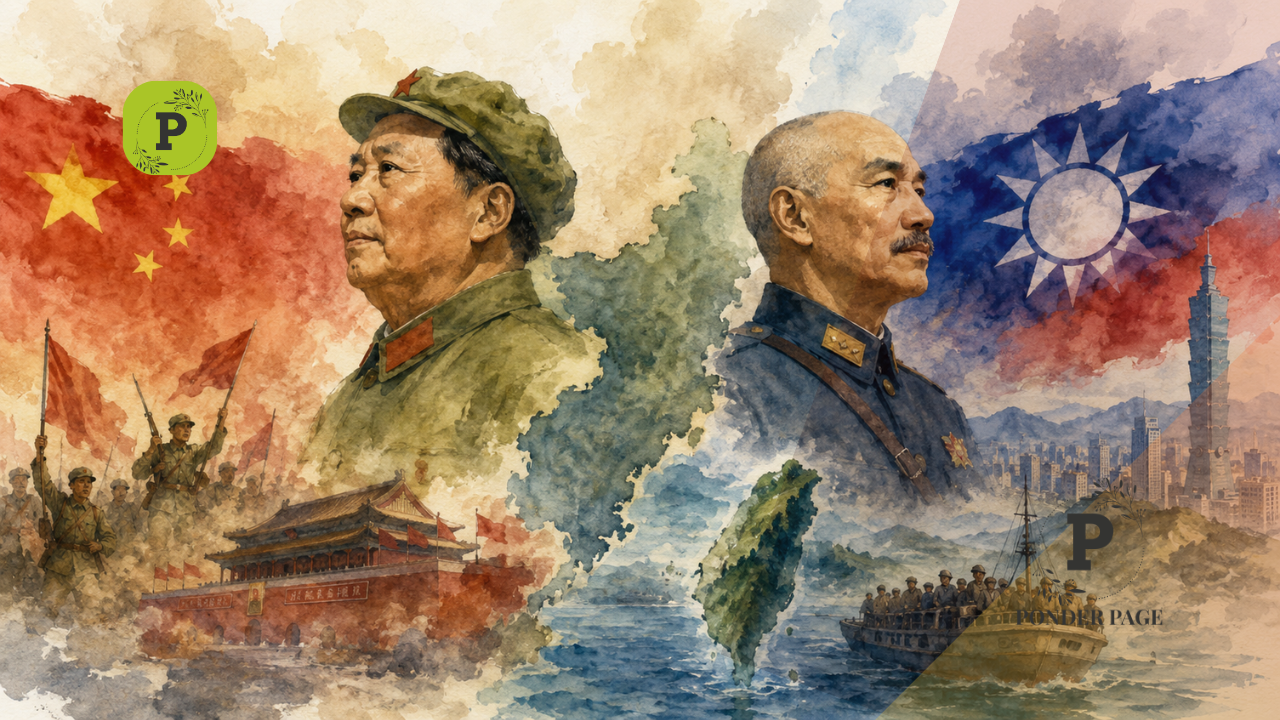
China vs Taiwan Explained: To understand the modern tensions between China and Taiwan, it is important to step back into history. The roots of this issue go far beyond present-day politics and military tensions. The story begins during a time when the global balance of power was changing rapidly, empires were collapsing, and nations were struggling to redefine themselves.
(You can now subscribe to our Ponder Page WhatsApp channel)

Table of Contents
The Decline of European Colonial Power
In 1927, European colonialism was still at its strongest point. Powerful nations such as Britain, France, and others controlled vast territories across Asia, Africa, and the Middle East. However, the aftermath of World War One weakened many imperial powers economically and politically. Across different parts of the world, anti-colonial movements began gaining strength.
As European influence slowly started retreating from regions like the Middle East and China, political instability increased. Old systems were collapsing, but new political structures had not yet fully emerged. This created power struggles in several countries, and China became one of the most significant examples of this transition.
China Descends Into Civil War
During this period of instability, China entered a long and devastating civil war that would shape the future of East Asia. The conflict began in 1927 and continued for nearly 22 years.
The war was fought between two major political forces with completely different visions for China’s future.
On one side stood the Communist Party of China (CCP), led by Mao Zedong. The communists aimed to establish a socialist state inspired by revolutionary ideology and supported largely by peasants and workers.
On the other side was the Kuomintang (KMT), also known as the Nationalist Party, led by Chiang Kai-shek. The KMT officially represented the government of the Republic of China and believed in a nationalist vision for the country.
The civil war was not a simple military conflict. It involved shifting alliances, internal rebellions, foreign invasions, and widespread suffering among civilians. The situation became even more complicated during the Second World War when Japan invaded China. For a temporary period, both the communists and nationalists united against the Japanese invasion. But once World War Two ended, the civil war resumed with full intensity.
The Communist Victory in 1949
After decades of conflict, Mao Zedong’s communist forces emerged victorious in 1949. The Communist Party gained complete control over mainland China and established a new government.
On October 1, 1949, Mao officially proclaimed the formation of the People’s Republic of China (PRC) in Beijing. This marked one of the most significant political transformations of the twentieth century.
The victory of the communists completely changed China’s political direction. The country shifted toward a centralized communist system under the leadership of the CCP.
Chiang Kai-shek’s Escape to Taiwan
While the communists took control of mainland China, Chiang Kai-shek and the nationalist government were forced to retreat. Chiang fled the mainland along with members of his government, military forces, financial reserves, national treasures, and millions of supporters.
They relocated to an island off the southeastern coast of China – the island now known globally as Taiwan.
From Taiwan, Chiang Kai-shek continued to claim that his government remained the legitimate government of all China. This created a unique and unusual situation in global politics.

The Emergence of Two Chinas
Since 1949, two separate governments have existed, each claiming legitimacy.
The first is the People’s Republic of China (PRC), which governs mainland China under the Communist Party.
The second is the Republic of China (ROC), based in Taiwan.
Although Taiwan is commonly referred to as a separate island nation, its political status remains one of the most sensitive and disputed issues in international relations. Taiwan has its own constitution, democratic government, military, currency, and political system. In practice, it functions independently.
Over time, Taiwan transformed itself into one of Asia’s most advanced economies. Despite its relatively small population of around 23 million people, Taiwan became a global leader in technology, manufacturing, and semiconductor production.
Today, Taiwan’s economy is valued at nearly one trillion dollars, making it one of the largest economies in the world.
Why Most Countries Do Not Officially Recognize Taiwan
Despite operating as a self-governing entity, Taiwan faces major diplomatic challenges. Only a small number of countries formally recognize Taiwan as an independent nation.
The primary reason lies in China’s “One China” policy. The government of the People’s Republic of China considers Taiwan to be part of its territory and strongly opposes any international recognition of Taiwanese independence.
Because China is one of the world’s largest economies and most influential global powers, many countries avoid formally recognizing Taiwan in order to maintain diplomatic and economic relations with Beijing.
As a result, Taiwan exists in a unique international position. It maintains strong trade relations and unofficial partnerships with many countries, yet formal diplomatic recognition remains limited.


China vs Taiwan Explained: A Conflict That Still Shapes Global Politics
The division between China and Taiwan is not just a historical issue. It continues to influence global politics, international trade, military strategy, and diplomacy even today.
What began as a civil war nearly a century ago eventually created one of the most complex geopolitical disputes in the modern world. The story of China and Taiwan reflects how historical conflicts can continue shaping international relations for generations.
What are your thoughts on this article? Let us know in the comments below. If you enjoyed this article, be sure to subscribe for more engaging content in the future! Stay updated on the latest developments and discussions by clicking the subscribe button above. Thank you for your support!
📢 Dive into the latest discussions on social & trending topics! 🌍💬 Subscribe to Ponder Page for thought-provoking articles and interviews that dissect current issues. Don’t miss out on insightful content—hit that like & subscribe button now!




Leave a Reply