
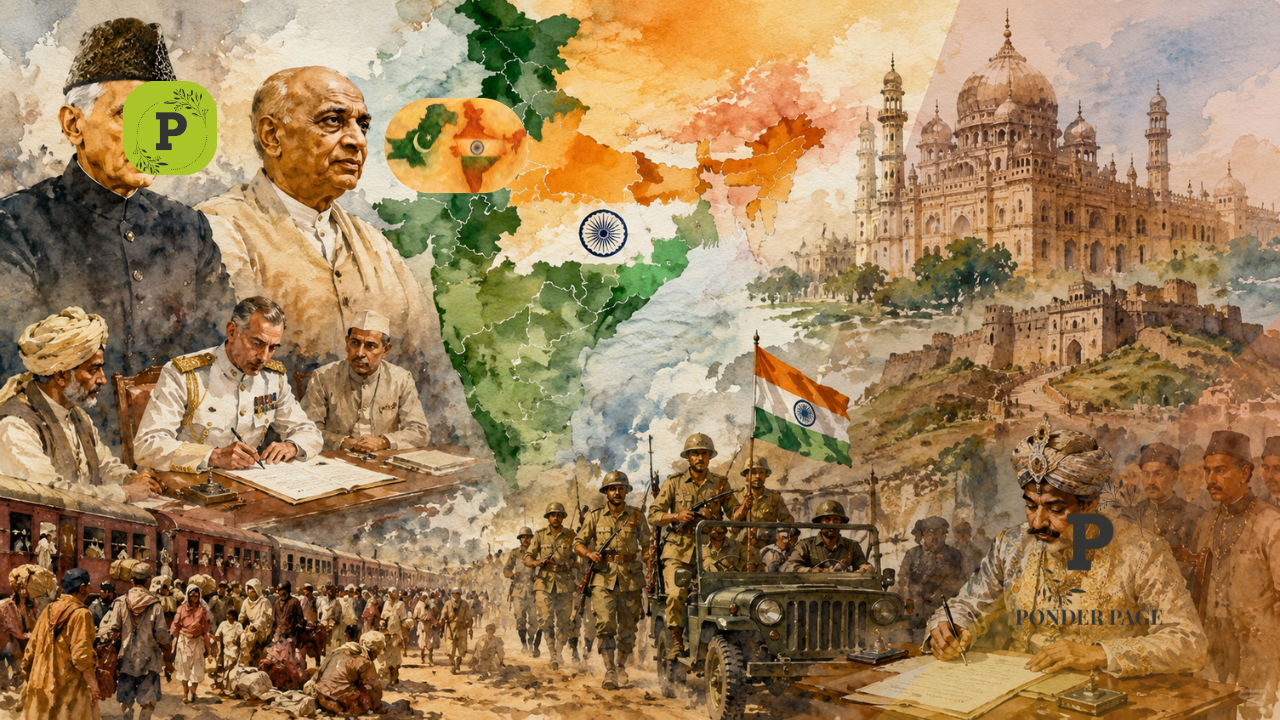
How India Integrated Junagadh and Hyderabad After Partition in 1947: When the British Empire decided to leave India in 1947, the future of the subcontinent stood at a turning point. Along with independence came one of the most dramatic political reorganizations in modern history – the Partition of India.
While the division between India and Pakistan is widely known, the intense struggle over princely states such as Junagadh, Hyderabad, and Jammu & Kashmir shaped the future borders of both nations in ways that still influence South Asia today.
(You can now subscribe to our Ponder Page WhatsApp channel)

Table of Contents
The Mountbatten Plan and the Division of British India
On 2 June 1947, the British government introduced the famous Mountbatten Plan. The main idea behind this plan was the division of British India into two separate countries based largely on Hindu and Muslim majority regions. Areas with a Muslim-majority population would form Pakistan, while Hindu-majority regions would become part of India.
However, one very important aspect of this plan is often overlooked. The Partition only applied to British-controlled territories. More than 560 princely states that existed across the subcontinent were not automatically included in either India or Pakistan.

These princely states were given three choices. They could join India, join Pakistan, or remain independent if they wished. This decision placed enormous political power in the hands of local rulers at one of the most sensitive moments in history.
On 18 July 1947, the British Parliament passed the Indian Independence Act of 1947, officially implementing the Partition plan. Bengal was divided into East Bengal and West Bengal, with East Bengal becoming part of Pakistan. Punjab was also split, with West Punjab going to Pakistan. Sindh and Baluchistan were included in Pakistan as well, while the remaining territories of British India became part of India.
Pakistan officially came into existence on 14 August 1947, followed by India’s independence on 15 August 1947.

The Complex Reality of the Princely States
While maps may make the division appear straightforward, the reality was far more complicated. Across the subcontinent, hundreds of princely states varied in size, wealth, military strength, and political influence. Many rulers were uncertain about which country to join, while others dreamed of remaining independent.
The process of integrating these states was led by two powerful political camps. On India’s side, Sardar Vallabhbhai Patel took charge of convincing rulers to join India. On Pakistan’s side, Muhammad Ali Jinnah worked to bring states into Pakistan’s fold.
The process was neither peaceful nor easy. Some rulers were persuaded through negotiations and political assurances, while others faced immense pressure. Whenever a princely state agreed to join either nation, the ruler signed a legal document known as the Instrument of Accession.
Most princely states eventually settled their status, but three major regions became highly controversial: Junagadh, Hyderabad, and Jammu & Kashmir.
Why Junagadh, Hyderabad, and Kashmir Became Major Disputes
These three princely states created a unique political problem because the religion of the rulers did not match the majority population in their territories.
In Junagadh and Hyderabad, Muslim rulers governed states where the majority of the population was Hindu. In Jammu & Kashmir, the situation was reversed. The ruler was Hindu, while the majority population was Muslim.
This created intense political arguments between India and Pakistan. Both countries used different interpretations of Partition principles to justify their claims.
Pakistan argued that Muslim-majority regions naturally belonged to Pakistan. India argued that princely states had the legal right to choose their future regardless of religion and emphasized its vision of a secular nation.
The Junagadh Crisis
The ruler of Junagadh was Nawab Muhammad Mahabat Khanji III. His administration included a Diwan named Shah Nawaz Bhutto, who had strong political leanings toward Pakistan. Interestingly, Bhutto himself was from Karachi and not originally connected to Junagadh.
As discussions intensified after independence in August 1947, the Nawab of Junagadh decided that his state would join Pakistan. On 15 September 1947, Junagadh officially signed the Instrument of Accession with Pakistan.
This decision angered Indian leaders, especially Sardar Vallabhbhai Patel. Indian leaders argued that if Partition was based on religious majorities, then a Hindu-majority state joining Pakistan contradicted the very logic behind Partition.
At the same time, Pakistan countered by arguing that Jammu & Kashmir, with its Muslim-majority population, should therefore belong to Pakistan.
The situation grew even more complicated when two smaller princely states under Junagadh, Mangrol and Babariawad, decided to join India instead. India responded by moving troops around Junagadh and effectively surrounding the state to block outside support and supplies.
Facing mounting pressure, the Nawab fled to Pakistan. Eventually, it was decided that the people of Junagadh themselves would determine the state’s future through a plebiscite.
On 20 February 1948, the referendum was held, and approximately 99.95% of votes favored joining India. Following this result, Junagadh officially became part of India.
Hyderabad and the Dream of Independence
At the same time, another major political crisis was unfolding in Hyderabad. The state was ruled by Mir Osman Ali Khan, one of the wealthiest rulers in the world at the time.
Although Hyderabad had a Hindu-majority population, the Nizam preferred independence. If independence proved impossible, he leaned toward maintaining close relations with Pakistan.
However, Hyderabad’s geographical location created a major strategic issue. The state was situated in the middle of Indian territory. Indian leaders believed that an independent or Pakistan-aligned Hyderabad inside India’s borders would become a serious security threat.
To avoid immediate conflict, Hyderabad signed a Standstill Agreement with India. The agreement essentially maintained the existing situation for one year while negotiations continued.
During this period, tensions increased sharply. The Nizam reportedly opened discussions with Pakistan and strengthened a private militia known as the Razakars. This armed group supported the idea of an independent Hyderabad and became increasingly aggressive. Reports of violence, border raids, and attacks on civilians created widespread instability in the region.
As the crisis worsened, the Indian government decided to intervene militarily. While Jawaharlal Nehru was initially hesitant about military action, Sardar Vallabhbhai Patel strongly supported intervention.
India launched a military operation known as Operation Polo in September 1948. Within a few days, Indian forces gained control of Hyderabad. Following the operation, the Nizam signed the Instrument of Accession, officially integrating Hyderabad into India.


How India Integrated Junagadh and Hyderabad After Partition in 1947 | A Defining Chapter in South Asian History
The integration of princely states was one of the most critical and challenging tasks faced by newly independent India and Pakistan. Behind the official agreements were political negotiations, military pressure, ideological clashes, and deep communal tensions.
The stories of Junagadh, Hyderabad, and Jammu & Kashmir reveal how complicated the Partition truly was. The decisions made during those turbulent years shaped the political geography of South Asia and left behind issues that continue to influence regional politics even today.
The Partition was not just about drawing borders on a map. It was a struggle over identity, sovereignty, power, and the future of millions of people living through one of the largest migrations and political transformations in human history.
What are your thoughts on this article? Let us know in the comments below. If you enjoyed this article, be sure to subscribe for more engaging content in the future! Stay updated on the latest developments and discussions by clicking the subscribe button above. Thank you for your support!
📢 Dive into the latest discussions on social & trending topics! 🌍💬 Subscribe to Ponder Page for thought-provoking articles and interviews that dissect current issues. Don’t miss out on insightful content—hit that like & subscribe button now!



Leave a Reply