
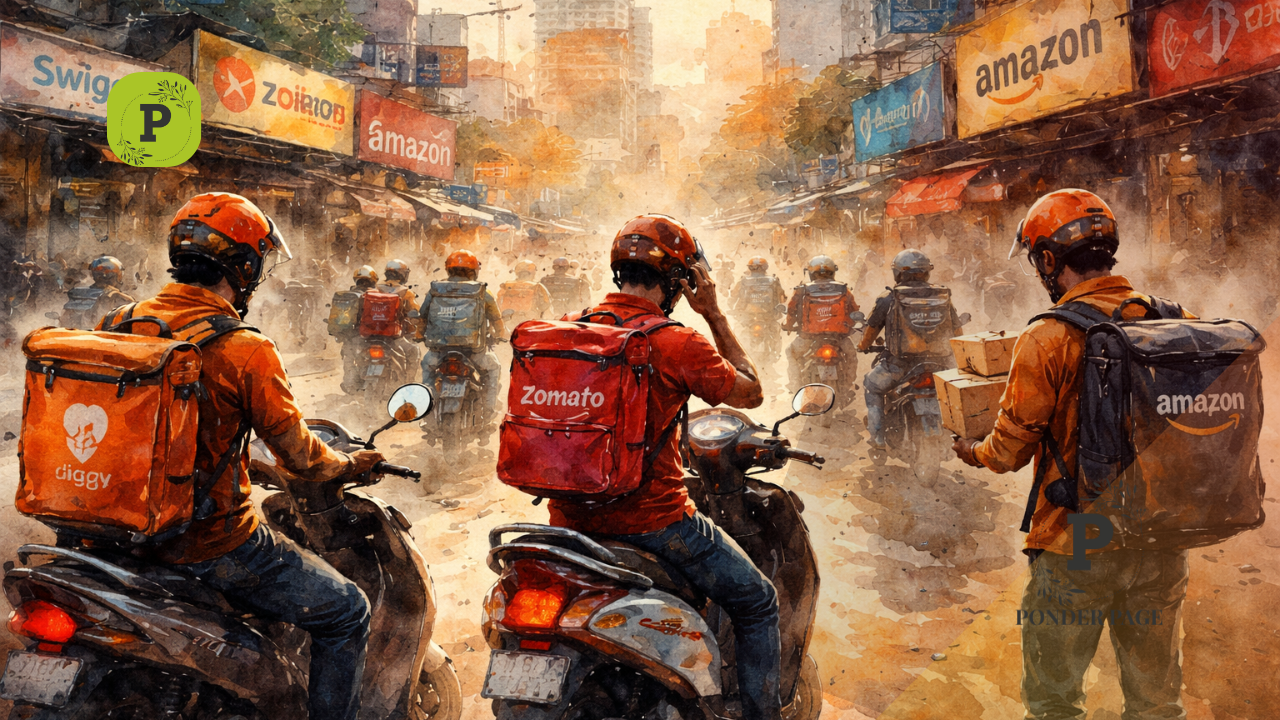
Is the Gig Economy Truly Fair? A silent conflict has been unfolding across India for years, but in recent times it has become impossible to ignore. This is not a war fought with weapons, but with livelihoods, algorithms, and power imbalance. On one side stand large technology-driven platforms. On the other stands a rapidly growing army of gig economy workers who keep these platforms running every single day.
This struggle is not new. It has existed since the early days of platform-based work. However, the scale at which it surfaced during the recent festive season made it visible to everyone. The coming years, particularly around 2026–27, are likely to witness this confrontation intensifying even further.
(You can now subscribe to our Ponder Page WhatsApp channel)

Table of Contents
The Rise of the Gig Workforce as a Community
Delivery partners working for platforms like Amazon, Swiggy, Zomato, Flipkart, Blinkit, Instamart and others are no longer a scattered workforce. They now form a massive and interconnected community across cities and towns. These workers are beginning to recognise their collective strength and are increasingly raising their voices for basic rights and dignity.
Their core allegation is simple but serious. They believe that large technology platforms are misusing their dominant position. Earnings are declining, incentives are shrinking, working conditions remain harsh, and accountability mechanisms are weak or non-existent.
This dissatisfaction came to a head during Christmas and New Year, when order volumes peak. Delivery partners attempted to organise industrial action on those days, hoping that collective pressure would force platforms to listen.
The Controversy Around the Strike and Its Aftermath
The reaction from platform leadership sparked widespread debate. The founder of Zomato publicly described the protesting workers as troublemakers and claimed that delivery volumes had reached record highs, suggesting that the strike had failed.
Worker unions, particularly in Telangana, strongly disputed this version. They alleged that platforms had taken the help of administrative authorities and law enforcement to break the strike. What escalated public outrage further was the public thanking of police forces by a company CEO.
This raised an uncomfortable question. Why was law enforcement machinery involved in a dispute between private platforms and workers demanding fair treatment? The moment delivery workers began talking about unions and collective bargaining, the conflict crossed from business into governance and civil rights.
Is the Gig Economy Truly Fair? The Question!
One of the most controversial claims made during this debate was that if the system were unfair, people would simply not work in it. This argument ignores a harsh reality. Numerous studies show that most people enter gig work not by choice but by necessity. When stable employment options disappear, temporary work becomes survival.
Many observers compared this structure to a modern form of feudalism, where platforms claim credit for “providing work” while offering minimal protection and extracting maximum output. The term “techno-feudalism” began circulating, capturing the sense that digital power has replaced traditional landlords.
What Gig Workers Are Actually Demanding
The demands raised by gig workers are not extraordinary. They speak of lack of access to basic facilities like toilets and elevators. They point out the absence of social security, job stability, and fair wages. Platform deactivation can occur without explanation, effectively cutting off a worker’s income overnight.
A common grievance is unpaid waiting time. Workers may remain logged into an app for hours without receiving orders, yet only active deliveries are paid. Surveillance and tracking through mobile applications are extensive, often justified in the name of safety but experienced as constant monitoring.
In some platforms, even minor discrepancies in inventory tracking or procedural compliance can result in account suspension. The balance of power heavily favours platforms, leaving workers with little recourse.
The Government’s Role and the Larger Employment Question
Traditionally, the role of the government in labour disputes is to mediate and find middle ground. However, in this case, there is widespread confusion about the government’s position. On one hand, gig work is being projected as evidence of employment generation. On the other, workers are forced to strike just to demand a minimum delivery fee of ₹20 per order.
This raises a deeper question. Can gig work even be counted as employment in the traditional sense? Or is it merely a temporary coping mechanism masking a much larger failure in job creation?
The Data That Reveals an Uncomfortable Truth
In response to criticism, Zomato’s founder shared extensive data on earnings and work patterns. According to these figures, average earnings per hour rose modestly year-on-year. Theoretically, a delivery partner working long hours across most days of a month could earn an amount comparable to an entry-level IT salary, even after accounting for fuel and maintenance costs.
However, theory and reality diverge sharply. The same data revealed that the average delivery partner worked only 38 days in an entire year. Only a tiny fraction of workers were active for more than 250 days annually. This admission alone confirms that gig work is not full-time employment for most participants.
These numbers also highlight excess labour supply. Many workers want to work more but cannot find enough orders. This surplus ensures that platforms face little pressure to raise pay rates.
Gig Work as Secondary Income, Not Job Creation
The data made one thing clear. Gig work is designed as supplemental income, not stable employment. This directly contradicts political narratives celebrating the gig economy as a job creation engine.
If the majority of gig workers had stable primary employment elsewhere, this system might appear reasonable. But if gig work is becoming the primary income source for millions, it reflects the deep weakness of India’s labour market.
The responsibility for this situation cannot rest solely on private platforms. They operate within economic realities shaped by policy, industrial strategy, and governance.
Cheap Labour and Shared Responsibility
The truth is uncomfortable but unavoidable. Cheap labour benefits everyone. Platforms lower costs, consumers enjoy convenience, and policymakers avoid confronting unemployment. Even consumers contribute by prioritising lower prices over fair wages.
If delivery services suddenly became expensive, many users would simply stop ordering. This reality forces an honest reckoning about shared responsibility.
Lessons from Other Sectors and Countries
India’s IT sector, once celebrated for transforming the economy, also reveals similar contradictions. Entry-level salaries have stagnated for decades while top management compensation has soared. Manufacturing ambitions failed to absorb the workforce. Deindustrialisation pushed people back into agriculture or informal labour.
Globally, countries like Australia have introduced legislation recognising gig workers and ensuring minimum pay and welfare standards. However, India faces a unique challenge. Over-regulation could crush fragile businesses, while under-regulation allows exploitation to continue unchecked.
What Can Actually Be Done
Public pressure matters. When citizens question powerful companies, welfare considerations enter boardroom discussions. Transparency forces accountability. Other platforms must also publicly disclose how they treat their workers.
The government must act carefully but decisively, balancing worker protection with industry sustainability. Legislation should recognise gig workers without strangling innovation.
Equally important is individual responsibility. Fair treatment should begin at home. Respect domestic workers, drivers, delivery partners and service staff. Small gestures, fair pay and basic courtesy matter.
The Reality of Tipping and Social Attitudes
One striking insight from shared data was how poorly Indian consumers tip. Only a small fraction of orders include tips, and average tipping amounts are negligible. This reflects a broader cultural reluctance to pay for services beyond the minimum.
Convenience has become an entitlement rather than a privilege, further squeezing those at the bottom of the system.


Is the Gig Economy Truly Fair? The Hard Truth About the Gig Economy
At its core, the gig economy in India is not a symbol of progress. It is a reflection of desperation. It exists because stable employment opportunities are insufficient. People accept deliveries for ₹30 not because it is empowering, but because alternatives are scarce.
This is not a system to celebrate. It is a warning sign. Until meaningful employment is created, gig work will continue to expand, not as a choice, but as a necessity.
What are your thoughts on this article? Let us know in the comments below. If you enjoyed this article, be sure to subscribe for more engaging content in the future! Stay updated on the latest developments and discussions by clicking the subscribe button above. Thank you for your support!
📢 Dive into the latest discussions on social & trending topics! 🌍💬 Subscribe to Ponder Page for thought-provoking articles and interviews that dissect current issues. Don’t miss out on insightful content—hit that like & subscribe button now!





Leave a Reply