
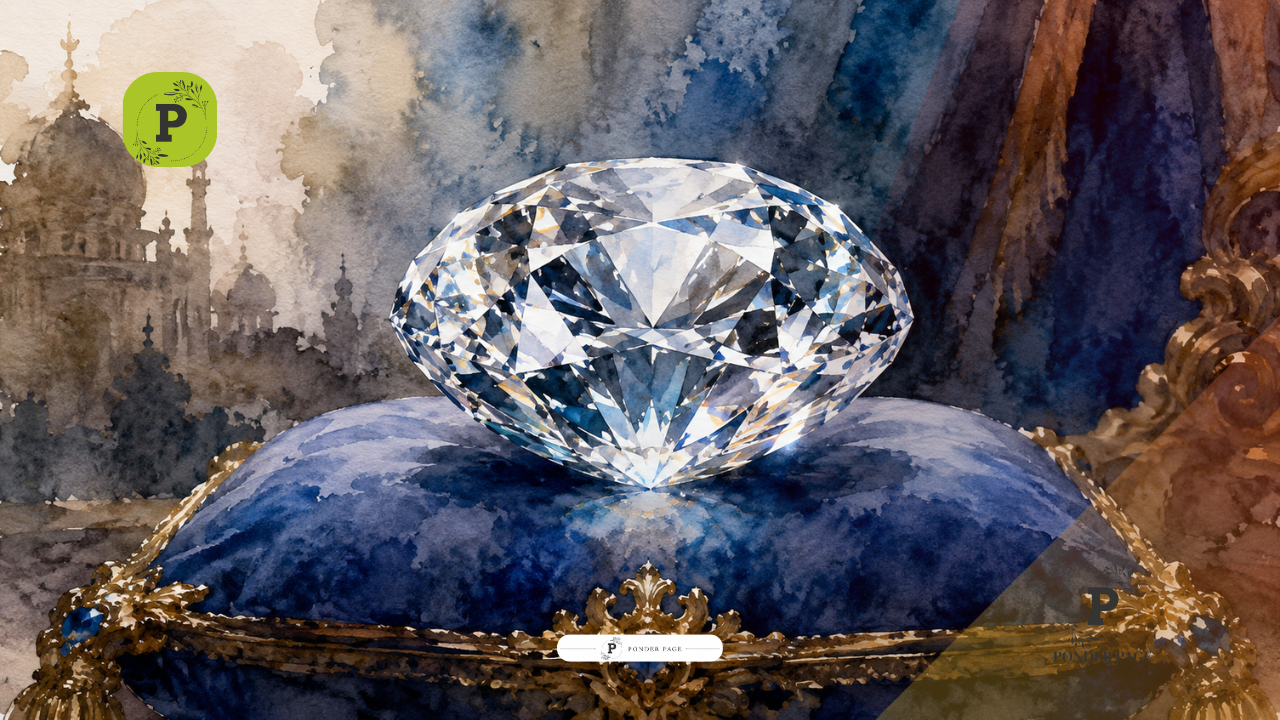
Kohinoor Diamond History: In the mid-19th century, the Sikh Empire was going through one of its most turbulent phases. After a series of conflicts, the British East India Company asserted dominance over the region, and a formal agreement was imposed that would change the course of history for one of the world’s most famous diamonds.
The Treaty of Lahore was signed under conditions that reflected the imbalance of power at that time. It is recorded that Maharaja Duleep Singh, who was only a child of around seven years, became the nominal signatory to this agreement. The treaty marked not just a political transition but also the transfer of valuable assets, among which the Koh-i-Noor diamond held extraordinary significance.
(You can now subscribe to our Ponder Page WhatsApp channel)

Table of Contents
Koh-i-Noor and Its Transfer of Control
Among the various clauses of the treaty, one of the most historically debated provisions concerned the Koh-i-Noor diamond. Through this agreement, the control of the diamond was formally transferred into British hands. Article III of the treaty is often cited in discussions about how ownership was recorded in official documents of that period.
The Koh-i-Noor, already surrounded by centuries of conquest, royal possession, and political symbolism, thus entered a new chapter. Its transfer was not merely symbolic; it represented the consolidation of imperial authority over the treasures of the former Sikh Empire.
A Ceremony of Formal Surrender
On 7 December 1849, a formal ceremony was held to mark the handover of the diamond. In this event, the Koh-i-Noor was presented to British officials, signifying its official possession by the British Crown.
Following this, plans were made to present the diamond as a gift to Queen Victoria. It was decided that the Koh-i-Noor would not just be stored as a treasure but would be reimagined as a royal symbol meant exclusively for the British monarchy. There was even an intention to frame its journey in a way that would enhance its mystique and historical appeal before it reached England.
Documenting the History of the Koh-i-Noor
Before the diamond could be transported, British officials considered it important to compile a detailed historical account of its origin and journey. Lord Dalhousie, who was serving as Governor-General, assigned the task of preparing an authoritative report on the Koh-i-Noor’s background.

An assistant magistrate was entrusted with gathering verified information, including its early mining origins, its passage through different rulers, and its association with figures such as Nadir Shah. Alongside historical facts, there were also popular narratives circulating at the time about the diamond being associated with misfortune and political downfall.
These stories, whether factual or embellished, added to the growing fascination around the Koh-i-Noor in both India and Britain. Newspapers in England began publishing accounts of the diamond’s dramatic past, turning it into a subject of widespread public curiosity.
The Journey from Lahore to England
The physical transfer of the Koh-i-Noor began in early 1850. It was first moved from Lahore Fort to Bombay under tight security arrangements. From there, it was prepared for its sea voyage to England.
On 6 April 1850, the diamond was placed aboard a British Royal Navy vessel. To ensure safety and secrecy, it was kept inside a locked box. The box was secured with a dual-key system, with responsibility shared between officers on board. This arrangement was designed to prevent any unauthorized access during the long journey.
Despite these precautions, the voyage was far from smooth. Accounts from the journey describe a series of difficulties, including an outbreak of illness on the ship. Cholera reportedly spread among the crew, leading to fatalities and forcing the ship to make an emergency stop at Mauritius for medical assistance and recovery.
After resuming its journey, the vessel encountered rough weather and additional maritime challenges. Despite these setbacks, it eventually reached Portsmouth in England on 2 July 1850.
Arrival in England and Public Fascination
The arrival of the Koh-i-Noor in England created a wave of excitement. Newspapers closely followed every development, and public anticipation grew rapidly. The diamond was no longer just a distant treasure; it had become a national topic of discussion.
On the very same day the Koh-i-Noor arrived, Britain also witnessed significant political and social events. The sudden death of Prime Minister Robert Peel in an accident added to the atmosphere of uncertainty and public emotion. Around the same period, Queen Victoria herself was involved in an incident during travel, which further fueled public speculation.
These coincidences led to rumors and interpretations among sections of the public, with some associating the diamond’s arrival with misfortune. Such beliefs contributed to the growing aura of mystery surrounding the Koh-i-Noor.
Presentation to Queen Victoria
On 3 July 1850, the Koh-i-Noor was formally presented to Queen Victoria. The handover was conducted by the President of the Board of Control, marking its official entry into the British royal collection.
At the time of receiving the diamond, Queen Victoria is described in historical accounts as being personally curious about its appearance and craftsmanship. However, the original cut of the diamond was not considered particularly impressive by European standards of the period.
This led to the decision to recut and reshape the stone in order to enhance its brilliance and visual appeal.
Recutting and Transformation of the Diamond
The task of recutting the Koh-i-Noor was assigned to David Brewster, a well-known figure in the field of optics and experimental science. He worked on improving its symmetry and brilliance, a process that significantly altered its original form.
The recutting process reduced the weight of the diamond substantially. After reshaping, it weighed approximately 105.6 carats, equivalent to about 21.12 grams. While the new cut enhanced its sparkle, it also permanently changed the historical form of the gem.
The Koh-i-Noor in the British Crown
In the years that followed, the Koh-i-Noor became deeply associated with the British royal family. After the death of Prince Albert in 1861, new beliefs and interpretations emerged around the diamond’s supposed influence. A popular notion developed that it was safer for female members of the royal family to wear it than male heirs.
As a result of these beliefs and royal tradition, the Koh-i-Noor was eventually set into the crown worn by Queen Victoria. It became part of the symbolic regalia associated with the British monarchy, particularly reserved for queens and female consorts.
Even in later years, the diamond remained a central feature of royal crowns, continuing to attract global attention and debate.


Kohinoor Diamond History | Legacy of the Koh-i-Noor
Today, the Koh-i-Noor remains one of the most discussed and contested gemstones in the world. Its journey from the Indian subcontinent to the British Crown is deeply intertwined with colonial history, political treaties, and cultural memory.
Beyond its physical beauty, the diamond represents complex historical narratives involving power, ownership, and identity. Its story continues to be revisited, analyzed, and interpreted from multiple perspectives across the world.
What are your thoughts on this article? Let us know in the comments below. If you enjoyed this article, be sure to subscribe for more engaging content in the future! Stay updated on the latest developments and discussions by clicking the subscribe button above. Thank you for your support!
📢 Dive into the latest discussions on social & trending topics! 🌍💬 Subscribe to Ponder Page for thought-provoking articles and interviews that dissect current issues. Don’t miss out on insightful content—hit that like & subscribe button now!



Leave a Reply