
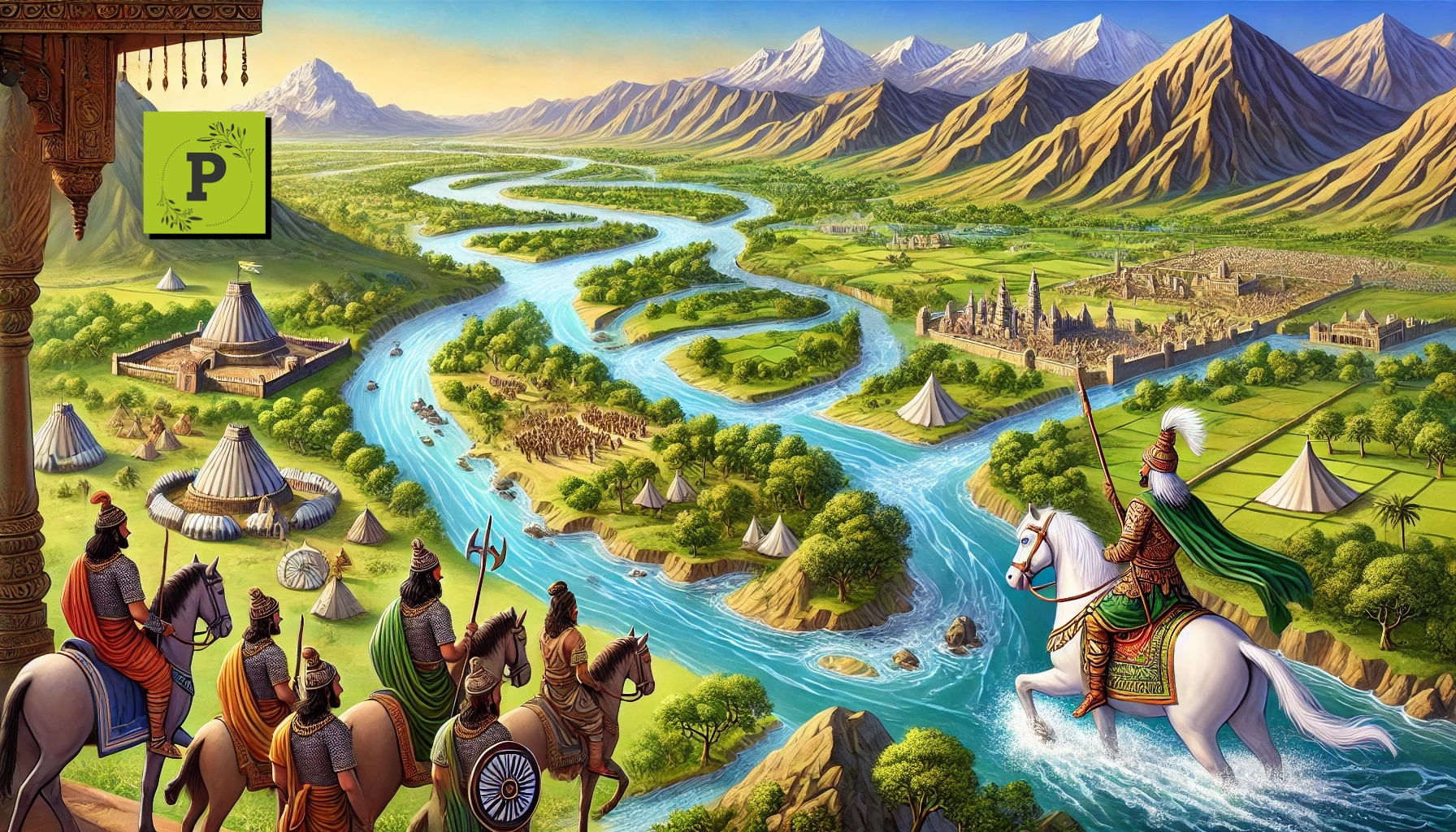
The Story of India, Bharat, and Sapta Sindhu: The Sindhu River, historically and culturally significant, originates in Tibet, flows through Pakistan, and merges into the Arabian Sea. Along with it, five rivers—Jhelum, Chenab, Ravi, Beas, and Sutlej—converge to form the Sindhu River. Saraswati Rivir also merges. This region was historically referred to as Sapta Sindhu, which also included areas around modern-day Haryana and Punjab.
According to the Rigveda, the Sapta Sindhu region was a confluence of seven rivers, repeatedly mentioned in Vedic literature. The historical and cultural importance of this region is evident as it was the center of many great stories and empires of ancient India.
(You can now subscribe to our Ponder Page WhatsApp channel)

Table of Contents
Sapta Sindhu and the Naming of Bharat
The Sapta Sindhu region was home to the Bharat tribe, a powerful and influential group during ancient times. Under the leadership of King Sudas, the Bharat tribe consolidated and strengthened this region.
The name “Bharat” originated from the Bharat tribe, while the name “India” emerged from the Sindhu River through foreign linguistic influences.
The Battle of Ten Kings
Around the 14th century BCE, a significant event occurred in the Sapta Sindhu region known as the “Battle of Ten Kings.” This battle was fought between the Bharat tribe and an alliance of ten other tribes.
Fought near the Ravi River, the Rigveda narrates how King Sudas led the Bharat tribe to a decisive victory against the alliance. Following this triumph, the Bharat tribe expanded eastward, conquering additional territories and establishing a vast empire.

Ashvamedha Yajna and Imperial Expansion
After the victory, King Sudas performed the Ashvamedha Yajna, a ritual symbolizing power and territorial expansion. In this ritual, a white horse was set free to roam, and the regions it traversed were claimed by the king. Any ruler opposing the claim had to battle the king’s forces.
This yajna significantly enhanced the influence and prestige of the Bharat tribe. The Bharat rulers, instead of imposing their traditions on conquered tribes, embraced their cultural and religious practices. This inclusive approach led to the integration of diverse traditions and the creation of the Vedas.
From Sapta Sindhu to Sapta Hindu to India
Over time, the name of the Sapta Sindhu region evolved. When the Persian civilization referred to this area, they pronounced “S” as “H,” leading to the term “Hapta Hindu.”
Later, the Greek civilization adopted this term but struggled with the pronunciation of “H” and “U.” As a result, “Hapta Hindu” became “Indos.” From “Indos,” the Latin term “India” emerged.
Thus, both “Bharat” and “India” trace their origins to the Sapta Sindhu region and the Bharat tribe. These names were not given by outsiders but evolved through linguistic changes over time.

King Bharat and Bharatvarsha
From the Bharat tribe emerged the great King Bharat, who expanded his empire to include present-day Afghanistan, Pakistan, Bangladesh, Sri Lanka, Myanmar, and parts of Iran. This vast territory was known as “Bharatvarsha.” References to Bharatvarsha can be found in the Mahabharata and other ancient texts.


The Story of India and its Origin
The names “Bharat” and “India” are deeply rooted in the Sapta Sindhu region’s history and culture. They represent not just geographical locations but also the rich heritage and unity of ancient India. The evolution of these names—from Sapta Sindhu to Sapta Hindu, Hapta Hindu, Indos, and finally India—is a testament to the linguistic and cultural exchanges that shaped the identity of this land. The idea of India, as we know it today, originated from within its own borders and reflects the enduring legacy of the Bharat tribe.
What are your thoughts on this article? Let us know in the comments below.
If you enjoyed this article, be sure to subscribe for more engaging content in the future! Stay updated on the latest developments and discussions by clicking the subscribe button above. Thank you for your support!
📢 Dive into the latest discussions on social & trending topics! 🌍💬 Subscribe to Ponder Page for thought-provoking articles and interviews that dissect current issues. Don’t miss out on insightful content—hit that like & subscribe button now!




Leave a Reply