
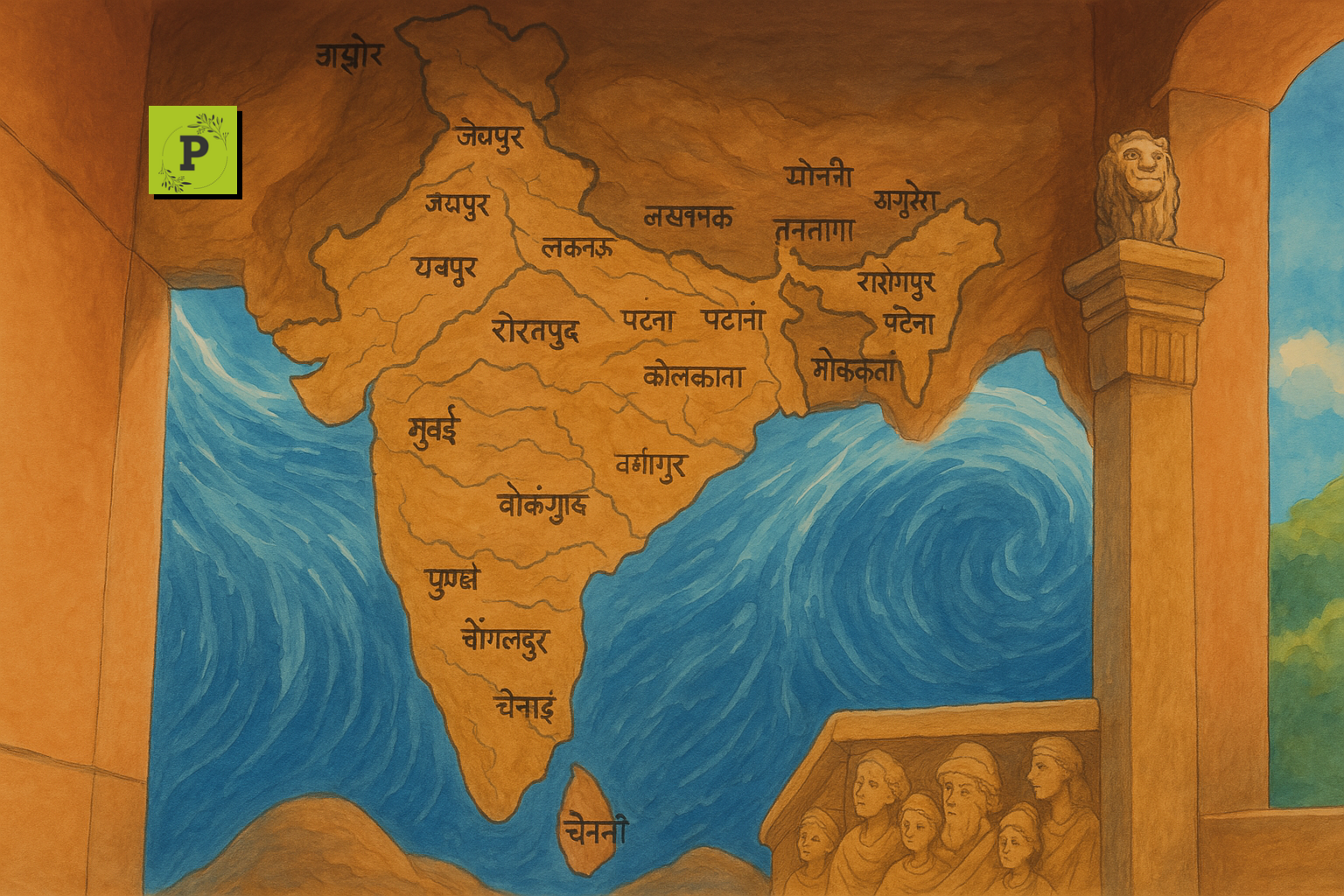
The Origin of the Names INDIA and BHARAT: The history behind the names India and Bharat is deeply rooted in the geography, culture, and ancient texts of the Indian subcontinent. Among the many narratives that exist, one story stands out for its historical depth and textual evidence found in ancient scriptures like the Rigveda. To understand this story, we must first travel back to the Vedic age.
(You can now subscribe to our Ponder Page WhatsApp channel)

Table of Contents
The Seven Rivers of the Vedic Land
The Sindhu River, known today as the Indus, originates in Tibet, flows through modern-day Pakistan, and eventually drains into the Arabian Sea. Along its journey, it gives rise to several tributaries — the Jhelum, Chenab, Ravi, Beas, and Sutlej. These rivers, along with the lost Saraswati River, together make up a group of seven rivers. This region, enriched by these rivers, was called Sapta Sindhu, meaning “land of seven rivers.”
This area roughly corresponds to parts of present-day Punjab and Haryana. While there are debates about the exact geographic boundaries of Sapta Sindhu, it is agreed that it was a culturally and strategically significant region in the early Vedic period.
The Bharata Tribe and the Birth of Bharat
This land of Sapta Sindhu was home to a tribe known as the Bharatas. Their most notable leader was King Sudas. The region they inhabited began to be referred to by the name of the tribe, giving rise to the term Bharat. The name Bharat, therefore, is both a tribute to the people and their homeland.
One of the most notable historical events involving the Bharata tribe was the famous Battle of Ten Kings, described in the seventh mandala of the Rigveda. In this epic conflict, the Bharata tribe, under King Sudas, faced a coalition of ten other tribes, including the Purus who came from the west. The battle occurred near the Ravi River, and despite being outnumbered, the Bharatas emerged victorious.
Following this victory, the Bharatas extended their influence eastward, defeating other tribes such as the Ajas, Sigrus, and Yakhsus. This marked the beginning of what could be described as the first known Indian empire, which became widely recognized under the name Sapta Sindhu, and the people were known collectively as Bharatas.

The Ritual of Ashvamedha and Cultural Integration
After consolidating power, the Bharata kings followed the ancient ritual of Ashvamedha Yagna, a ceremony described in the Yajurveda. In this ritual, a white horse was released to wander freely, accompanied by warriors. Any region the horse entered without resistance was considered conquered. If opposed, battles would ensue to assert dominance.
Unlike many conquerors who imposed their beliefs on the vanquished, the Bharatas under King Sudas took a different path. Instead of enforcing their traditions, they brought together the learned individuals from all the tribes — including the defeated ones — and combined their knowledge, spiritual practices, and customs. This collaborative cultural synthesis laid the foundation of what would eventually become the Vedas.
As a result, more and more tribes allied with the Bharatas. This inclusive approach led to rapid expansion of the empire, and the people of the region began to identify themselves as Bhartiya, or followers of the Bharata lineage, while the land continued to be known as Sapta Sindhu.
The Evolution from Sapta Sindhu to India
Foreign observers, however, had their own way of referring to this land and its people. The Persians, due to their linguistic limitations, pronounced ‘Sindhu’ as ‘Hindu’, since they often substituted the ‘S’ sound with an ‘H’. Thus, Sapta Sindhu became known in Persian texts as Hapta Hindu. This transformation is evident in ancient Iranian religious texts like the Avesta.
Over time, the term Hapta Hindu became simplified to Hindu, and the region came to be known as Hindustan by several cultures. When the Greeks adopted the term, they faced their own linguistic challenges. The Greek language lacked both the ‘H’ sound and the exact pronunciation of ‘U‘. As a result, ‘Hindu’ morphed into Indos, which later evolved into the Latin word India.
This progression—from Sapta Sindhu to Hapta Hindu to Indos and finally India—demonstrates how the modern name of the country was shaped through layers of foreign pronunciation and adaptation.

The Legacy of King Bharat and Bharatvarsha
There is another widely accepted historical account that complements this narrative. It speaks of a great king named Bharat, a descendant of the original Bharata tribe. He is remembered as one of the most successful rulers of the Kshatriya dynasty.
King Bharat is said to have unified vast regions, including what are today Afghanistan, Pakistan, Bangladesh, Sri Lanka, Myanmar, and parts of Iran, under a single rule. The land he ruled was referred to as Bharatvarsha, or “the land of Bharat”, emphasizing both the geographical unity and the cultural identity of his empire.
The Origin of the Names INDIA and BHARAT: The Real Meaning Behind India and Bharat
The twin names India and Bharat are not just arbitrary labels but carry centuries of history, legacy, and cultural richness. While India may seem like a name given by outsiders, its roots trace directly back to the land, people, and rivers that defined early Vedic civilization.
India emerged through a chain of mispronunciations and linguistic transformations by Persians and Greeks. Bharat, on the other hand, remained closer to the original identity of the people and their homeland. Both names, however, originate from the same source: the region of Sapta Sindhu and its noble tribe, the Bharatas.
So, the idea of India was not a colonial creation, nor was it named by outsiders in the true sense. Instead, it was the evolution of indigenous identity, shaped by time, language, and culture.


What are your thoughts on this article? Let us know in the comments below. If you enjoyed this article, be sure to subscribe for more engaging content in the future! Stay updated on the latest developments and discussions by clicking the subscribe button above. Thank you for your support!
📢 Dive into the latest discussions on social & trending topics! 🌍💬 Subscribe to Ponder Page for thought-provoking articles and interviews that dissect current issues. Don’t miss out on insightful content—hit that like & subscribe button now!




Leave a Reply