
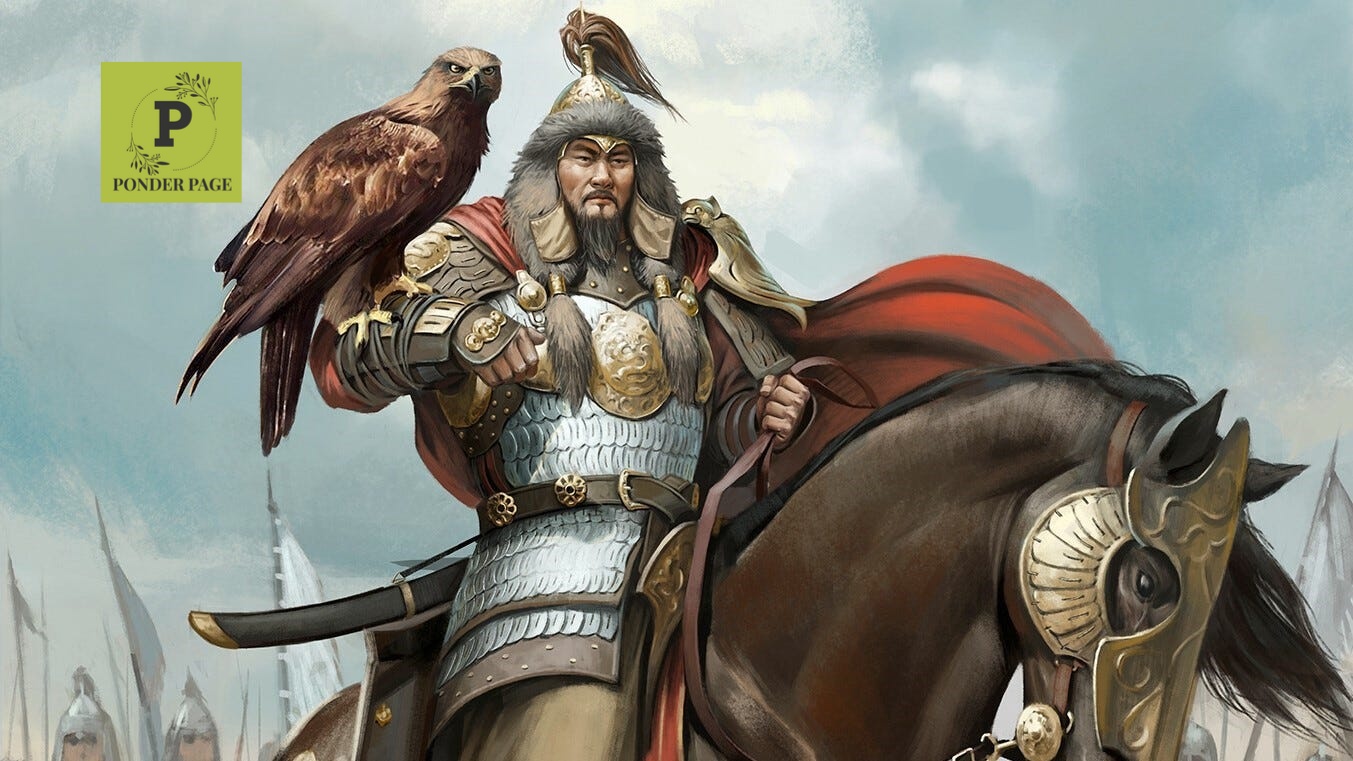
The Brutal Legacy of Genghis Khan: This article offers a fresh perspective on history, steering away from the usual retelling of events to focus on the compelling stories surrounding Genghis Khan. Through these narratives, readers are immersed in the depths of human ambition, witnessing how individuals, whether for noble or nefarious purposes, can drive themselves to extraordinary lengths. Exploring Genghis Khan’s life provides valuable insights into the resilience of the human spirit and the profound impact of unwavering determination, regardless of the ethical complexities involved.
(You can now subscribe to our Ponder Page WhatsApp channel)

Table of Contents
Genghis Khan’s Tale of Vengeance
The first tale harks back to Genghis Khan’s youthful years, a time when a seemingly inconsequential event left a lasting impact. At the tender age of 14, Genghis Khan found himself embroiled in a dispute over a fish he had caught, only to have it snatched away by his younger brother. What ensued was a chain of events marked by vengeance, culminating tragically in the untimely demise of his own sibling. This sobering account highlights the capacity within individuals, even at a young age, for acts of profound brutality. It prompts reflection on the trajectory of Genghis Khan’s life and the harrowing deeds that may have unfolded as he matured.
-
 How Ajit Doval Helped End the Mizoram Insurgency
 -
 Kohinoor Diamond History: The Diamond Taken by Treaty, Transformed by Empire, and Still Controversial Today
 -
 Operation Neptune Spear: The Secret Mission That Changed the World
 -
 Story Behind China and Taiwan: China vs Taiwan Explained
 -
 How India Integrated Junagadh and Hyderabad After Partition in 1947 | Operation Polo | Indian Independence Act of 1947 | Sardar Patel
The Aftermath of the Battle of Kalka River
In the historical records, the year 1223 holds significant importance, marking a pivotal juncture in the clash between the Mongols and the Russians—the Battle of Kalka River. During this confrontation, Genghis Khan’s forces emerged victorious over the Russian army, subsequently gaining control over their cities. Faced with the formidable strength of Genghis Khan, Russian generals and leaders swiftly surrendered, acknowledging Mongol supremacy. However, the true narrative unfolded in the aftermath of this decisive victory.

Following the triumph on the battlefield, a sense of jubilation permeated through the ranks of Genghis Khan’s army, leading to elaborate celebrations. At the heart of these festivities stood a monumental wooden gate, beneath which the captured Russian dignitaries were positioned. While Mongol warriors reveled in merriment, partaking in libations and feasting, their Russian counterparts endured a grim ordeal, trapped beneath the weight of the gate—a somber reminder of the harsh realities accompanying conquest.
The Ruthless Conquests of Genghis Khan: The Sacking of Murg and Neyshabur
In February 1221, Genghis Khan launched an attack on the city of Murg, known as the City of the Fortress. In this assault, Genghis Khan ordered his soldiers to kill every single one of the city’s inhabitants, numbering around 300. Reflecting on the magnitude of this attack, a prominent historian wrote that during the time of Genghis Khan’s campaign, his army slaughtered more than 1.3 million people.
Merely two months after this incident, in April 1221, Genghis Khan attacked the city of Neyshabur. In this assault, Genghis Khan spared not even a single creature, not even dogs or cats. The Mongol army, under the command of Genghis Khan, launched an attack on Neyshabur, located in what is now Iran. Genghis Khan’s direct order for this attack was to leave no one alive in Neyshabur.
Consequently, the Mongol army bombarded the city with large stones and fireballs, reducing it to rubble. Within just an hour, Genghis Khan’s forces mercilessly slaughtered approximately 1,748,000 people. Not stopping at this horrific act, the Mongols piled the heads of the slain into pyramids, with one pyramid for men, one for women, and one for children’s skulls.

Genghis Khan’s Mysterious Death and Burial
According to Mongolian tradition, if a ruler wished for secrecy surrounding their burial site upon their death, soldiers were prepared to do whatever it took to ensure this. Similarly, Genghis Khan harboured the desire for utmost secrecy surrounding his tomb. The exact reason for Genghis Khan’s death remains unknown to this day, but according to a History documentary, Genghis Khan fell ill for eight days before passing away due to his illness.
On August 18, 1227, Genghis Khan passed away. When it came time to bury him, his soldiers took extreme measures to ensure secrecy. Along the route to his burial site, they ruthlessly slaughtered all who crossed their path, be they human or animal, to prevent anyone from locating Genghis Khan’s dead body. When his body was finally transported to his realm for burial, 2000 people were invited to attend his funeral. Shockingly, these 2000 individuals were also mercilessly slain. To this day, the reasons behind their invitation and subsequent massacre remain a mystery, shrouded in uncertainty.

The Final Secrecy: The Mysterious End of Genghis Khan
So, Genghis Khan was laid to rest in that place. His soldiers ran a thousand horses over the ground to make it appear entirely regular, concealing any indication of the burial site’s significance. However, what followed was even more horrifying. Suddenly, a massive force of army emerged and killed the soldiers present. Subsequently, another army arrived and slaughtered the second snake. Then, yet another force of army appeared, which was also killed. In this macabre game, more than 40,000 soldiers were senselessly slain, and not a single person remained alive who knew the exact location of Genghis Khan’s tomb. This is how the most cruel king of history met his end.


The Brutal Legacy of Genghis Khan & its Conclusion
The story of Change Khan serves as a stark reminder of the darkest depths of human nature. His reign of terror, marked by unimaginable violence and oppression, stands as a testament to the capacity for cruelty within us all. As we reflect on history, let us not forget the forgotten chapters, the stories of those who wielded power with a heavy hand, leaving behind a legacy of bloodshed and fear.
If you enjoyed this blog post, be sure to subscribe for more engaging content in the future! Stay updated on the latest developments and discussions by clicking the subscribe button above. Thank you for your support!



Leave a Reply