
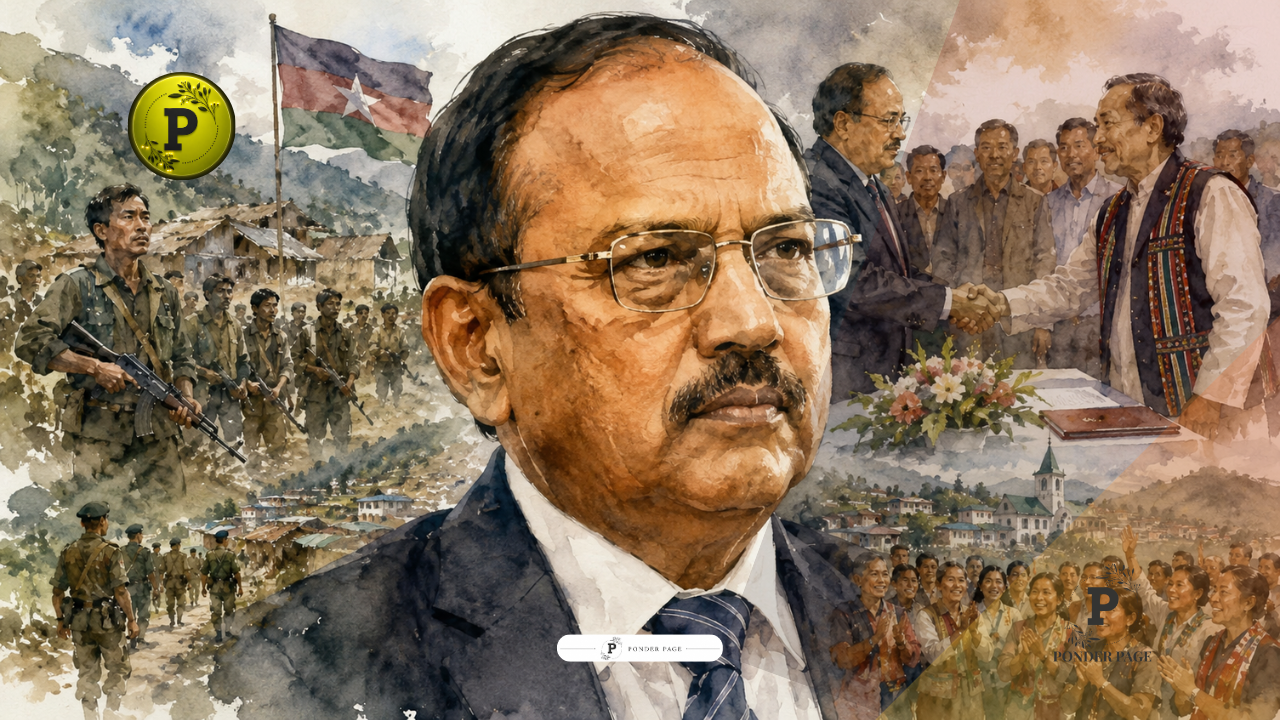
How Ajit Doval Helped End the Mizoram Insurgency: The history of Mizoram’s insurgency is one of the most fascinating and complex chapters in independent India. What began as a humanitarian crisis eventually evolved into a political movement, an armed rebellion, and ultimately a peace process that transformed the region. During this period, the Indian government faced one of its most difficult internal security challenges, as a significant portion of the local population sympathized with the insurgent movement.
Among the many figures associated with this chapter, Ajit Doval is often credited with playing a crucial role in weakening the insurgency through intelligence-based operations and negotiations. This article explores the origins of the conflict, the rise of the Mizo National Front (MNF), and the events that eventually led to peace.
(You can now subscribe to our Ponder Page WhatsApp channel)

Table of Contents
The Famine That Sparked Political Unrest
In the 1960s, Mizoram was not a separate state but a district within Assam. The region faced severe hardship following a devastating famine that affected thousands of residents. Many local people believed that the government’s response was inadequate and demanded compensation and greater support.
Amid growing dissatisfaction, a leader named Laldenga emerged as a prominent voice for the Mizo people. To address the crisis and advocate for local concerns, he established the Mizo National Famine Front (MNFF). Initially focused on relief efforts, the organization gradually evolved into a political movement. Eventually, it was renamed the Mizo National Front (MNF).
As public frustration increased, Laldenga gained widespread support by raising issues related to governance, economic neglect, and the rights of the Mizo people.
Language Policy and Growing Discontent
At the same time, another issue intensified tensions in the region. A policy associated with Assam’s administration created concerns among the Mizo population regarding employment opportunities and cultural identity. Many people believed that preference was being given to those proficient in the Assamese language for government jobs.
The MNF strongly opposed these developments and positioned itself as a defender of Mizo interests. As a result, support for the organization expanded rapidly among ordinary citizens.
The movement was no longer just about famine relief. It had become a broader struggle centered on political representation, identity, and regional autonomy.
The Dismissal of Assam Rifles Battalions
A major turning point occurred when two battalions of the Assam Rifles, reportedly consisting largely of Mizo personnel, were dismissed. This decision generated significant resentment among many former soldiers.
After returning to their home region, several experienced military personnel became increasingly critical of the government. Among them were seven influential commanders who eventually aligned themselves with Laldenga and the MNF.
Their involvement dramatically strengthened the organization. The MNF now had access not only to popular support but also to individuals with military experience and organizational capabilities.
From Political Movement to Armed Insurgency
As tensions escalated, the conflict moved beyond political protests. The MNF began engaging in armed activities against government institutions and security forces. Calls for separation from India became increasingly prominent within sections of the movement.
During this period, insurgents reportedly attacked security installations, replaced the Indian flag in some locations with their own symbol, and declared an independent entity. These developments transformed the situation from a political dispute into a serious national security challenge.
The Indian government now faced a dilemma. While it needed to restore order, a large section of the local population sympathized with the MNF. Any heavy-handed military action risked alienating civilians and further strengthening support for the insurgency.
A Difficult Challenge for the Indian Government
The greatest obstacle for New Delhi was the deep local support enjoyed by the MNF. Traditional military measures alone were unlikely to solve the problem because the insurgency was rooted in political grievances and community sentiment.

Government officials recognized that a purely force-based response could backfire. Winning the confidence of local communities and undermining the insurgency’s leadership structure became equally important.
It was during this challenging phase that intelligence operations gained increasing importance.
Ajit Doval’s Assignment in Mizoram
According to accounts often cited by former intelligence officials and journalists, Ajit Doval was assigned to Mizoram as the head of the local Subsidiary Intelligence Bureau (SIB).
Upon arriving in the region, he reportedly focused on gathering detailed information about the insurgency. Within a short period, he identified what he believed was a critical vulnerability within the MNF’s structure.
His assessment suggested that much of Laldenga’s strength depended on the support of seven key commanders who possessed significant influence among the insurgent ranks.
Discovering Internal Divisions
As intelligence gathering continued, it became apparent that differences existed between Laldenga and some of his commanders. These internal disagreements presented an opportunity that could potentially weaken the insurgency from within.
The seven commanders were reportedly operating from bases in the mountainous regions of Myanmar. Reaching them and gaining their trust was not an easy task.
Rather than relying solely on conventional intelligence methods, efforts were made to establish direct personal relationships with these leaders.
Building Trust with the Commanders
Accounts of this period describe an unusual strategy centered on personal engagement. Through repeated interactions, trust-building exercises, and informal meetings, relationships gradually developed between intelligence operatives and the insurgent commanders.
Over time, communication channels opened. Conversations moved beyond conflict and began focusing on possible political solutions.
The argument presented to the commanders was straightforward: lasting peace and political recognition would bring greater benefits to the people of Mizoram than a prolonged armed struggle.
Discussions reportedly included the possibility of greater autonomy, political participation, and resolution of long-standing grievances through constitutional means.
Weakening the Insurgency
Between 1972 and 1974, efforts to persuade the commanders reportedly continued. Gradually, six of the seven influential leaders were convinced to move away from Laldenga’s position.
This development significantly weakened the MNF’s military and organizational strength. Without the unified support of his key commanders, Laldenga found it increasingly difficult to maintain the movement’s previous momentum.
As the balance of power shifted, negotiations with the Indian government became a more practical option.
The Beginning of Peace Talks
With the insurgency losing cohesion, peace discussions gained momentum. According to statements later attributed to Laldenga in interviews, the loss of support from several key commanders left him with limited alternatives.
The changing circumstances encouraged both sides to pursue dialogue rather than continued confrontation.
This marked the beginning of a gradual transition from armed conflict to political negotiation.
Mizoram’s Transformation
Laldenga eventually entered mainstream politics and went on to serve as the Chief Minister of Mizoram. The transformation of a former insurgent leader into a constitutional political figure became one of the most remarkable outcomes of the peace process.
Today, Mizoram is often cited as one of the most successful examples of conflict resolution and democratic integration in India.


How Mizoram’s Insurgency Challenged India | How Ajit Doval Helped End the Mizoram Insurgency
The story of Mizoram’s insurgency demonstrates how humanitarian crises, identity politics, and governance issues can combine to create long-lasting conflicts. It also highlights the importance of dialogue, intelligence gathering, and political negotiation in resolving complex security challenges.
While military strength remained an important factor, the eventual resolution of the conflict was achieved through a combination of strategic engagement, trust-building, and political compromise. The role attributed to Ajit Doval in establishing contacts with key insurgent leaders remains an often-discussed aspect of this remarkable chapter in India’s history.
The peaceful and democratic Mizoram seen today stands as a testament to the success of reconciliation over prolonged conflict.
What are your thoughts on this article? Let us know in the comments below. If you enjoyed this article, be sure to subscribe for more engaging content in the future! Stay updated on the latest developments and discussions by clicking the subscribe button above. Thank you for your support!
📢 Dive into the latest discussions on social & trending topics! 🌍💬 Subscribe to Ponder Page for thought-provoking articles and interviews that dissect current issues. Don’t miss out on insightful content—hit that like & subscribe button now!



Leave a Reply