
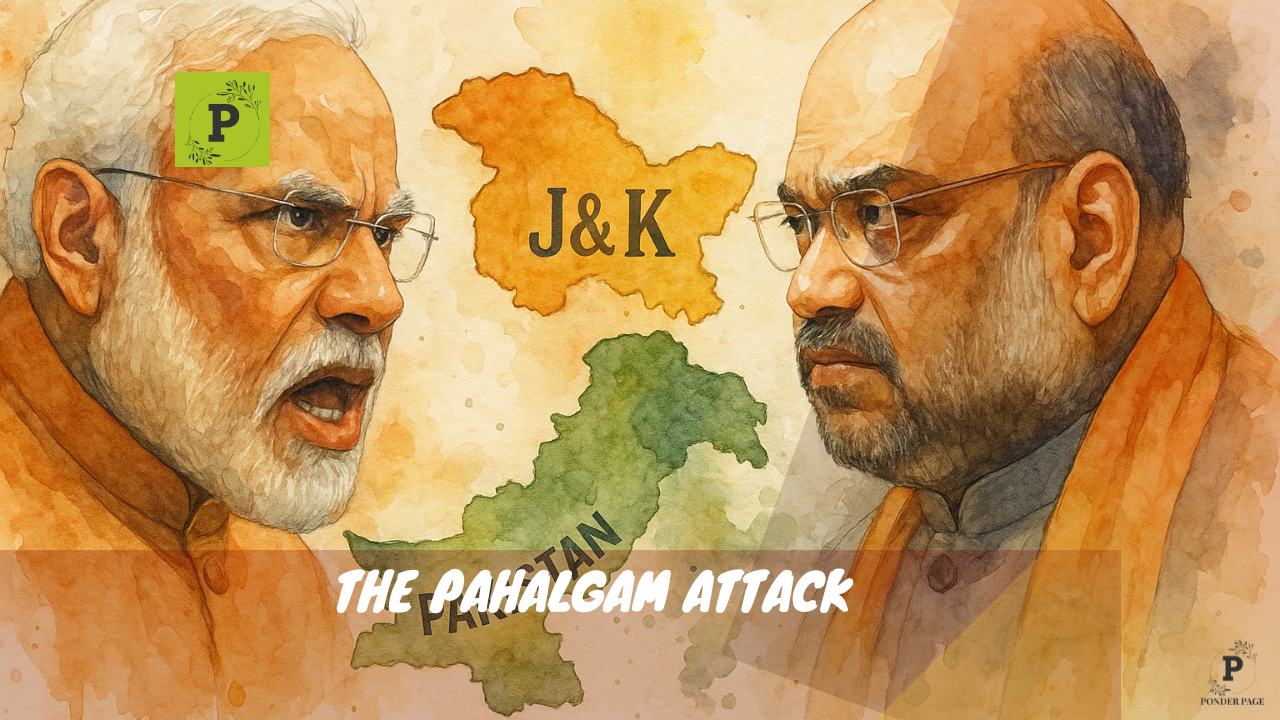
The Pahalgam Attack: On a fateful day in Pahalgam, a meticulously planned terrorist attack shook the serene valleys of Kashmir, leaving behind a trail of devastation, fear, and unanswered questions. Within 24 hours of the assault, it became evident that the perpetrators had achieved their sinister objectives with chilling precision. This tragic event not only exposed critical security lapses but also ignited a volatile atmosphere of suspicion and communal tension. As the nation grapples with the aftermath, it is imperative to dissect the motives behind the attack, hold those responsible accountable, and chart a path forward to prevent such tragedies in the future.
(You can now subscribe to our Ponder Page WhatsApp channel)

Table of Contents
A Calculated Strike with Devastating Precision
The Pahalgam attack was no random act of violence. The terrorists executed their plan with surgical accuracy, targeting tourists in an area they knew was devoid of security forces. This level of foresight suggests meticulous reconnaissance and insider knowledge, raising serious concerns about intelligence failures. The absence of any security apparatus in a region that has long been a hotspot for tourism, especially during peak season, is nothing short of alarming. How could such a significant breach occur undetected? The attackers’ ability to strike and vanish into the rugged terrain of Kashmir within 24 hours further highlights the sophistication of their operation. Their escape routes were clearly pre-planned, allowing them to evade capture despite the passage of a full day.
This precision points to a larger, more troubling reality: the involvement of a well-organized support structure. The attack’s complexity—requiring advanced communication systems, training, and logistical coordination—suggests the backing of a state or quasi-state actor. The shadow of Pakistan looms large in this context, given its historical involvement in similar acts of terror in Kashmir. The attackers’ ability to infiltrate deep into Indian territory, approximately 150-200 kilometers from the international border, and execute such a high-profile assault without immediate interception demands a thorough investigation into border security measures.
Communal Tensions and the Long-Term Divide
Beyond the immediate loss of life, the Pahalgam attack was designed to sow seeds of discord among communities. The targeting of Hindu tourists, with reports of victims being singled out based on their names and clothing, leaves no doubt that the attack carried a communal agenda. This deliberate attempt to inflame religious tensions has, unfortunately, succeeded in creating an atmosphere of suspicion and fear. Social media platforms are ablaze with calls for boycotts and divisive rhetoric, playing directly into the hands of the perpetrators.
However, the narrative is not as black-and-white as some would portray. Amid the chaos, stories of bravery and humanity emerged, such as that of a local ponywallah who courageously attempted to disarm the attackers, only to lose his life in the process. His sacrifice serves as a poignant reminder that the people of Kashmir, irrespective of religion, are often the first victims of such violence. The region’s complex socio-political fabric defies simplistic “us versus them” narratives. While the attackers sought to frame the conflict as a Hindu-Muslim issue, the reality in Kashmir is far more nuanced, painted in shades of grey.
The economic fallout of the attack further complicates the situation. Tourism, the lifeblood of Kashmir’s economy, contributes an estimated 7,500 crores annually. A mass exodus of tourists, driven by fear and calls for boycotts, would devastate the livelihoods of countless Kashmiris, particularly the Muslim-majority population. Those who stoke communal flames, ignoring the broader India-Pakistan dynamic, inadvertently serve the terrorists’ agenda. The true traitors, in this sense, are those who fail to see the long-term game of destabilization being played by external forces.
Pakistan’s Role: A Pattern of Denial and Deflection
The question of Pakistan’s involvement in the Pahalgam attack is not a matter of speculation but one rooted in historical precedent and logical reasoning. The sophistication of the attack, reminiscent of past incidents like the 26/11 Mumbai attacks, Pulwama, and Uri, points to the involvement of a well-resourced entity. These operations require not only trained operatives but also high-end support systems, including communication networks and logistical planning. The fact that the attackers could execute their plan and escape without a trace within 24 hours suggests a level of coordination that local or hybrid terrorists alone could not achieve.
Pakistan’s military and intelligence establishment has long maintained an unwavering obsession with Kashmir, even as the country grapples with internal crises. Recent statements from General Munir, the Pakistan army chief, reveal a delusional ambition to “reclaim” Kashmir, despite Pakistan’s crumbling economy and reliance on IMF bailouts. This rhetoric, coupled with Pakistan’s history of harboring terrorists like Osama bin Laden and Dawood Ibrahim, paints a damning picture. The discovery of the world’s most wanted terrorists on Pakistani soil, combined with the country’s consistent denial of involvement in terror attacks, erodes its credibility on the global stage.
The Pahalgam attack also reflects a strategic shift. Unlike previous incidents that targeted security forces, this assault deliberately struck civilians, specifically tourists. This choice was not arbitrary. By attacking Kashmir’s tourism sector, the perpetrators aimed to cripple the region’s economy and deter visitors, thereby weakening India’s grip on the valley. The Resistance Front, a shadow organization linked to Lashkar-e-Taiba, has been named in connection with the attack, further implicating Pakistan’s deep state. The question remains: how long will the international community tolerate Pakistan’s double game?
India’s Response: Accountability and Action
While Pakistan’s role in the attack demands a robust response, India cannot ignore its own failures. The Pahalgam attack exposed glaring deficiencies in intelligence, security, and crisis response. How could such a large-scale operation go undetected in a region that has been under intense scrutiny for decades? The lack of security forces in a tourist-heavy area, coupled with the delayed deployment of response teams, cost precious lives. The logistical challenges in reaching the attack site, including the time taken to mobilize helicopters, highlight systemic inefficiencies that must be addressed.
Equally troubling is the absence of accountability. In the aftermath of previous attacks like Pulwama, critical questions about intelligence failures and security lapses went unanswered. The Pahalgam attack raises similar concerns: Who will take moral responsibility for this tragedy? Why were there no preventive measures in place despite the influx of tourists? The government’s assurances that the situation in Kashmir was under control and safe for visitors now ring hollow. Blaming historical figures or external actors will not suffice; the current administration must answer for its shortcomings.
The media’s portrayal of the government’s response has also drawn criticism. High-profile optics, such as convoys and ceremonial events, stand in stark contrast to the somber reality on the ground. The continuation of cultural programs and photo opportunities in the wake of such a tragedy reflects a disconnect that undermines public trust. If the government is serious about addressing the crisis, it must prioritize substance over symbolism.
Charting a Path Forward: Confronting Pakistan and Healing Kashmir
To prevent future attacks, India must adopt a multi-pronged approach that addresses both external threats and internal vulnerabilities. On the international front, Pakistan must face consequences for its role in sponsoring terrorism. Declaring Pakistan a terror state, as attempted in the past, could isolate it diplomatically and economically. Targeting terror financing, including reinstating Pakistan on the Financial Action Task Force’s grey list, would choke its ability to fund such operations. Additionally, India could escalate its demands for the extradition of known terrorists like Hafiz Saeed, whose organizations continue to orchestrate attacks.
Militarily, India has the capability to disrupt terror supply lines and infrastructure in Pakistan-occupied Kashmir, as signaled in parliamentary resolutions. However, any action must be carefully calibrated to avoid collateral damage and escalation. The changing geopolitical landscape, with the United States signaling support for India under President Donald Trump, presents an opportunity to build a coalition against Pakistan’s terror ecosystem.
Domestically, India must overhaul its security apparatus in Kashmir. This includes strengthening intelligence networks, enhancing border security, and ensuring rapid response mechanisms. The government must also investigate the possibility of local support for the attackers, without resorting to blanket vilification of Kashmiri communities. Winning the hearts of Kashmiris, through inclusive governance and economic opportunities, is as critical as wielding the gun.
Finally, India must resist the temptation to frame the attack solely in communal terms. While the religious angle is undeniable, amplifying divisive narratives serves the terrorists’ goal of fracturing society. The government should counter calls for boycotts and promote unity, emphasizing that the people of Kashmir, particularly its Muslim majority, stand to lose the most from economic isolation.
The Pahalgam Attack: A Call for Reflection and Resolve
The Pahalgam attack is a stark reminder of the persistent threat posed by terrorism and the complex challenges facing Kashmir. It is a moment for India to reflect on its failures, hold those responsible accountable, and forge a path toward resilience. Pakistan’s role in orchestrating such attacks cannot be ignored, but India’s response must go beyond rhetoric and optics. By addressing security lapses, fostering unity, and taking decisive action against terror sponsors, India can honor the memory of those lost and ensure that such a tragedy never occurs again.
The road ahead is fraught with challenges, but it is also an opportunity to redefine India’s approach to Kashmir—not just as a battleground, but as a land of promise and peace. The nation must rise above division, confront its enemies with clarity, and build a future where the valleys of Pahalgam echo with laughter, not sorrow.


What are your thoughts on this article? Let us know in the comments below. If you enjoyed this article, be sure to subscribe for more engaging content in the future! Stay updated on the latest developments and discussions by clicking the subscribe button above. Thank you for your support!
📢 Dive into the latest discussions on social & trending topics!
🌍💬 Subscribe to Ponder Page for thought-provoking articles and interviews that dissect current issues. Don’t miss out on insightful content—hit that like & subscribe button now!






Leave a Reply