
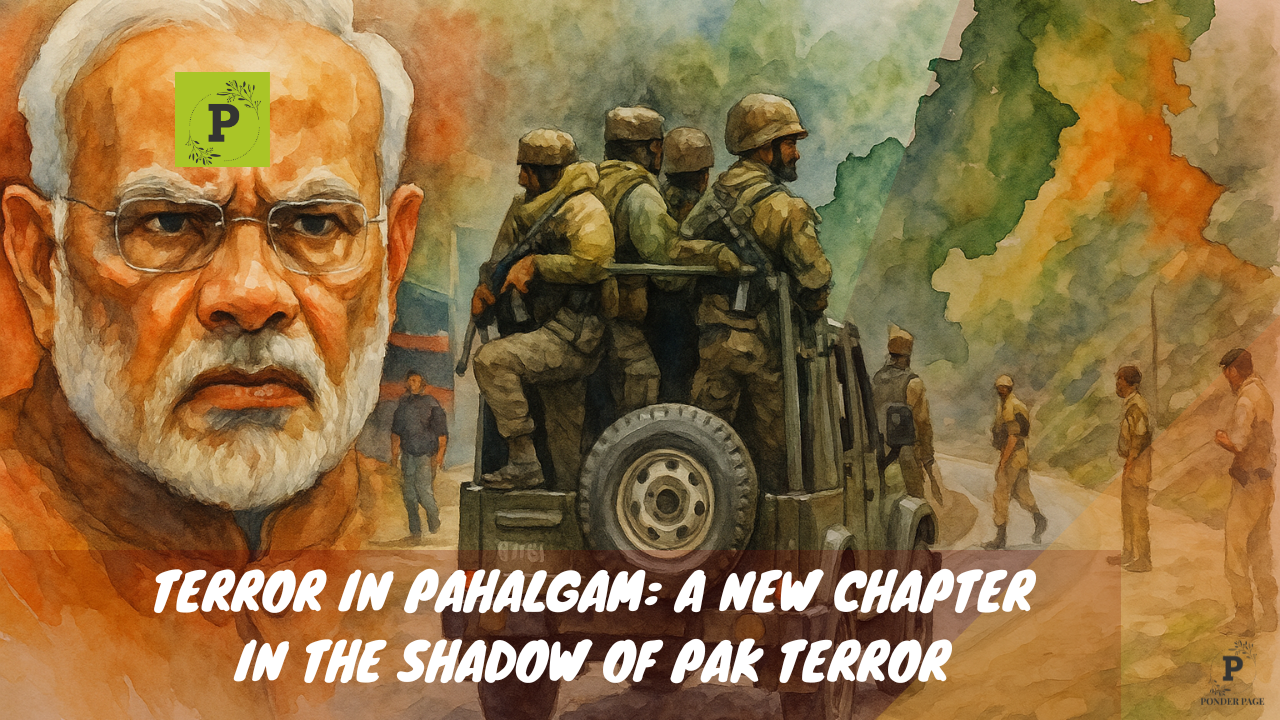
Terror in Pahalgam: Jammu and Kashmir, a land known for its breathtaking beauty and turbulent history, once again finds itself in the grip of a tragedy that has shocked the nation and stirred international concern. While the region has long been familiar with the scourge of terrorism, the incident that occurred on April 22 marks a grim turning point in its already painful legacy.
(You can now subscribe to our Ponder Page WhatsApp channel)

Table of Contents
A Dark Night in Pahalgam
The attack on April 22 was unlike anything seen in the valley for the past 25 years. A group of 40 tourists, most of them families and innocent civilians, were cornered by terrorists in the peaceful region of Pahalgam—a site often referred to as the Switzerland of India. The area where the attack occurred is reachable only on ponies or by foot, making immediate rescue efforts nearly impossible.
What makes this incident particularly harrowing is its clear intent. The tourists were enjoying a night under the stars, far from any security threat, when the attackers opened fire. The death toll, which currently stands at 28, includes two foreign nationals. The brutality of this attack, targeting civilians with such precision and venom, is being regarded as one of the most horrific assaults in recent memory.
Echoes of the Past
This was not the first time civilians have borne the brunt of violence in Jammu and Kashmir. From the 2001 attack on the state legislature to the 2006 massacre in Doda, and the assault on the Amarnath Yatra in 2017, the region has seen its share of bloodshed. Yet, what sets this incident apart is its timing, target, and the location chosen—suggesting a desperate shift in strategy by those behind the violence.
The choice to attack tourists, people who bring life and livelihood to the region, is a chilling departure from past tactics. Historically, even the most radical elements refrained from harming visitors, recognizing tourism’s critical role in the local economy. This deviation signals a disturbing level of desperation.
The Global Outcry
The international response has been swift and sharp. Prominent global leaders including JD Vance, Donald Trump, and Vladimir Putin condemned the attack, calling it a senseless act of terrorism. The solidarity expressed by the international community highlights the gravity of the incident and opens avenues for India to rally support for decisive action.
A Message from the Shadows
One of the chilling aspects of this attack is the alleged claim of responsibility by a group known as The Resistance Front (TRF), widely believed to be a proxy of Lashkar-e-Taiba. A message attributed to them, circulated on social media, claimed that tourists were being used as a facade for demographic change. They accused the Indian government of settling non-locals in Jammu and Kashmir under the guise of tourism.
This narrative, while unsubstantiated, is designed to incite hatred and justify brutality. But the victims were tourists—innocents caught in a war they had no part in. Among them was Manjunath, a tourist from southern India who had come to the valley with his wife Pallavi. Hours before the attack, he had recorded a cheerful video about their stay in a houseboat and a peaceful Shikara ride. His last message stands as a haunting reminder of the lives lost.
The Pakistan Connection
Questions are being raised about Pakistan’s role in this incident. Historically accused of fostering cross-border terrorism, Pakistan has predictably distanced itself from the attack. Their former foreign minister claimed that the location was too far from the border to warrant suspicion. But such denials have become routine, especially when Pakistan’s standing with global watchdogs like the Financial Action Task Force (FATF) is at stake.
In 2022, Pakistan was removed from the FATF grey list, having promised to crack down on terror financing. An admission of involvement now could jeopardize that fragile reprieve. Thus, hybrid warfare has become the new norm—deniable operations, proxy groups, and false narratives that attempt to mask the true origins of such terror.
Security Lapses and Unanswered Questions
As the dust settles, hard questions are being asked about security preparedness. With 2000 tourists gathered in one location and international dignitaries visiting India, how did this attack go unnoticed? How did terrorists, reportedly including six foreign nationals, manage to slip in and out undetected?
This attack has exposed a worrying overconfidence. Despite the apparent reduction in terror incidents and repeated declarations of normalcy, the security lapse in Pahalgam suggests otherwise. It’s a reminder that peace in Jammu and Kashmir remains fragile and conditional.
The Road Ahead: Military, Political, and Moral Response
India’s response must now be both strategic and decisive. Militarily, the country has shown it can act—Pulwama and Uri stand as examples. But the real challenge lies in the political and diplomatic arenas. A proportionate response may not suffice. What is needed now is a strong, sustained, and disproportionate strategy that not only dismantles terror networks but also dismantles their infrastructure and support systems.
This is also a moment to hold introspection. Attacks often follow patterns. There’s a historical pattern of violence during high-profile visits—when Bill Clinton visited, there was bloodshed. Now, during JD Vance’s presence, terror has struck again. Why weren’t these patterns noticed and addressed?
A Battle of Narratives
This incident is more than a terror attack—it’s part of a broader psychological warfare. By targeting civilians, especially Hindus, the perpetrators aim to incite communal tension and divide the country from within. It is essential that India does not fall into this trap. Communal protests, violent backlashes—these are precisely what such terror outfits want. The real victory lies in unity, resilience, and a focused response.


Terror in Pahalgam: Beyond the Headlines
This is not just another tragic chapter in the long story of Jammu and Kashmir. It is a warning. A sign that the methods of terrorism are evolving. That desperation is setting in among those who seek to bleed India with a thousand cuts. The time for a business-as-usual approach is over.
India must respond not only with force but with clarity of vision. This includes reevaluating internal security mechanisms, holding those accountable for lapses, and ensuring that such attacks are not just mourned—but prevented. The world is watching. So are the families of those who died while simply trying to enjoy the beauty of their own country.
What are your thoughts on this article? Let us know in the comments below. If you enjoyed this article, be sure to subscribe for more engaging content in the future! Stay updated on the latest developments and discussions by clicking the subscribe button above. Thank you for your support!
📢 Dive into the latest discussions on social & trending topics!
🌍💬 Subscribe to Ponder Page for thought-provoking articles and interviews that dissect current issues. Don’t miss out on insightful content—hit that like & subscribe button now!



Leave a Reply