
Table of Contents
The Brewing Lakshadweep-Maldives controversy: A Digital Trigger
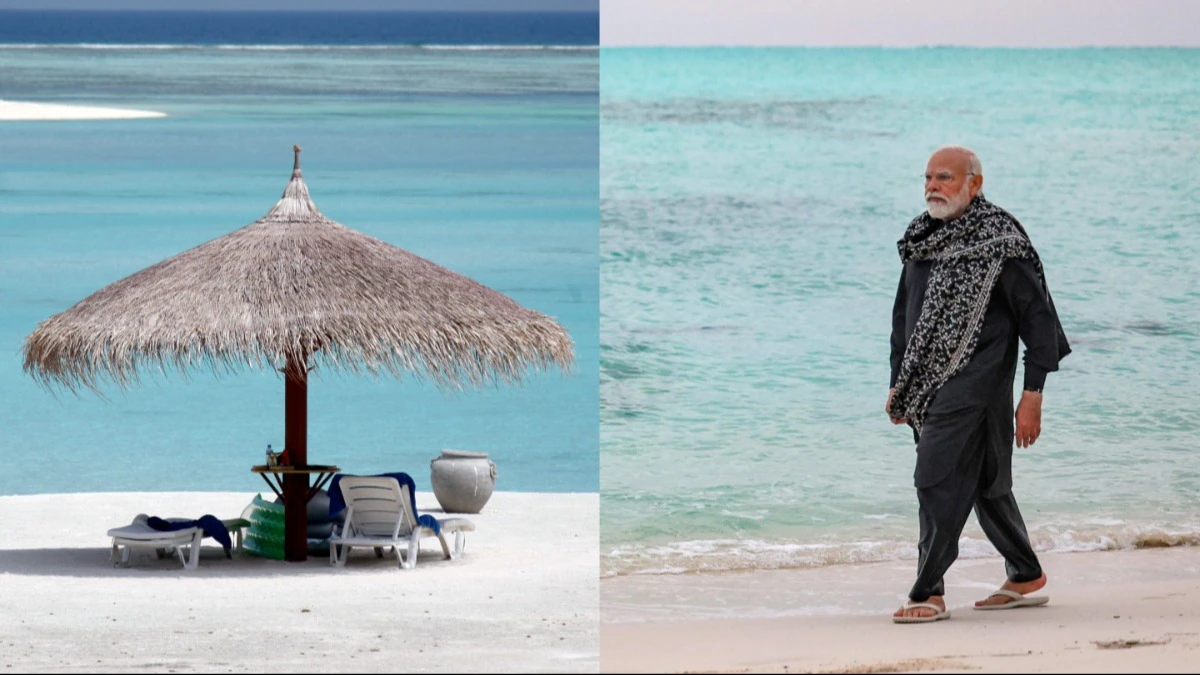
At the heart of the brewing Lakshadweep-Maldives controversy lies a seemingly innocuous photograph shared by Prime Minister Modi at the onset of his Lakshadweep expedition. In a digital age where images arry profound messages, the absence of a particular term, “Maldives,” in the Prime Minister’s entire social media post triggered a chain of events that spiraled into a significant dispute.

Genesis of the Lakshadweep-Maldives controversy: Lakshadweep Expedition Invitation
The genesis of the Lakshadweep-Maldives controversy can be traced back to the Prime Minister’s invitation to the public, urging them to embrace the allure of the adventurous and serene ambiance in Lakshadweep. However, conspicuous by its omission was any reference to the neighboring Maldives. This omission ignited a virtual storm, giving rise to a widespread online campaign originating from India, with a resolute call to boycott Maldives and explore the scenic beauty of Indian islands instead.
Celebrities and Travel Industry Join the Cause: Lakshadweep-Maldives controversy

Celebrities of national stature, including Akshay Kumar and Salman Khan, lent their influential voices to the cause, encouraging citizens to redirect their travel preferences towards Lakshadweep. The reverberations extended to the travel industry, with the prominent travel website, EaseMyTrip, taking a decisive stance by suspending all travel bookings to Maldives.

Escalation and Verbal Sparring Amidst the Lakshadweep-Maldives controversy
The pivotal moment triggering this Lakshadweep-Maldives controversy unfolded when the Prime Minister shared the aforementioned image, only to be met with a derogatory response from Maldives’ Deputy Minister of Youth Empowerment. The exchange escalated further when ministers from Maldives employed offensive language in response to the tweet. The fallout continued as members of the ruling political party in Maldives asserted that Lakshadweep could not match the allure of their nation. This exchange of verbal blows further fueled the flames of discontent between the two nations, as citizens grappled with the question of why a mere photograph could provoke such a significant diplomatic rift.
Lakshadweep-Maldives controversy Takes a Distressing Turn
The Lakshadweep-Maldives controversy took a distressing turn as some of the posts fueling the dispute veered into the realm of racism. A party member went so far as to disparage the capability of Indian officials, asserting that they could not match the level of service provided by their Maldivian counterparts. The derogatory remarks extended to insinuations about cleanliness, insinuating that the stench in Indian rooms would persist indefinitely. In response to these offensive posts, Maldives took a decisive step by suspending the implicated officials.
Geopolitical Dynamics Unveiled: Maldives’ Strategic Importance
However, the ramifications of this Lakshadweep-Maldives controversy extend beyond the confines of a social media boycott. Far from being a superficial disagreement, the Lakshadweep-Maldives controversy delves into the intricacies of a multifaceted geopolitical game involving Maldives, India, and China within the context of the Indian Ocean. At the center of this complex web is Mohammad Muizzu, who ascended to the presidency of Maldives following the India Out campaign, adding layers of political nuance and regional dynamics to an ostensibly digital disagreement.
Inception of the India Out Campaign: Historical Alignments beyond the Lakshadweep-Maldives controversy
The inception of the India Out campaign in a historically friendly nation like Maldives raises questions about the underlying motivations. Surprisingly, the catalyst for this campaign was a seemingly incongruous combination of helicopter and yoga. The details of this unusual pairing will be unravelled in the course of this blog.
Overarching Geopolitical Significance of Maldives for India
To gain a profound understanding of the ongoing Lakshadweep-Maldives controversy, it is essential to recognize the critical significance of Maldives in the geopolitical landscape of India. We’ve delved extensively into this particular aspect in a previous blog post. You can explore the in-depth discussion by simply clicking here.
At first glance, one might question why this small archipelago in the Western Indian Ocean holds such strategic importance for India’s geopolitics. Let’s dissect the factors that render Maldives pivotal in this context.
Maldives’ Strategic Importance: Unveiling Key Factors
Maldives, with its more than 1000 islands and a population of over 95% Muslim, covers a land area of less than 500 sq km—smaller than Mumbai—and has a population of only 4 lakh people. However, the geopolitical value of Maldives stems primarily from its strategic location. There are three key reasons for Maldives’ strategic importance.
Maritime Trade Routes: A Crucial Nexus
First and foremost, it is situated in an area critical for maritime trade. Positioned along the world’s busiest sea lane of communication, the SLOC, Maldives plays a crucial role in facilitating trade flows from the Gulf of Aden and the Strait of Hormuz to Southeast Asia through the Strait of Malacca. This entire maritime region holds immense significance for India, as 90% of the country’s trade, particularly in terms of oil, traverses the Indian Ocean. Notably, 80% of India’s oil imports originate from the Arabian Gulf.
Expansive Exclusive Economic Zone (EEZ): A Resource Treasure Trove
The second crucial aspect contributing to Maldives’ strategic importance for India is the presence of valuable minerals in the region. Extending over more than 800 km from north to south, Maldives boasts an expansive Exclusive Economic Zone (EEZ). An EEZ, extending 200 nautical miles from a country’s maritime border, grants the nation control over both living and non-living resources within that zone.
Within this vast EEZ lie numerous rare earth metals, essential components for emerging green technologies like electric vehicles, solar panels, and wind turbines. As the global shift towards zero emissions gains momentum, the value of these minerals is anticipated to rise significantly. Notably, a country has the autonomy to exploit resources within its EEZ without seeking external permission.
Maldives, thus, assumes importance not only as a repository of valuable minerals but also as a strategic stopover for India’s maritime exploration missions. To safeguard its interests in mineral resources and maintain a peaceful maritime environment, India seeks to align Maldives as a crucial ally in the region. These considerations underscore the multifaceted nature of the geopolitical dynamics at play in the India-Maldives relationship.
Military Importance: Security in the Indian Ocean
The third pivotal factor underscoring the strategic significance of Maldives is its military importance. In the complex realm of geopolitics, nations aspire to extend their influence beyond their geographic boundaries, whether to secure their interests, defend against potential threats, or safeguard their citizens. This global strategy is exemplified by the United States, which maintains military bases in over 80 countries, facilitating its ability to project power globally.
For India, aspiring to enhance its influence in the Indian Ocean necessitates a friendly relationship with Maldives. This extends beyond Maldives and includes other key nations in the region, such as Sri Lanka, Seychelles, and Mauritius. These diplomatic ties are crucial for safeguarding India’s interests and ensuring security in the broader Indian Ocean region.
However, Maldives is not only vital for India but equally significant for China. Given that 80% of China’s oil trade transits through the Indian Ocean, the region holds strategic importance for Beijing as well. Additionally, the presence of a U.S. military base in Diego Garcia, a disputed overseas territory claimed by both the United Kingdom and Mauritius, further complicates the geopolitical landscape.
China, aiming to counterbalance the U.S. military presence in the Indian Ocean, sees Maldives as a key instrument in expanding its own military footprint in the region. As the global power dynamics continue to evolve, the strategic importance of Maldives emerges as a focal point for both India and China, adding a layer of complexity to the geopolitical chessboard in the Indian Ocean. The competition for influence in this crucial maritime space underscores the intricate interplay of economic, environmental, and security considerations at the heart of the India Out controversy.
Historical Alignments and Shifting Political Landscape
Delving into the intricate politics of Maldives reveals a historical inclination towards pro-India sentiments. This alignment has roots in a shared past, as both India and Maldives were once British territories. Even after India gained independence, Maldives retained its status as a British territory with a military base until 1965.
India’s Role in Maldives’ Independence
A significant turning point occurred in 1965 when Maldives declared its independence, marking the end of its British affiliation. The former president of Maldives acknowledged India’s substantial role in facilitating this independence. In a gesture of solidarity, India became the first country to formally recognize Maldives as an independent nation.
India’s Timely Intervention: Operation Cactus
The political landscape in Maldives underwent a substantial shift in 1978 when Mamoon Abdul Gayoom assumed power, ultimately becoming a long-standing dictator who ruled for three decades until 2008. During this period, India extended considerable support to Gayoom’s regime. In a notable instance in 1988, when faced with a military coup, Gayoom urgently sought India’s assistance. In a swift response, Operation Cactus was executed, deploying 1,600 Indian paratroopers to Malé, the capital of Maldives, within 12 hours. This intervention successfully thwarted the attempted coup.
These historical alliances and instances of support contributed to Gayoom’s pro-India stance. The complex interplay of history, geopolitics, and strategic alliances underscores the multifaceted nature of Maldives’ political dynamics and its enduring ties with India.
Democracy Dawns: Nasheed’s Era and China’s Entry
The political landscape of Maldives underwent a significant transformation in 2008 when, after three decades of dictatorship, the nation embraced democracy. India played a crucial role in this transition by providing training to electoral officials and supplying electronic voting machines. The Maldivian Democratic Party (MDP), led by Mohammad Nasheed, emerged victorious in the elections that followed.
Pro-India Stance and Diplomatic Outreach
Both Nasheed and his party, MDP, exhibited pro-India sentiments, and in 2009, a strategic agreement was reached. This pact granted India the authority to monitor Maldives’ waters using 26 coastal radars. The Indian Coast Guard and Navy were also enlisted to assist in patrolling Maldives’ territory. Nasheed, while maintaining strong ties with India, also explored diplomatic relations with China. Notably, Maldives opened its embassy in China during Nasheed’s presidency, indicating a diplomatic outreach.
Twist of Political Events: Nasheed’s Ouster and China’s Entry
Despite Nasheed’s pro-India stance, a twist occurred in 2013 when he ordered the arrest of a judge, triggering a political upheaval. Faced with opposition, Nasheed was expelled from the presidency, alleging that this was an anti-democratic coup. In this political vacuum, China seized the opportunity. Nasheed’s vice president, Mohamed Waheed, assumed the presidency, and Maldives swiftly shifted its allegiance.
President Waheed secured a promise of $500 million in Chinese assistance and a $150 million loan for a housing complex during a meeting with the Chinese Prime Minister. Waheed, who once served as Nasheed’s vice president, ordered Nasheed’s arrest upon assuming the presidency. Seeking refuge, Nasheed turned to the Indian High Commission for protection, spending two weeks there before being arrested upon leaving.
Furthermore, President Waheed cancelled Maldives’ significant foreign investment project with GMR, affecting the airport infrastructure. Nasheed, later released, attempted a political comeback in the 2013 elections but was unsuccessful. The new president, Abdullah Yameen of the Progressive Party of Maldives, continued Maldives’ pro-China policy, aligning with the timing of China’s Belt and Road Initiative (BRI) launched in 2013.
The Belt and Road Initiative (BRI) and String Pearl Strategy
The BRI, a vast infrastructure project, aimed to enhance China’s geopolitical influence globally. The String Pearl Strategy, associated with the BRI, involved developing maritime infrastructure in countries supportive of China. This strategy posed concerns for India as it would lead to China encircling India, impacting both its economy and security. China strategically acquired ports in countries such as Sri Lanka, Pakistan, and the Maldives.
China’s Influence in the Maldives
To solidify its influence in the Maldives, China invested in significant projects, including a new runway at the main international airport and a friendship bridge connecting Malé with Hulhumalé Island. This intricate web of political shifts, diplomatic maneuvers, and economic projects paints a comprehensive picture of the evolving relationships between India, China, and the Maldives.
Changing Political Dynamics in the Maldives
During President Yameen’s tenure, the political dynamics in the Maldives shifted significantly towards China. Despite anti-India sentiments, India extended assistance during a water crisis in 2014 through Operation Neer. However, the Maldives continued to align itself with China, resulting in a substantial increase in Chinese tourists and a surge in debt due to Chinese infrastructure projects, reaching $1.5 billion by 2018.
India’s Involvement and the India Out Campaign
Amidst this political backdrop, the India Out campaign began taking root during Yameen’s presidency. The introduction of two Dhruv Advanced Light Helicopters (ALH) by India in 2010 and 2015 played a pivotal role. These helicopters were intended for search and rescue operations, weather surveillance, and medical evacuations between islands. Additionally, a Dornier aircraft was provided to monitor illegal vessels, particularly Chinese ones, entering Maldivian territory and track potential terrorist activities.
A bilateral agreement allowed Indian officers to train Maldivian counterparts in operating these helicopters and aircraft. While both governments asserted the humanitarian nature of this assistance, Yameen and his party contended that India aimed to establish a military presence in the Maldives. Tensions between the Yameen government and India escalated as these geopolitical dynamics unfolded.
In 2015, the pro-India figure, Nasheed, faced charges in a closed-door hearing, leading India to request his release. However, the Yameen government remained unresponsive. Prime Minister Modi, planning a tour of the Indian Ocean that included stops in the Maldives, Sri Lanka, Seychelles, and Mauritius, canceled the visit when Yameen rejected the request. The tensions persisted and reached a climax in 2016 when Yameen ordered India to retrieve the helicopters, a demand India declined.
Further complicating matters, in 2018, China proposed installing an ocean observatory near Malé, close to India’s Lakshadweep Island. Opposition leaders in the Maldives opposed this move, expressing concerns about potential military uses by China.
Election of President Solih and Shift in Relations
In the political drama of the Maldives, multiple twists unfolded. In 2018, Yameen announced elections, anticipating an easy victory as the popular face of the opposition, Nasheed, was in exile in Sri Lanka due to legal issues. Unexpectedly, opposition parties united against Yameen, fielding Ibrahim Mohamed Solih as their candidate. Solih, a close associate of Nasheed, secured victory, becoming the new president of the Maldives.
Yameen’s officials expressed shock at the election results, marking a dramatic 180-degree shift in Maldivian politics that favored India’s interests. The complex interplay of political maneuvers, shifting alliances, and the influence of external powers underscores the intricate nature of the political landscape in the Maldives.
Upon assuming the presidency, Solih took steps to renew the agreement regarding the helicopters and emphasized an “India First” policy. He openly acknowledged India’s special and enduring friendship with the Maldives, highlighting his understanding of India’s security concerns.

India’s Strategic Concerns and Conditions
While not explicitly mentioning China, Solih indicated the precarious financial situation of the Maldives, alluding to the burden of mega-projects driven by political considerations. He acknowledged corruption cases in the previous government, which had led to inflated contract prices for Chinese projects. Notably, over 90% of the trade between the Maldives and China consisted of Chinese exports to the Maldives.
India sought to assist the Maldives in managing its financial situation. Reportedly, India offered loans to help repay Chinese debts, but with two conditions. First, the Maldives was expected to distance itself from China, and second, the Maldives was encouraged to establish a stronger security relationship with India, potentially involving a permanent military presence. These conditions reflected India’s strategic concerns and the complex geopolitical landscape in the Indian Ocean region.
The India Out Campaign Resurgence and Elections of 2023
In February 2019, the pro-China former president Yameen was arrested on corruption charges related to a questionable $1 million transfer to his bank account, resulting in a 5-year prison sentence. Faced with limited political options, Yameen sought a new strategy for a comeback, and this led to the inception of the India Out campaign.
The primary objective of the India Out campaign was to advocate for the removal of India’s military presence from the Maldives. Initially, the campaign struggled to gain traction, but it gained momentum when the Solih government declared it illegal. This move drew more attention to the campaign, propelling its growth.
Controversy Surrounding the UTF Harbor Project: Evolving Narratives and Strategic Disputes
A significant episode unfolded in 2019 related to the UTF Harbor project. In 2021, an agreement was signed between Dr. Jai Shankar and the Maldives’ defense minister for the construction of a coastguard harbor and dockyard near Malé, based on the 2016 action plan between India and the Maldives. The original intent was to strengthen defense cooperation and address mutual strategic and security interests in the Indian Ocean.
However, upon the Solih government coming to power, local press reports suggested that the UTF project was not just a harbor but intended to be India’s naval base. The Maldives’ Chief of Defence Forces, Major General Abdullah Shamaal, dismissed these claims, stating that there were no plans for any foreign military base in the Maldives, be it permanent or temporary.
Escalation of Tensions: Anti-India Propaganda, Security Concerns, and the Disturbing Arrest During the India Out Campaign
During the India Out campaign, anti-India posts proliferated, notably in a publication named Dhiyares. The situation escalated to the point where the Indian High Commission urged the Maldives’ government to enhance security measures. In a letter, the Indian High Commission expressed concerns about the motivated and personal attacks, emphasizing the potential harm to bilateral relations between India and the Maldives. This twist in the narrative further complicated the delicate balance of geopolitics in the region.
In July 2021, the Maldivian Ministry of Foreign Affairs announced that the Dhiyares publication was spreading fake news, prompting increased security measures for the Indian High Commission. A day later, on July 3rd, a 42-year-old Maldivian activist associated with the pro-India party was arrested for threatening to bomb the Indian High Commission. This incident exemplified the popularity and impact of the India Out campaign in the Maldives.
Rising Hostility: Incidents Targeting Indian Citizens, Security Threats, and Political Exploitation during the India Out Campaign
While the campaign resulted in some targeted incidents against Indian citizens, such as the expulsion of an Indian doctor from a taxi in February 2022, the situation escalated further when Indian diplomats faced a security threat related to the celebration of International Yoga Day in June 2022. During the event in Malé, a large crowd gathered outside the stadium, forcing their way in. The local police had to use tear gas to disperse the protesters, who claimed that Yoga was against Islam. A political party representative argued that news about issues against Muslims in India was used as a tool in the Maldives to fuel the India Out propaganda.
Despite differing views within the political landscape, the Maldivian Democratic Party issued a statement against the news publication Dhiyares, which targeted Indian diplomats. The India Out campaign provided Yameen and his party, PPM, with a potent weapon for political resurgence, highlighting the complex interplay of ideologies and political maneuvering.
Recent Developments and Policy Changes
In the 2023 elections, the pro-China camp emerged victorious, with Mohammad Muizzu, a coalition candidate, becoming president. While it would be simplistic to attribute the election outcome solely to the India-China issue, it is evident that the India Out campaign played a role in shaping public sentiment. The Solih government faced criticism, particularly for policies such as relocating people from Malé Island to a new island, which also led to corruption charges. The success of the India Out campaign underscored the nuanced nature of political dynamics in the Maldives.
Unconventional Presidential Actions: Muizzu’s Departure from Tradition and Diplomatic Shifts
After assuming the presidency, Muizzu took two significant actions. Traditionally, the first trip of a newly elected president is to India, but Muizzu deviated from this norm. The Ministry of External Affairs inquired about this decision, and Muizzu further declared that all Indian military officials must be removed from the Maldives. Officially, his government stated that there were 77 Indian military personnel in the Maldives. Muizzu conveyed this demand directly to Prime Minister Modi during their meeting in Dubai, asserting that India had agreed to comply. However, India did not provide any official comment on the matter.
In a recent development during this Lakshadweep-Maldives controversy, Muizzu’s government announced the cancellation of an agreement with India for joint hydrographic surveys in Maldivian waters. This agreement, signed in 2019, was terminated on the grounds that India could potentially use the survey data for military intelligence purposes.
Insights from Political Commentary on PM Modi’s Posts and the Lakshadweep-Maldives controversy
Delving into the nuanced political landscape of the Maldives provides valuable insights into the motivations behind the engagement of political party members in discussions surrounding Prime Minister Modi’s social media posts. The intricacies of Maldivian politics, marked by historical alliances, geopolitical shifts, and power struggles, create a context where even seemingly unrelated events can become arenas for expressing political stances.
In summary, the engagement of Maldivian political party members in discussions around Prime Minister Modi’s social media posts is deeply intertwined with the intricate political landscape of the Maldives. Social media, acting as a dynamic and influential arena, not only reflects the local political climate but also becomes a tool for navigating and influencing broader geopolitical narratives. The interplay between social media dynamics and political motivations underscores the complex nature of contemporary political communication in the Maldives.
If you’re curious about delving into the captivating similarities and differences between two maritime gems—Lakshadweep and the Maldives—feel free to explore the insights we’ve shared in our previous blog. Click here to unravel the unique features that distinguish these two enchanting destinations.
If you’re keen on gaining insights into the geopolitical significance of the Maldives for India, click here for a comprehensive exploration of the subject.
Subscribe
If you enjoyed this blog post, be sure to subscribe for more engaging content in the future! Stay updated on the latest developments and discussions by clicking the subscribe button above. Thank you for your support!
Leave a Reply