
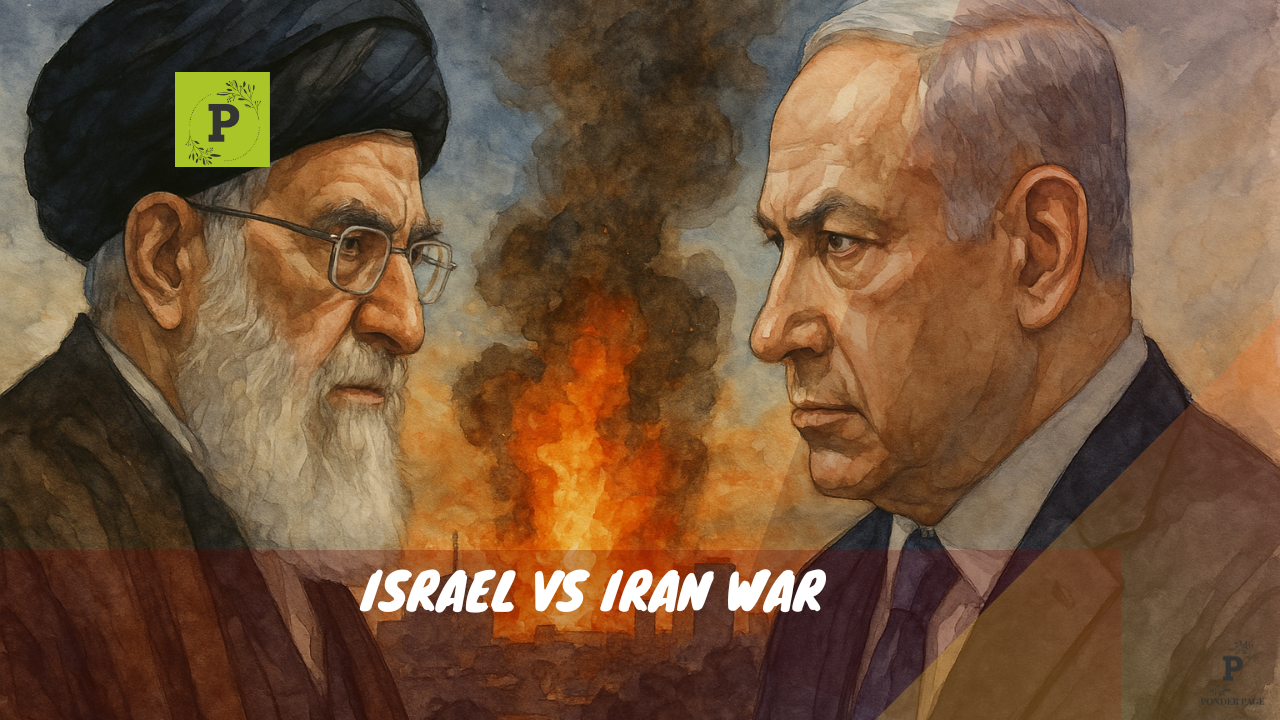
Israel vs Iran: The world is once again witnessing a dramatic escalation in the Middle East, with Tel Aviv being struck by ballistic missiles and Iran and Israel launching back-and-forth military operations that many are calling a potential precursor to all-out war.
(You can now subscribe to our Ponder Page WhatsApp channel)

Table of Contents
Missiles Over Tel Aviv: The Immediate Fallout
Tel Aviv, one of Israel’s most populated and strategically important cities, came under attack as Iran launched over 150 ballistic missiles. Of these, seven reportedly landed inside Tel Aviv’s city limits. One missile fell dangerously close to a key installation of the Israeli Defense Forces (IDF). This was not an isolated act—it was a direct retaliation. Iran’s counteroffensive came in response to a significant and unprecedented Israeli military operation named Operation Rising Lion.
Operation Rising Lion: Israel’s Pre-emptive Strike
Just a day before the missile strikes on Tel Aviv, around 200 Israeli fighter jets executed a sweeping aerial assault on Iran. This operation, launched early Friday morning, was not publicly anticipated and shocked the region. The targets included nuclear facilities, air defense systems, military bases, and most significantly, Iran’s top military leadership. Israel has justified the operation by citing Iran’s rapid advancement toward nuclear weapons capability—a concern Israel has voiced consistently for over three decades.
The operation was launched soon after the International Atomic Energy Agency (IAEA) passed a resolution declaring Iran non-compliant with its nuclear non-proliferation commitments. This marked the first such resolution in decades, backed by fresh IAEA findings of secret nuclear activities at at least three undisclosed sites in Iran. Israel interpreted this as a red line and moved swiftly to act.

The Immediate Repercussions: Iran Strikes Back
In retaliation, Iran launched over 100 drones targeting Israel. However, these drones were reportedly intercepted and neutralized without causing significant damage. But the exchange didn’t end there. Later that day, Israeli jets again struck Iranian targets, focusing on high-value nuclear facilities like Fordow and Isfahan, following their earlier attack on the Natanz enrichment facility—the core of Iran’s uranium processing infrastructure.
Satellite imagery and early assessments indicate that many of these facilities have suffered considerable damage, though the full extent—especially to underground centrifuge halls—remains unclear.
Leadership Decapitation: Mossad’s Shadow Role
What has surprised many is the precision with which Israeli forces struck. Reports suggest that Mossad, Israel’s elite intelligence agency, played a central role. Agents reportedly coordinated with fighter pilots in real time, providing GPS coordinates and identifying the exact locations of Iran’s top military leadership. In an operation reminiscent of Ukraine’s “spider web” campaign, Israeli teams disabled Iranian radar stations from within, paving the way for deep strikes into Iranian airspace.
Among the targets were top military officials, including Major General Mohammad Bagheri and IRGC head General Hossein Salami. Reports claim these leaders were targeted in their residences, causing a leadership vacuum in Iran’s military hierarchy.
From Covert Attacks to Open Warfare
For years, Israel has carried out covert operations to sabotage Iran’s nuclear program—ranging from the infamous Stuxnet cyber attack to targeted assassinations like the remote-controlled killing of a nuclear scientist in 2021. But this time, Israel abandoned deniability. For the first time, military scientists were openly targeted, and Prime Minister Netanyahu has vowed that these operations will continue until Iran’s nuclear capabilities are permanently dismantled.
Iran’s Retaliation: Ballistic Missile Barrage
Iran’s Supreme Leader Ayatollah Khamenei, in a nationally televised address, declared open retaliation. Over 150 ballistic missiles were launched towards Israel, specifically targeting Tel Aviv. While Israel’s Iron Dome and other defense systems intercepted most, the psychological and political impact has been significant. This marks the first time since the Iran-Iraq War that strikes of this scale have rocked the region.
A Cold Alliance Turned Hot Conflict
What makes this all the more ironic is the shared history between Israel and Iran. When Israel was formed in 1948, Iran under Shah Mohammad Reza Pahlavi was one of the few Muslim-majority countries that quietly established ties. Iran supplied oil to Israel, while Israel helped modernize Iran’s military and technology. Mossad and Iran’s SAVAK once shared intelligence.
But the 1979 Islamic Revolution shattered this covert alliance. Iran declared Israel an illegitimate state and handed over its embassy to Palestine. Still, throughout the 1980s, especially during the Iran-Iraq war, there were discreet exchanges. However, by the 1990s, Iran’s nuclear ambitions fundamentally altered the relationship. Israel began to perceive Iran as an existential threat, particularly due to Iran’s support of groups like Hezbollah, Hamas, and the Houthis.

The Nuclear Clock: From 3.5% to 60% Enrichment
Developing nuclear weapons is a technically complex and time-consuming process. Iran began pursuing nuclear capabilities in the 1990s. By 2006, they had achieved uranium enrichment at 3.5%. A 2010 UN watchdog report revealed that this had increased to 19.75%. The 2015 nuclear deal (JCPOA) led to some restrictions—centrifuges were dismantled, enrichment capped at 3.67%, and uranium stockpiles limited.
But in 2018, the U.S. under President Donald Trump withdrew from the deal. Iran resumed its enrichment program, now reaching 60% purity, just short of weapons-grade (90%). Israel insists this is only weeks away from achieving a functional nuclear warhead, and views the program as an immediate danger.
Trump, Netanyahu, and the US Position
Interestingly, President Trump recently claimed that he stopped Netanyahu from targeting Iran’s nuclear facilities because he wanted to negotiate a new peace deal. But as of now, Netanyahu has charted his own course. The US administration has stated that Israel acted independently, though it had prior knowledge of the strikes. The US has issued regional warnings, mobilized fleets, and publicly distanced itself from the escalation—perhaps playing the “good cop” role while Israel intensifies pressure.
A Turning Point for the Region?
The current conflict poses a grave risk of regional destabilization. Iran has halted nuclear negotiations. Trump’s attempts to resume talks appear sidelined. Iran has conventional military strength, a massive missile arsenal, and regional alliances. Israel, meanwhile, has global diplomatic clout, advanced intelligence capabilities, and Western military support.
What remains uncertain is the role of global powers—Will Russia support Iran? Will the West rein in Israel? Will Gulf states stay neutral? The possibilities are open and dangerous.


Israel vs Iran: Standing at the Edge
The situation is fluid, volatile, and teetering on the brink of escalation. What began as covert cyber strikes and proxy warfare has now erupted into direct state-to-state military confrontation. The international community now faces a stark choice: intervene decisively to de-escalate, or watch as the region spirals into one of the most consequential conflicts of the 21st century.
History may look back on Operation Rising Lion as the moment when the world crossed from deterrence into direct confrontation—and whether it leads to containment or catastrophe will depend on what happens next.
What are your thoughts on this article? Let us know in the comments below. If you enjoyed this article, be sure to subscribe for more engaging content in the future! Stay updated on the latest developments and discussions by clicking the subscribe button above. Thank you for your support!
📢 Dive into the latest discussions on social & trending topics!
🌍💬 Subscribe to Ponder Page for thought-provoking articles and interviews that dissect current issues. Don’t miss out on insightful content—hit that like & subscribe button now!





Leave a Reply