
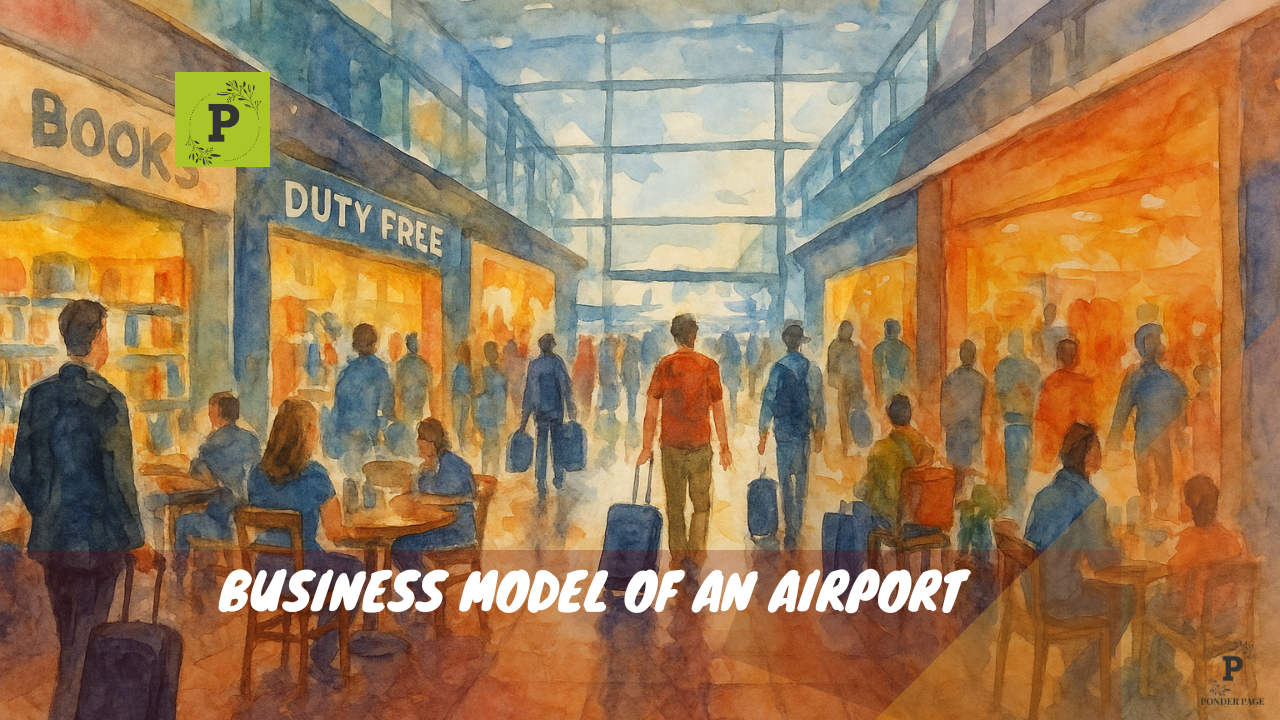
Business Model of an Airport: The moment you step inside an airport, it feels less like entering a travel hub and more like walking into a giant, upscale mall—only this mall has an entry fee, which you’ve already paid through your flight ticket. Without a ticket, you won’t be allowed in, and once inside, everything starts to come at a premium. A water bottle that costs ₹10 outside is suddenly priced at ₹100. Thinking of grabbing a bite? Be prepared to shell out hundreds or even thousands.
(You can now subscribe to our Ponder Page WhatsApp channel)

Table of Contents
The Economics of Spending Time at the Airport
The longer you stay at the airport, the more money you’re likely to spend. This is no accident. Airports are carefully designed to guide you through a labyrinth of shops and restaurants on your way to the boarding gate. Every path to your flight is intentionally lined with retail outlets, duty-free shops, book stores, and food joints. It’s a strategy—one that thrives on your waiting time and confusion.
Despite all the modern technologies airports claim to have, there’s still massive uncertainty about when exactly one should arrive. Ask a friend when to reach the airport for a 3 PM flight, and answers will vary: some will say two hours early, others two and a half, and for international flights, maybe even three or more. During festive seasons, most prefer arriving even earlier to avoid missing their expensive flights. This confusion indirectly benefits airports, as passengers end up spending more time—and consequently more money—on premises.
Limited Seating, Strategic Retail
Passenger footfall in airports is massive, yet seating arrangements in main areas remain relatively limited. The intent is clear: keep passengers on their feet. As fatigue sets in, people naturally seek out restaurants or lounges to sit, and while they’re at it, perhaps place an order or two. Shops and dining options are tactically placed in high-traffic areas like near the boarding gates to maximize visibility and customer engagement.

Take the example of Delhi Airport—it’s hard to find a single major food chain or bar that isn’t represented there. Airport operators typically take a 10% to 25% cut from these retail and dining sales. In cases where they don’t take a percentage of the sales, they charge higher rent to balance the equation. This business model helps airports generate anywhere between ₹50 to ₹200 per day just from passenger spending.
The Allure of Duty-Free Zones
Most international terminals are packed with duty-free shops strategically located in both arrival and departure sections. These are designed to encourage purchases either before catching a flight or just after landing. The concept originated in 1947 at Shannon Airport in Ireland. The idea was simple—create a zone where passengers can shop without paying domestic or international taxes.
Buying from a duty-free shop means you don’t have to pay local taxes either at the departure or arrival location, which can significantly lower the final price. For instance, if you were to buy a product in the U.S. and then bring it to India, you would be liable for taxes in both countries. Duty-free shops eliminate this burden, making them highly appealing.
Only international travelers can access these zones, and they are considered high-value customers due to their presumed greater purchasing power. In fact, duty-free sales form about 15% to 20% of the total non-aeronautical revenue at many Indian airports. Of this, 75% to 80% typically comes from the sale of alcohol and cigarettes. However, there are government-imposed limits. As per the Central Board of Indirect Taxes and Customs (CBIC), there’s a cap on the value of duty-free goods a passenger can purchase.
The Premium Experience: Airport Lounges
Another major source of revenue and consumer engagement is the airport lounge. Offering a premium experience compared to general areas, lounges provide comfort, complimentary meals, drinks, Wi-Fi, and sometimes even spa services. Airports charge lounge operators to run these spaces, and in turn, lounge operators find multiple ways to make money from passengers.
Some lounges charge a direct entry fee—around ₹1800 at airports like Delhi—while others offer memberships. Many credit card companies provide complimentary lounge access as a customer benefit. These companies cover the lounge fees, betting on the fact that well-traveled individuals with strong purchasing power will prefer their cards for the associated perks. In return, credit card companies charge higher annual fees and benefit when customers use their cards frequently.
Business Model of an Airport: Why Airports Are Always a Good Investment
It’s no secret that airports are expensive to build—often costing thousands of crores. Yet, with the exception of disruptions like the COVID-19 pandemic, airports are rarely unprofitable. Their business model, heavily supported by non-aeronautical revenue streams such as retail, dining, duty-free sales, and lounge partnerships, ensures strong financial returns.
This is precisely why private companies are willing to take on massive loans to develop and operate airports. They know that once operational, the airport won’t just be a travel point—it will be a high-yielding business hub thriving on every minute a traveler spends within its walls.


What are your thoughts on this article? Let us know in the comments below. If you enjoyed this article, be sure to subscribe for more engaging content in the future! Stay updated on the latest developments and discussions by clicking the subscribe button above. Thank you for your support!
📢 Dive into the latest discussions on social & trending topics!
🌍💬 Subscribe to Ponder Page for thought-provoking articles and interviews that dissect current issues. Don’t miss out on insightful content—hit that like & subscribe button now!






Leave a Reply