
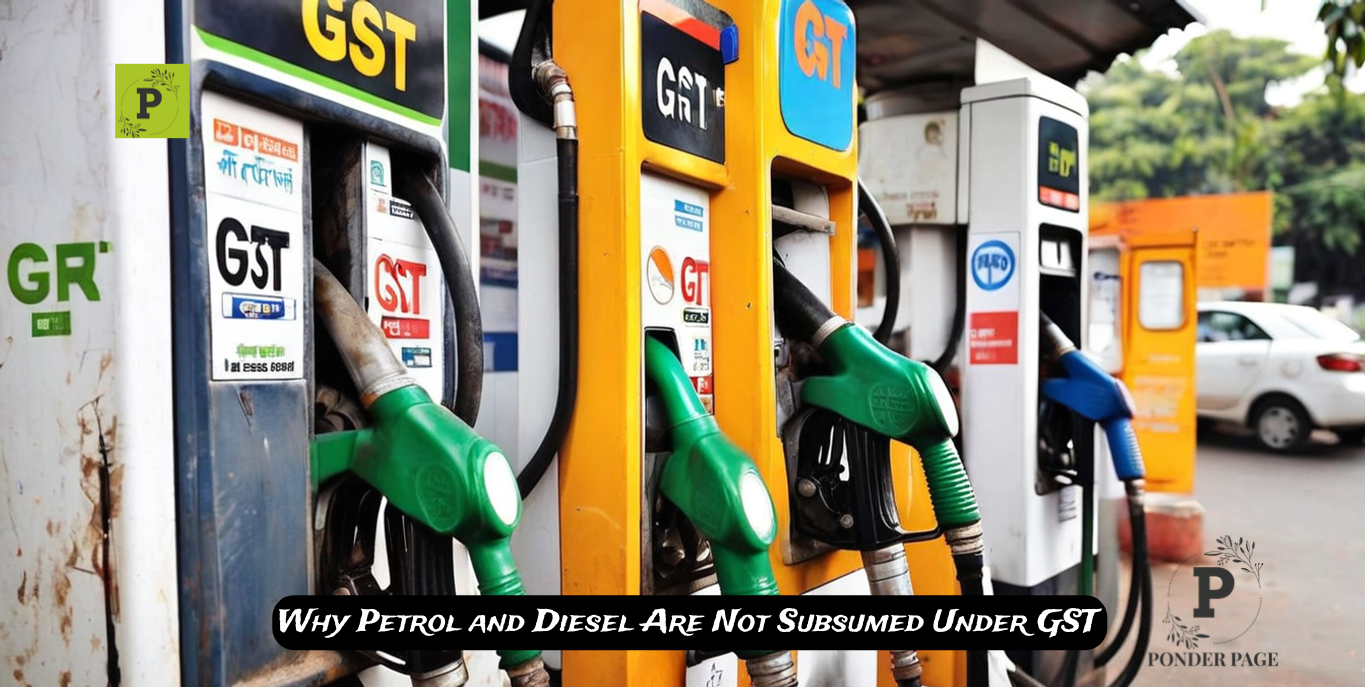
Why Petrol and Diesel Are Not Subsumed Under GST? The Goods and Services Tax (GST) is a comprehensive tax reform introduced in India to simplify the tax structure and create a unified market. However, despite its wide-reaching impact, petrol and diesel remain outside the purview of GST. This exclusion has been a subject of significant debate. Let’s delve into the reasons why petrol and diesel have not been subsumed under GST.
(You can now subscribe to our Ponder Page WhatsApp channel)

Table of Contents
1. Revenue Implications for State and Central Governments
State Government Revenue
One of the primary reasons petrol and diesel are excluded from GST is the substantial revenue they generate for state governments. States impose Value Added Tax (VAT) on petroleum products, which is a significant source of their income. Subsuming petrol and diesel under GST would mean states would lose this revenue and have to rely on GST compensation from the central government, which may not fully cover their financial needs.

Central Government Revenue
Similarly, the central government imposes excise duty on petrol and diesel. This excise duty forms a significant portion of the central government’s revenue. Including petrol and diesel under GST would necessitate the elimination of excise duty, leading to a substantial reduction in central revenue.
2. Price Volatility and Fiscal Stability
Price Control Mechanism
The prices of petrol and diesel are influenced by international crude oil prices, which are highly volatile. The current tax structure allows both state and central governments to adjust VAT and excise duty to manage retail prices and mitigate the impact of global price fluctuations. Under GST, this flexibility would be lost, potentially leading to more volatile retail prices for consumers.
Fiscal Stability
The current taxation structure provides a predictable and steady revenue stream for both state and central governments. Transitioning petrol and diesel to GST could introduce uncertainty in revenue collection, affecting fiscal stability. Governments rely on this stable revenue for budgeting and planning their expenditures.
-
 Ceasefire Politics and Rise of Pakistan as a Global Mediator
 -
 From Protest to Turning Point: The Story of Jallianwala Bagh and Its Aftermath
 -
 The Roots of the India China Border in Ladakh
 -
 The Origins of the Indian National Congress: A Turning Point in Colonial India
 -
 The Evolution of Money: Life Before Currency
3. Federal Structure and Autonomy
Autonomy of States
India’s federal structure grants significant financial autonomy to state governments. This autonomy includes the ability to levy and collect taxes on certain goods, including petroleum products. Subsuming petrol and diesel under GST would centralize this power, reducing the financial independence of states. Many state governments resist this move to protect their fiscal sovereignty.

Political Consensus
Achieving a consensus among states and the central government on including petrol and diesel under GST is challenging. States with significant revenue from VAT on petroleum products are particularly opposed. Without unanimous agreement, such a major policy shift cannot be implemented, reflecting the complexities of India’s federal system.
4. Impact on Consumers and Inflation
Consumer Prices
The current taxation regime on petrol and diesel results in higher prices compared to what might be under GST. However, the sudden transition to GST could lead to an initial drop in prices but might also lead to volatility and uncertainty. The fear of fluctuating prices can impact consumer sentiment and spending behavior.
Inflationary Pressures
Petrol and diesel are critical inputs in various sectors, including transportation and manufacturing. Changes in their prices can have a cascading effect on the overall inflation rate. The government uses the current tax structure to moderate these effects. Bringing petrol and diesel under GST could remove this moderating tool, potentially leading to increased inflationary pressures.

5. Policy and Legislative Hurdles
Legislative Amendments
Incorporating petrol and diesel under GST would require significant legislative changes. This includes amending the Constitution and altering the GST framework. Such changes demand extensive political negotiation and support from multiple stakeholders, which can be a protracted and complex process.
Implementation Challenges
Transitioning to a new tax regime involves numerous practical challenges, including changes in billing systems, compliance requirements, and monitoring mechanisms. Given the critical nature of petroleum products in the economy, ensuring a smooth transition without disrupting supply chains or causing administrative bottlenecks is a formidable task.


Why Petrol and Diesel Are Not Subsumed Under GST? Conclusion
The exclusion of petrol and diesel from the GST regime is a multifaceted issue rooted in revenue considerations, fiscal stability, federal autonomy, and consumer impact. While there are arguments in favor of bringing these fuels under GST for a more unified tax structure, the potential downsides and complexities involved make it a contentious issue.
As of now, the status quo allows both state and central governments to maintain their revenue streams and control over pricing, providing a level of fiscal and economic stability amidst global uncertainties. Until a viable consensus and a balanced approach are found, petrol and diesel are likely to remain outside the GST framework.
If you enjoyed this blog post, be sure to subscribe for more engaging content in the future! Stay updated on the latest developments and discussions by clicking the subscribe button above. Thank you for your support!





Leave a Reply