

Wedding reception is not as a part of marriage ritual: The Bombay High Court recently, in Writ Petition No. 8829 of 2023, delivered a significant ruling regarding the jurisdiction of family courts in divorce cases. In a case where a husband filed for divorce after a wedding reception in Mumbai following a marriage ceremony held in Rajasthan, the High Court’s decision shed light on the distinction between marriage rituals and associated events like receptions in the eyes of the law.

Table of Contents
The Case Overview
In a recent judgment led by Justice Rajesh Patil, the High Court overturned a prior ruling by a family court in Mumbai. This earlier decision had claimed jurisdiction over a divorce petition based on the occurrence of the wedding reception within the city. At the heart of the matter was the interpretation of whether a wedding reception constitutes an integral part of the marriage ritual.

Justice Patil emphasized that while a wedding reception symbolizes the celebratory aspect following the marriage ceremony, it does not hold the same inherent significance as the core marital ritual itself. Consequently, the jurisdiction to file a divorce petition should align with the venue where the marriage ceremony was solemnized, rather than where subsequent events like receptions occurred. This ruling clarifies the legal distinction between the marriage ceremony and post-ceremony celebrations, providing clarity on the appropriate jurisdiction for divorce proceedings and ensuring consistency in legal interpretation.
-
 Ceasefire Politics and Rise of Pakistan as a Global Mediator
 -
 From Protest to Turning Point: The Story of Jallianwala Bagh and Its Aftermath
 -
 The Roots of the India China Border in Ladakh
 -
 The Origins of the Indian National Congress: A Turning Point in Colonial India
 -
 The Evolution of Money: Life Before Currency
Key Points of the Ruling
Definition of Marriage Rituals
The High Court clarified that marriage rituals refer specifically to the customs and ceremonies directly involved in solemnizing the marriage, excluding events such as receptions or other post-marriage celebrations.
Jurisdictional Considerations
Highlighting the importance of jurisdictional clarity in divorce cases, the Court pointed out that the location of the marriage ceremony determines the appropriate family court for filing divorce petitions.
Residency and Jurisdiction
The Court took into account the couple’s residency after the marriage, emphasizing that they primarily resided in the USA, not Mumbai, where they stayed briefly for only ten days following the wedding.

Implications of the Ruling
Legal Clarity
The ruling provides clarity on the distinction between marriage rituals and associated events, offering guidance for future jurisdictional disputes in similar cases.
Precedent Setting
This decision sets a precedent for divorce cases involving multiple locations of marital events, ensuring consistency in determining jurisdiction across different scenarios.
Protecting Rights
By affirming the jurisdictional principle based on the location of the marriage ceremony, the ruling protects the rights of both parties involved in divorce proceedings, ensuring fair access to legal remedies.
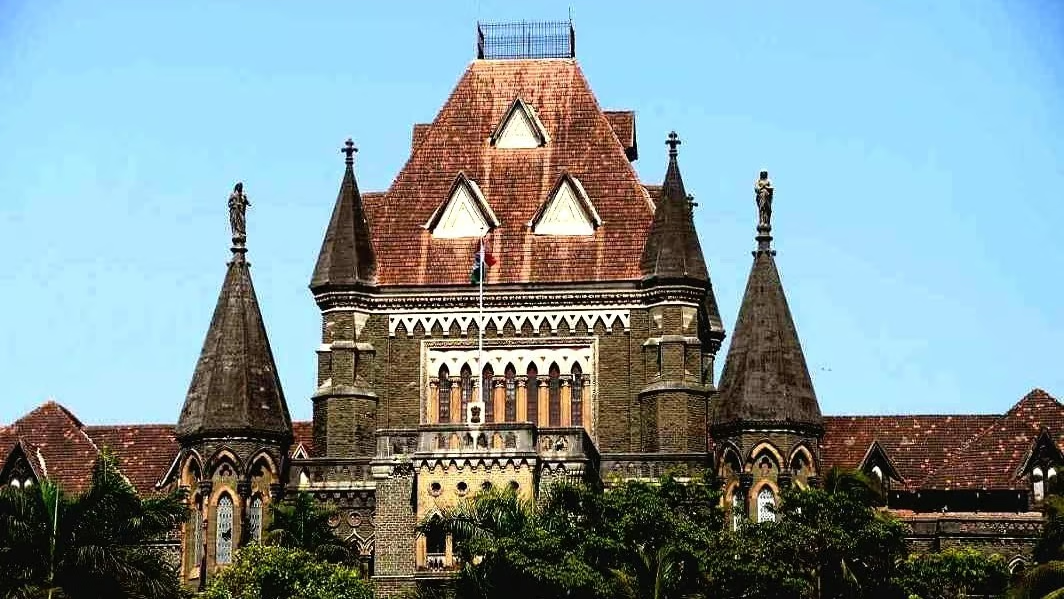


Wedding reception is not as a part of marriage ritual: Editorial Opinion
This ruling by the Bombay High Court regarding jurisdiction in divorce cases highlights the necessity for precise legal definitions concerning marriage rituals and related events. Through its determination to establish jurisdiction according to the site of the marriage ceremony, the Court has promoted clarity and uniformity in settling jurisdictional conflicts. In doing so, it has upheld the fundamental tenets of fairness and justice within matrimonial proceedings.
By drawing a clear line between the core marital ceremony and subsequent celebrations like wedding receptions, the Court has ensured a more consistent application of the law. This decision not only provides guidance for future cases but also reinforces the importance of legal precision in understanding complex matters of family law.
If you enjoyed this blog post, be sure to subscribe for more engaging content in the future! Stay updated on the latest developments and discussions by clicking the subscribe button above. Thank you for your support!
You can now subscribe to our Ponder Page WhatsApp channel
Source: Chatterjee Law Chambers





Leave a Reply