
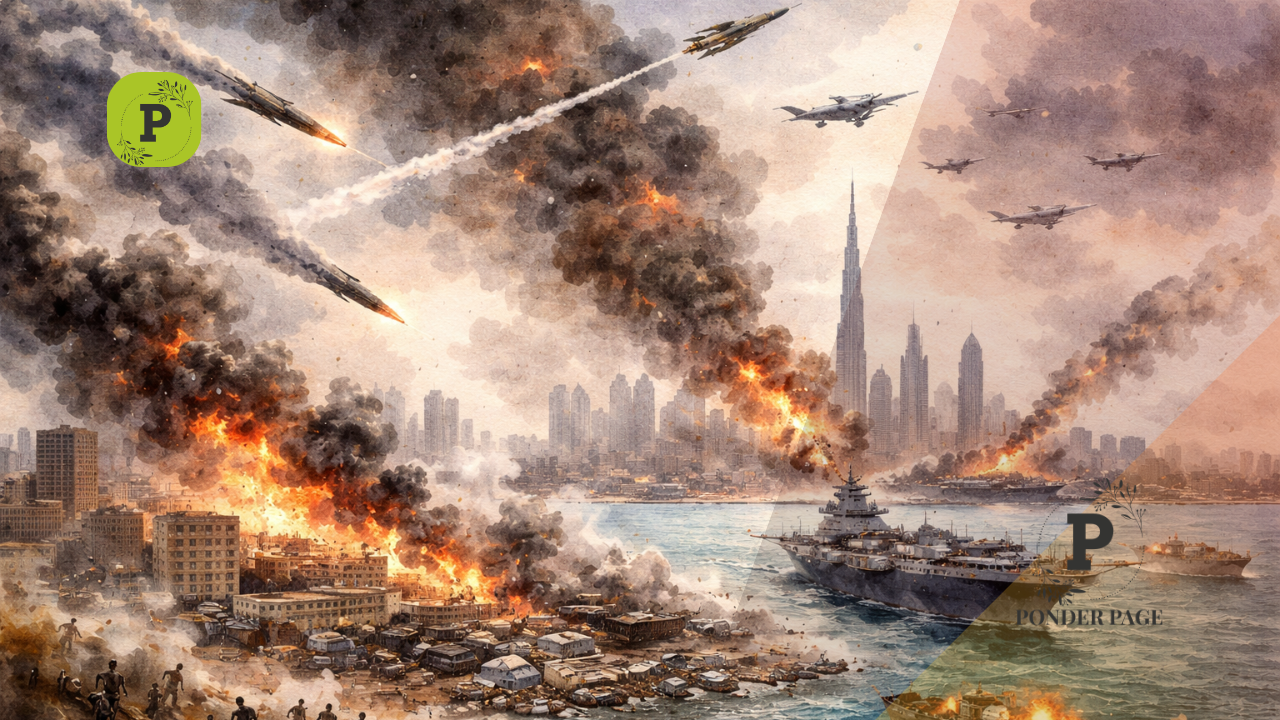
The Uncertain Future of the Middle East: There is an unmistakable atmosphere of fear across the Middle East today. In cities once known for their glittering skylines and economic ambition, anxiety has replaced confidence. From Israel to the Gulf, from Iraq to Iran, the possibility of destruction arriving from the sky at any moment has become a shared reality. Civilian or soldier, resident or visitor, no one feels entirely safe.
At the heart of this crisis lies a dramatic escalation between Iran, United States, and Israel. What began as a calculated military operation has evolved into a confrontation that threatens to reshape the region’s strategic balance for years to come.
(You can now subscribe to our Ponder Page WhatsApp channel)

Table of Contents
Operation Epic Fury and the Shockwaves That Followed
Within hours of the launch of Operation Epic Fury, Iran retaliated with a wave of missile strikes targeting American and Israeli positions across the Middle East. Sirens blared in Israeli cities, explosions were reported in Jerusalem, and chaos rippled through urban centers that had long prepared for such scenarios but hoped never to witness them at this scale.

The confrontation quickly widened. American bases in Bahrain and Kuwait were struck. Oil tankers linked to Western interests were targeted near the Strait of Hormuz. Reports emerged of attacks on commercial infrastructure, including ports and airports in the Gulf. Even the USS Abraham Lincoln aircraft carrier was reportedly targeted, though official confirmations remain limited.
The Strait of Hormuz, through which roughly one-fifth of the world’s oil supply flows, became a focal point. Tanker traffic slowed dramatically. Global markets reacted instantly, with oil prices surging and stock markets trembling under renewed geopolitical uncertainty.
A Leadership Decapitated, but Not Defeated
The crisis intensified following the assassination of Iran’s Supreme Leader, Ayatollah Ali Khamenei. In coordinated strikes, more than forty senior Iranian commanders were eliminated. On paper, this appeared to be a devastating blow. Iran’s centralized leadership was severely weakened. Its air defense systems had already suffered significant damage.
Yet Tehran did not collapse.
Instead, an Interim Leadership Council assumed control, and the Islamic Revolutionary Guard Corps signaled that its most intense phase of operations was still to come. The Iranian president declared retaliation not only justified, but obligatory.
The assumption in Washington and Tel Aviv had been that such a leadership vacuum would accelerate surrender or internal fragmentation. That assumption now appears flawed.
The Mosaic Defense Doctrine: Decentralization as Survival
The reason Iran has not folded lies partly in a doctrine developed years ago: the decentralized “Mosaic Defense” strategy.

Rather than relying on a single command structure, Iran divided its defense framework across its 31 provinces. Each operates with a degree of autonomy. Even if central command is crippled, local units retain authority to continue operations. It is a layered, guerrilla-style system designed specifically to counter technologically superior adversaries.
The logic is stark: remove the head, and the body keeps fighting.

This doctrine emerged from lessons learned during conflicts in Iraq and Afghanistan. Iran concluded that asymmetrical warfare, long, decentralized, and attritional, can exhaust even the most powerful militaries.
Ballistic Missiles and the Race Against Interceptors
Another critical factor is Iran’s missile arsenal. Estimates suggest Iran possesses between 2,000 and 2,500 operational ballistic missiles with ranges capable of striking targets up to 2,500 kilometers away. This puts virtually every U.S. base in the region within reach.
Among the more advanced systems reportedly in play are the Fatah hypersonic series and the Khorramshahr-4 medium-range ballistic missile. Some feature advanced reentry vehicles capable of deploying decoy swarms, multiple objects designed to confuse missile defense systems such as Patriot, THAAD, and Arrow.
This introduces a dangerous arithmetic. Interceptor missiles are limited and expensive. If Iran launches volleys equipped with decoys, defending forces may be forced to expend multiple interceptors per incoming missile. The conflict thus becomes a race: whose missile stockpile depletes first?
Oil as a Strategic Weapon
The second pillar of Iran’s retaliation strategy targets energy infrastructure. By threatening or disrupting traffic in the Strait of Hormuz, Tehran applies economic pressure not only on Washington but on global markets.
Major shipping companies paused crossings. Insurance costs surged. Oil prices spiked within hours. The message was unmistakable: if military power is brought to Iran’s doorstep, Tehran can strike at the economic lifeline of its adversaries.
This approach carries risks. Civilian economies in the Gulf could suffer severe damage. Over time, regional states may align even more closely with Washington in response. Yet Tehran appears focused less on long-term diplomacy and more on immediate cost imposition.
The Political Gamble in Washington
For U.S. President Donald Trump, the stakes are immense. The expectation of a swift campaign – cripple leadership, force surrender, declare victory – has not materialized. Iran has refused negotiations and rejected calls for ceasefire.
Complicating matters further, the International Atomic Energy Agency reportedly stated that no recent attacks had occurred on Iranian nuclear facilities in the days preceding escalation. Additionally, briefings to Congress suggested Iran was not imminently preparing to attack the United States.
These revelations raise uncomfortable questions about strategic calculations and political motivations.
History casts a long shadow. Prolonged engagements in the Middle East have repeatedly demonstrated that aerial bombardment alone rarely achieves regime change. Ground intervention carries staggering costs. The specter of another drawn-out conflict (echoing Afghanistan) looms large in policy debates.
Revenge, Nationalism, and the Closing Window for Revolution
Before the war, internal dissatisfaction simmered within Iran. Protests had erupted in previous years. Economic hardship and political repression had fueled public frustration.
Yet external attacks often trigger a different response: consolidation. The assassination of Ayatollah Khamenei during the holy month of Ramadan has inflamed religious and national sentiment. What might once have been domestic dissent risks transforming into defiant unity against a perceived foreign aggressor.
The calculation that military strikes would catalyze regime collapse may have underestimated this dynamic. In moments of existential crisis, populations frequently rally behind even unpopular governments.
How Does This End? The Uncertain Future of the Middle East
Experts now ask a question that perhaps should have preceded the first missile launch: what is the endgame?
Iran appears determined to impose tangible costs before considering negotiations. Washington seeks strategic leverage without descending into an endless war. Israel prioritizes security but faces sustained missile pressure.
The conflict contains multiple flashpoints capable of escalation – oil disruption, civilian casualties, regional proxy involvement, or miscalculated strikes on high-value assets. Each carries the potential to widen the war beyond its current scope.
The ultimate outcome may not be decided solely on the battlefield. It may hinge on economic endurance, political resilience, and public opinion – both within Iran and in the United States.
What began as a demonstration of power has evolved into a test of strategy, patience, and consequence. Whether this confrontation becomes a turning point toward de-escalation or the opening chapter of a prolonged regional war remains uncertain.
But one truth is clear: the Middle East stands at a precipice, and the decisions made in the coming days will shape not only the region’s future, but the global order itself.


What are your thoughts on this article? Let us know in the comments below. If you enjoyed this article, be sure to subscribe for more engaging content in the future! Stay updated on the latest developments and discussions by clicking the subscribe button above. Thank you for your support!
📢 Dive into the latest discussions on social & trending topics! 🌍💬 Subscribe to Ponder Page for thought-provoking articles and interviews that dissect current issues. Don’t miss out on insightful content—hit that like & subscribe button now!




Leave a Reply