
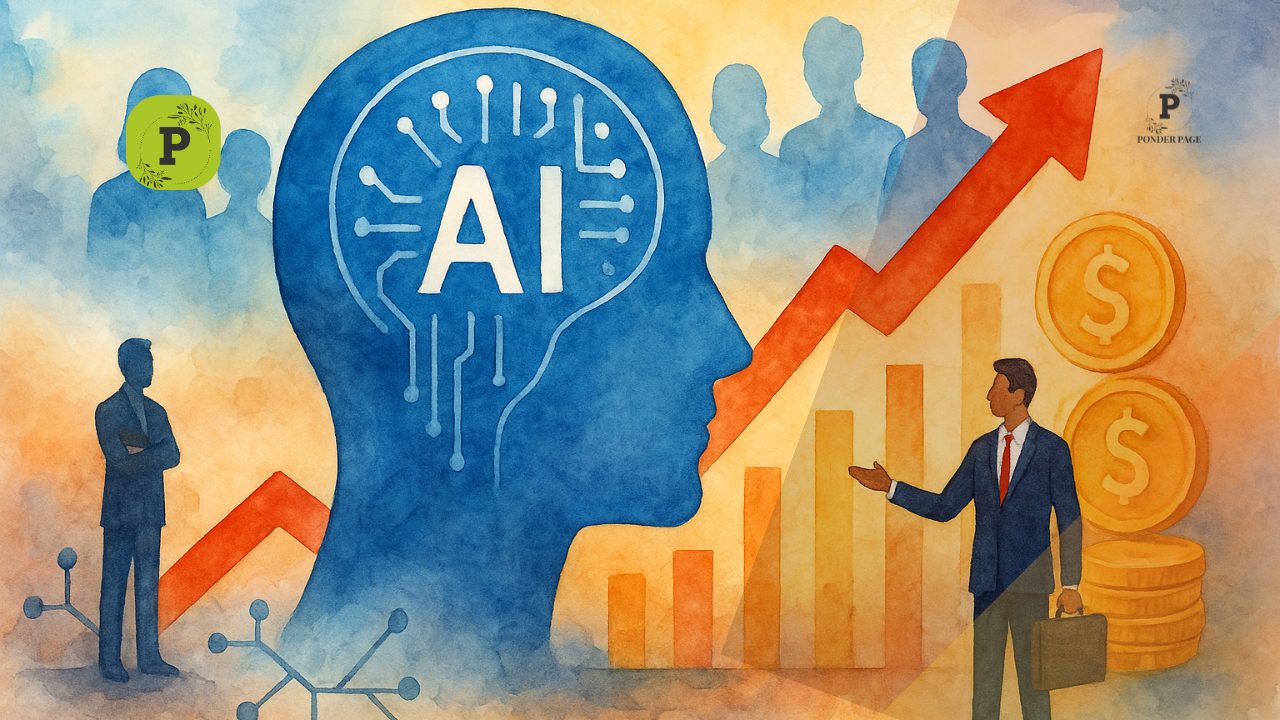
The Rise of Artificial Intelligence Craze: Just a few years ago, Artificial Intelligence was hailed as the next big revolution — a technology that would reshape industries, redefine jobs, and change how we live and think. The turning point came in late 2022 when OpenAI launched ChatGPT. Within a week, it reached a million users, and in just a few months, crossed 100 million. It became the fastest-growing digital product in history. Suddenly, AI was no longer confined to research labs; it was everywhere — from Silicon Valley boardrooms to startups in Bengaluru.
Every company wanted to be “AI-powered.” The term became a marketing slogan rather than a measure of innovation. The global corporate investment in AI crossed a staggering $330 billion by 2025. Startups that barely had a working product added the “AI” tag to attract investors. According to data from venture capital funding, nearly 71% of the total VC money in early 2025 went to AI-linked ventures. Adding an “AI” label to any product could inflate its valuation by 40% — even if it had zero revenue.
This frenzy led to a global “AI gold rush,” where logic was replaced by fear of missing out. But like every bubble, behind the excitement lay deep uncertainty.
(You can now subscribe to our Ponder Page WhatsApp channel)

Table of Contents
The Warning Signs: When Innovation Becomes Speculation
Economists Brent Goldfarb and David Kirsch, in their book Bubbles and Crashes, outline four major signs that indicate when technological innovation turns into speculative mania: uncertainty, pure plays, retail investor mania, and a compelling narrative. Unfortunately, AI seems to be ticking all four boxes today.
Uncertainty
Despite billions poured into AI firms, there’s still no clear business model. Popular platforms like ChatGPT run on massive computing costs that exceed the revenue they generate. An MIT study revealed that 95% of generative AI investments have yielded zero measurable returns. In other words, companies are losing money while trying to look futuristic.
Pure Plays
A worrying trend is that many AI startups depend entirely on this one technology. Instead of focusing on real-world applications, a large chunk of AI funding is circulating among the same players. Big names like OpenAI, Nvidia, and Oracle are intertwined in what economists call mutual leverage feedback. For instance, Nvidia invests billions into OpenAI, which in turn buys Nvidia chips. Oracle powers OpenAI’s data systems — which again depend on Nvidia hardware. This flow of money artificially inflates valuations and gives an illusion of booming growth.
The AI Hype and the New-Age Dot Com Moment
If all this sounds familiar, it’s because we’ve seen it before. Between 1995 and 2000, the dot-com bubble built similar castles in the air. Investors threw money into internet startups without understanding how they’d make profits. When the bubble burst in 2000, nearly $5 trillion in market value vanished. Giants like Amazon saw their stocks fall by 90%.
Today’s AI enthusiasm mirrors that same irrational exuberance. Nvidia’s valuation alone has crossed $5 trillion — more than the GDP of countries like India or Canada. The company now represents nearly 8% of global stock market value. But the concern is that much of this value is propped up by expectations rather than sustainable earnings.
Retail Investors and the Speculative Spiral
What makes the situation riskier is the participation of ordinary investors. In 2024 and 2025, Nvidia became the most bought retail stock globally. People are investing not because they understand the technology but because they believe it’s the future. This was exactly how the internet mania unfolded two decades ago.
Even pension funds and private credit institutions are entering the AI-linked debt market — products that are opaque and risky. If the AI bubble bursts, it won’t just hit tech billionaires; it will ripple across retirement savings, mutual funds, and global credit markets.
The Story that Fuels the Bubble
Every bubble needs a story. For the internet, it was “the web will change everything.” For AI, it’s “intelligence will be automated.” Visionaries like Sam Altman, Elon Musk, Sundar Pichai, and Mark Zuckerberg are driving this belief that AI will solve all problems — from curing cancer to reversing climate change. The result is blind optimism where caution is replaced by urgency.
As of now, seven tech giants — often called the Magnificent 7 Stocks — control nearly a third of the S&P 500’s total market valuation. Most of them are deeply tied to AI. This kind of market concentration creates fragility. If even one company underperforms, it can trigger a chain reaction across the global markets.
What Happens If the AI Bubble Bursts?
If history is any guide, the aftermath could be painful. A collapse would affect three key areas:
1. Capital Spending:
The current AI infrastructure boom — data centers, chips, cloud systems — represents a $750 billion pipeline. If investor confidence wanes, these projects will halt overnight. Economists are already warning of a “GPU glut,” similar to the overbuilt fiber networks of the early 2000s.
2. Credit Markets:
Many banks and private credit firms have issued loans based on projected AI profits. If valuations crash, defaults will follow, creating a liquidity crunch similar to the 2008 financial crisis.
3. Jobs:
Ironically, even a crash won’t save jobs. Companies have already committed to automation to cut costs. Roles like customer support, data entry, and junior coding are the first to go. While valuations might fall, layoffs could rise.

The Ripple Effect on India
Though India isn’t at the epicenter of the AI boom, its economy is closely tied to it. Indian IT giants like TCS, Infosys, and Wipro are implementing AI solutions for global clients. A slowdown in US and European tech spending would directly hit their revenues. Funding for Indian AI startups, which crossed $500 million in early 2025, is also likely to shrink as global investors grow cautious.
However, there’s a silver lining. If the AI bubble bursts in the West, India could benefit from cheaper, proven technologies. Just as the IT outsourcing boom followed the dot-com crash, India could emerge as a hub for cost-efficient AI solutions in sectors like healthcare, agriculture, and logistics.


The Rise of Artificial Intelligence Craze: Preparing for the Coming Storm
The AI revolution is real, but so is the hype surrounding it. Every technological leap goes through a phase of over-expectation before finding its true equilibrium. The AI bubble, if it bursts, could wipe out trillions in paper wealth — but it will also filter out the noise, leaving behind genuine innovation.
India, like the rest of the world, must brace for impact — not by rejecting AI, but by understanding it, regulating it wisely, and investing where it truly adds value. Because when this bubble finally bursts, it won’t just test companies — it will test our collective preparedness for the future.
What are your thoughts on this article? Let us know in the comments below. If you enjoyed this article, be sure to subscribe for more engaging content in the future! Stay updated on the latest developments and discussions by clicking the subscribe button above. Thank you for your support!
📢 Dive into the latest discussions on social & trending topics! 🌍💬 Subscribe to Ponder Page for thought-provoking articles and interviews that dissect current issues. Don’t miss out on insightful content—hit that like & subscribe button now!





Leave a Reply