
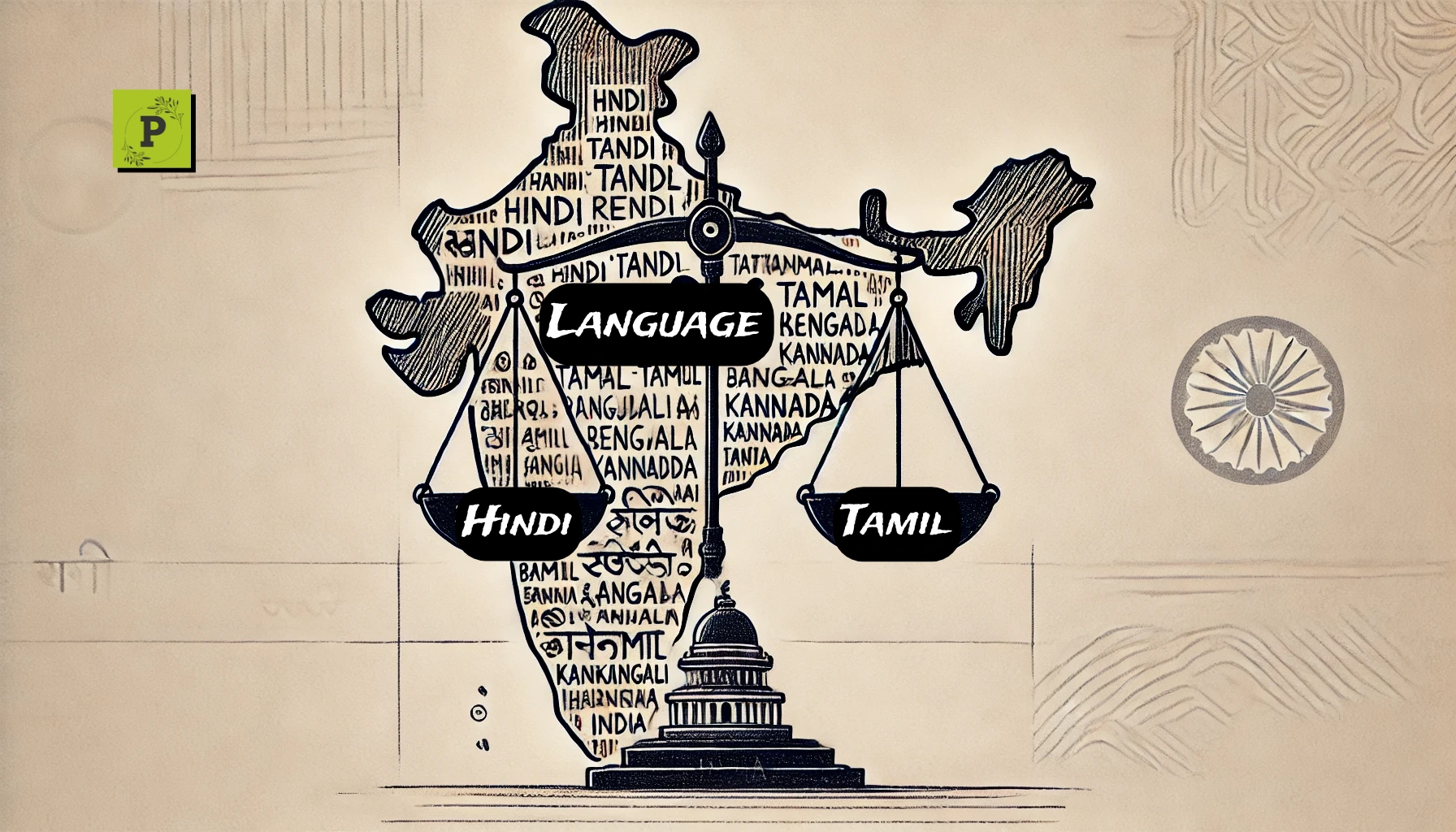
The Hindi Imposition Debate: On January 26, 1965, while the rest of India celebrated its 16th Republic Day, the state of Madras (now Tamil Nadu) witnessed violent protests. The reason for this unrest was language. The question of which language should serve as India’s official mode of communication had been contentious since independence. Many political leaders pushed for Hindi to be the national language, triggering opposition from non-Hindi-speaking states, particularly in the South.
(You can now subscribe to our Ponder Page WhatsApp channel)

Table of Contents
The Constituent Assembly Debate: A Warning from the South
The debate over language was fierce in the Constituent Assembly in 1946. T.T. Krishnamachari, a leader from the Madras Congress, issued a stark warning. He cautioned that many people in the South feared the imposition of Hindi and that such a move could lead to a new form of division in the country. His words were clear: “There are people in the South who want another partition…. My friends in Uttar Pradesh have to decide whether they want a united India or just a Hindi India.”
A Temporary Compromise: Hindi and English Coexist
To maintain unity, a compromise was reached. It was decided that for 15 years, both Hindi and English would remain the official languages of India. However, by 1965, this arrangement was set to expire, and the transition to Hindi as the sole official language was imminent. This change was seen as a direct threat in non-Hindi-speaking regions, particularly in Tamil Nadu.
The 1965 Anti-Hindi Agitation: A Turning Point
When Prime Minister Lal Bahadur Shastri, a strong proponent of Hindi, and the Congress Chief Minister of Madras pushed for a three-language formula—introducing Hindi in schools alongside Tamil and English—Tamil Nadu erupted in protest. The Dravida Munnetra Kazhagam (DMK) declared January 26, 1965, as a day of mourning. Thousands of students took to the streets, burning railway coaches and Hindi signage. Some even sacrificed their lives in protest. Official estimates recorded at least 70 deaths within two weeks.
Following the violent protests, the central government agreed to continue using both Hindi and English for official communication. Tamil Nadu refused to implement the three-language formula and instead adopted a two-language system—Tamil and English—a policy that continues to this day.
Political Ramifications: DMK’s Rise to Power
The 1967 state elections saw the DMK emerge victorious, ending Congress’s rule in Tamil Nadu. The anti-Hindi agitation had significantly strengthened the Dravidian movement, and the issue of linguistic identity became central to Tamil politics.

The Modern-Day Language Controversy: Renewed Tensions
Recent developments indicate that history may be repeating itself. Tamil Nadu’s Chief Minister, M.K. Stalin, has accused the central government of attempting to impose Hindi on the state. The DMK claims that by withholding an education fund of ₹2,000 crore, the central government is coercing Tamil Nadu into accepting the three-language formula. In response, Stalin has stated that Tamil Nadu is prepared to fight another language war to protect its linguistic identity.
DMK leaders argue that their commitment to Tamil is as strong as the Bharatiya Janata Party’s (BJP) commitment to religion. However, language imposition is just one of several issues fueling tensions between North and South India.
Delimitation and Financial Devolution: The North-South Divide
On March 5, Chief Minister Stalin convened an all-party meeting in Tamil Nadu. Even the main opposition party, AIADMK, participated, and a resolution was passed demanding that the process of delimitation be frozen for another 30 years. This is a significant development, akin to Congress and BJP agreeing on a major national issue.
Union Home Minister Amit Shah has attempted to reassure South Indian leaders that the upcoming delimitation process will not reduce their parliamentary representation. However, many in the South remain unconvinced. The concern is that North Indian states, due to their larger populations, will gain disproportionate control over Parliament, marginalizing the South.
The Impact of Delimitation on South India
Delimitation, the process of redrawing parliamentary constituencies based on population, was frozen in 1971 to prevent states with lower population growth from being penalized. If implemented using 2026 census data, South India’s parliamentary seat share could fall from 24% to 19.5%, while Uttar Pradesh and Bihar’s share would increase from 32% to 38-40%. This would mean that just two states, Uttar Pradesh and Bihar, could wield more influence in Parliament than all of South India combined.
To prevent this, 35 South Indian parties have demanded that the 1971 data continue to be used for determining seat distribution. The fear is that a sudden increase in North India’s representation would permanently shift the balance of power.
The Financial Imbalance: Taxation and Resource Allocation
Another major grievance among South Indian states is financial devolution. Tamil Nadu, Karnataka, and Kerala contribute significantly to India’s GDP but receive a smaller share of central government funds. For instance, Tamil Nadu contributes ₹1 to the central pool but gets only 29 paise in return, whereas Uttar Pradesh gets ₹2.71 and Bihar receives ₹7. This disparity has fueled resentment, with many in the South arguing that their economic success is being punished while poorer states receive disproportionate benefits.
The Politics of Identity: The Dravidian Resistance
Since the early 20th century, the Dravidian movement has resisted Hindi imposition, seeing it as a tool for North Indian cultural dominance. Leaders like Periyar and Annadurai promoted the idea that Dravidians are the original inhabitants of South India, while Aryans from the North introduced caste-based oppression and linguistic hegemony. This sentiment has persisted, influencing Tamil Nadu’s political landscape for decades.
Education and Language Policy: The Tamil Nadu Model
Tamil Nadu has consistently opposed the three-language formula. The state argues that English is the true link language of India, facilitating access to global opportunities. Unlike in the Hindi belt, where Sanskrit is often chosen as a third language but rarely mastered, Tamil Nadu focuses on English and Tamil. The state leads in educational indicators, further justifying its stance against the central government’s education policies.


The Hindi Imposition Debate: A Divided Nation?
The language debate is deeply intertwined with India’s federal structure, economic policies, and political representation. As Tamil Nadu and other Southern states push back against what they perceive as Northern dominance, the divide between North and South India is widening. With upcoming elections, language and representation will be pivotal issues. Whether the central government finds a way to address these concerns or exacerbates the divide remains to be seen.
History has shown that linguistic and cultural imposition can lead to unrest. If India is to remain a united federation, it must recognize and respect its linguistic diversity. Tamil Nadu’s stance on Hindi is not about rejecting India but about protecting its rich heritage. The challenge for policymakers is to strike a balance that ensures both unity and diversity, without undermining the identity of any region.
What are your thoughts on this article? Let us know in the comments below. If you enjoyed this article, be sure to subscribe for more engaging content in the future! Stay updated on the latest developments and discussions by clicking the subscribe button above. Thank you for your support!
📢 Dive into the latest discussions on social & trending topics! 🌍💬 Subscribe to Ponder Page for thought-provoking articles and interviews that dissect current issues. Don’t miss out on insightful content—hit that like & subscribe button now!



Leave a Reply