
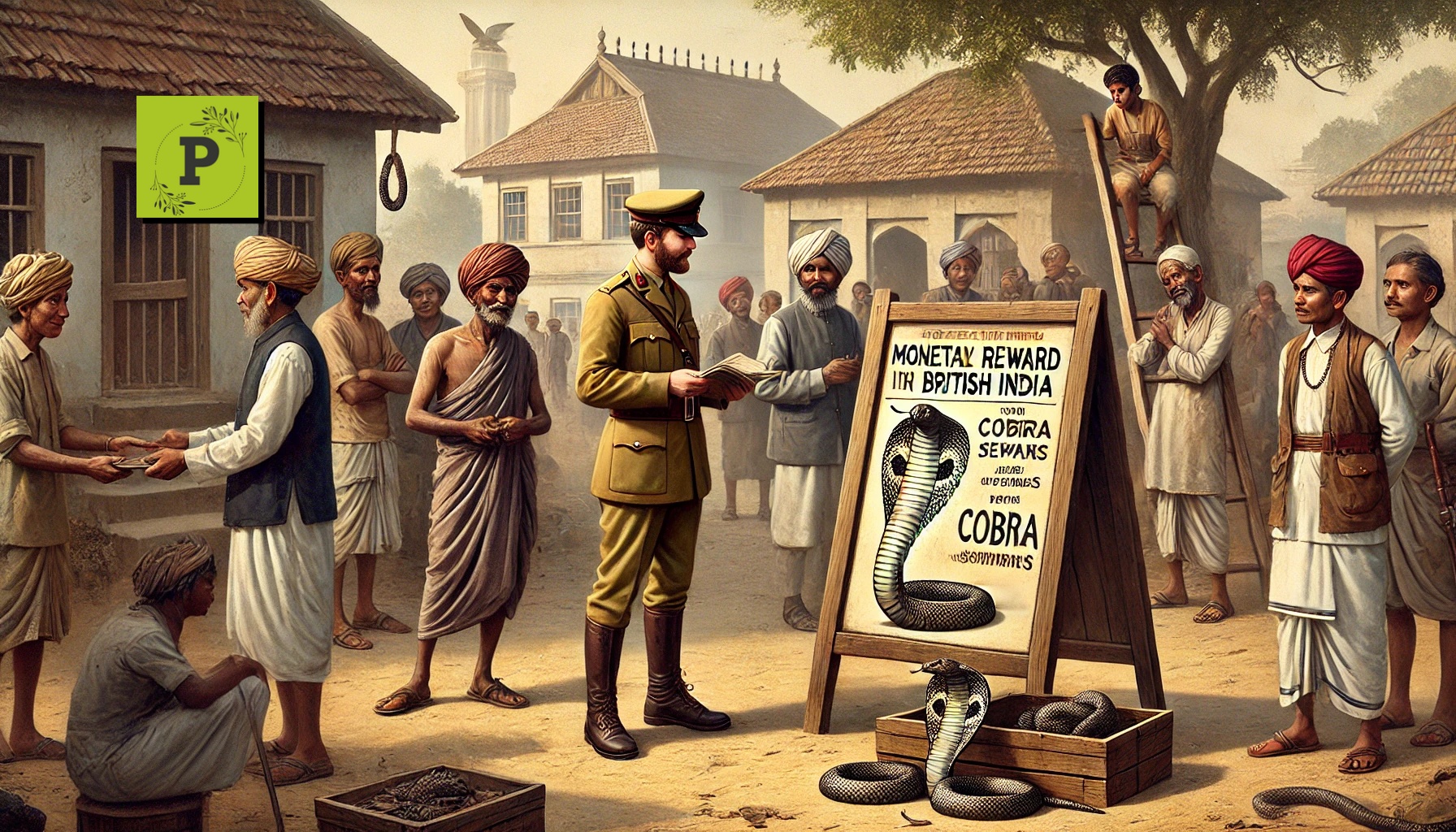
The Cobra Effect: The period of British colonial rule in India was marked by various social, economic, and administrative policies that often led to unexpected and far-reaching outcomes. Among these, one of the most fascinating and frequently cited examples is the story of the cobra snakes in Delhi during British rule. This tale, while seemingly simple, serves as a profound lesson in unintended consequences and the challenges of policy-making. Known as the “Cobra Effect,” this story illustrates how well-intentioned solutions can sometimes backfire.
(You can now subscribe to our Ponder Page WhatsApp channel)

Table of Contents
The Problem: An Overpopulation of Cobras in Delhi
During the British colonial period, Delhi faced a significant problem with cobras. These venomous snakes posed a considerable threat to the safety and lives of the city’s residents. Cobras were not only a danger to humans but also a symbol of fear and uncertainty, particularly in densely populated areas where encounters with these reptiles were more likely.
In an attempt to address this issue, the British administration decided to take swift and decisive action. The goal was simple: reduce the population of cobras in the city and make Delhi a safer place for its inhabitants. However, the approach they chose turned out to be more problematic than the original issue.
The Solution: A Bounty System
The British authorities introduced a bounty system to tackle the cobra problem. Under this scheme, a monetary reward was offered to anyone who killed a cobra and brought its skin or head as proof. This incentive was designed to encourage the local population to actively participate in reducing the number of snakes.
At first, the policy seemed to be working. Cobra skins began pouring in, and it appeared that the population of these dangerous reptiles was declining. The government officials were satisfied, believing that their solution was both effective and efficient. However, this initial success was short-lived, as the unintended consequences of the policy soon began to manifest.
The Unintended Consequences: Breeding Cobras for Profit
What the British authorities failed to anticipate was the ingenuity of human behavior when financial incentives are involved. Some enterprising individuals saw the bounty system as an opportunity to earn easy money. Rather than hunting wild cobras, they began breeding them in secret.
Cobra farms sprung up in various parts of Delhi, where snakes were bred solely for the purpose of claiming the government reward. This led to an ironic and alarming situation: instead of reducing the cobra population, the policy was indirectly contributing to its growth.
When the British administration eventually discovered this scheme, they were understandably outraged. In response, they decided to cancel the bounty system altogether. However, this decision led to yet another unintended consequence.
The Aftermath: An Even Bigger Problem
With the bounty system abolished, the cobra breeders found themselves with a large number of snakes that were now worthless. Since keeping them served no purpose, these breeders released the cobras into the wild. As a result, the population of cobras in Delhi increased dramatically, far surpassing its original levels.
What started as a well-meaning attempt to solve a public safety issue had now become an even bigger problem. The “Cobra Effect,” as this phenomenon came to be known, is now a term used in economics and policy-making to describe situations where solutions to problems create worse outcomes due to unforeseen consequences.
The Broader Lesson: The Complexity of Policy-Making
The story of the cobra snakes in British India offers a timeless lesson in the complexities of policy-making and the importance of understanding human behavior. While the British authorities were well-intentioned in their efforts, their failure to anticipate the possible reactions of the local population led to the failure of their policy.
This phenomenon is not limited to colonial India. The Cobra Effect has been observed in various contexts around the world. For instance:
- In Vietnam during French colonial rule, a similar policy to control the rat population led to locals breeding rats to claim rewards.
- In modern-day environmental policies, subsidies for biofuels have sometimes led to unintended consequences, such as deforestation to make way for biofuel crops.
These examples highlight the importance of carefully designing policies that consider potential loopholes and human ingenuity.
How to Avoid the Cobra Effect
To avoid falling into the trap of the Cobra Effect, policymakers must:
- Understand Incentives: Analyze how individuals or groups might respond to the incentives created by a policy.
- Pilot Programs: Test policies on a small scale before implementing them widely to identify potential unintended consequences.
- Monitor Outcomes: Continuously monitor the results of a policy and make adjustments as needed to address emerging issues.
- Engage Stakeholders: Consult with local communities and experts to gain insights into possible reactions and loopholes.
- Evaluate Alternatives: Consider multiple solutions and weigh their potential risks and benefits before deciding on a course of action.


The Cobra Effect: A Tale Worth Remembering
The Cobra Effect remains a powerful reminder of the unintended consequences that can arise from poorly planned policies. It underscores the need for foresight, adaptability, and a deep understanding of human behavior in addressing complex problems.
As we sail through the challenges of modern governance, economics, and social development, the story of the cobras in British India serves as a cautionary tale. It reminds us that even the most well-intentioned solutions can sometimes have unforeseen outcomes, and that careful planning and continuous evaluation are essential in crafting effective policies.
By learning from the past, we can strive to create policies that not only solve problems but do so in a way that minimizes the risk of creating new ones.
What are your thoughts on this article? Let us know in the comments below.
If you enjoyed this article, be sure to subscribe for more engaging content in the future! Stay updated on the latest developments and discussions by clicking the subscribe button above. Thank you for your support!
📢 Dive into the latest discussions on social & trending topics! 🌍💬 Subscribe to Ponder Page for thought-provoking articles and interviews that dissect current issues. Don’t miss out on insightful content—hit that like & subscribe button now!





Leave a Reply