
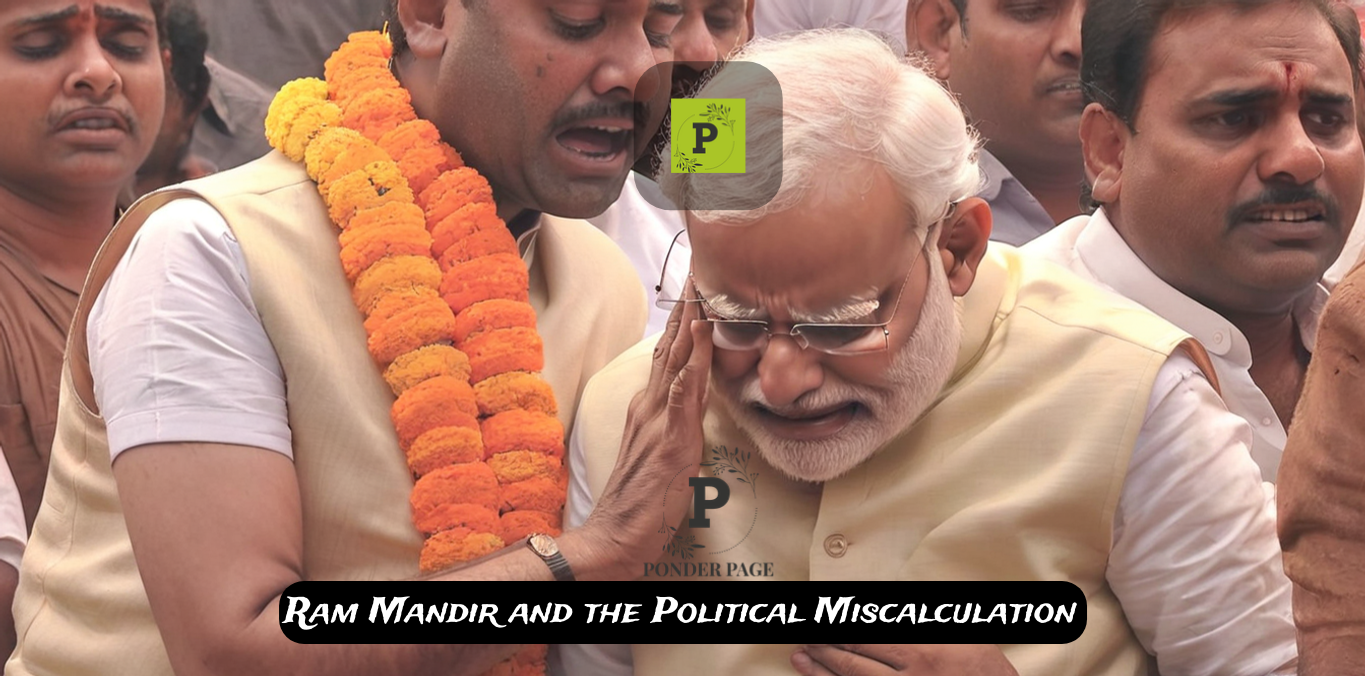
Ram Mandir and the Political Miscalculation: The Context and the Event – Earlier this year, in January, a significant event took place. After 500 years, the grand Ram Mandir in Ayodhya saw the reinstallation of Lord Ram Lalla. The Bharatiya Janata Party (BJP) believed this would spark a national sentiment, giving them a significant boost in the upcoming elections.
However, as the elections drew to a close, it became apparent that the anticipated national sentiment around the Ram Mandir did not materialize, not even within Uttar Pradesh (UP). Contrary to what the fraudulent exit polls had predicted, BJP’s strength was reduced by half in UP. Even if BJP had formed a coalition government or failed to come to power independently, it would have been somewhat acceptable. However, what BJP and its supporters found hardest to accept was their defeat in the Faizabad Lok Sabha constituency, home to Ayodhya.
(You can now subscribe to our Ponder Page WhatsApp channel)

Table of Contents
The Shocking Defeat
How could it happen that in Ayodhya, where the BJP’s entire ideological laboratory and the birthplace of their Hindutva movement exist, an MLA from the Samajwadi Party (SP), Abhdesh Prasad, belonging to the Dalit community, defeated the two-time sitting MP Lallu Singh by 50,000 votes? This was a constituency with a non-reserved seat, and the loss was unprecedented. Ayodhya, where the grand Ram Mandir was expected to galvanize votes nationwide, saw BJP’s defeat. Many, including party members and fraudulent exit pollsters, never anticipated such an outcome.
Media and Public Reaction
Deepak Chaurasia expressed his dismay on Twitter, noting that Ayodhya, once deserted when Sita was exiled, was now thriving with tourism and employment opportunities due to the grand Ram Mandir. He questioned why the very people who brought Ram Lalla back were not voted for. Chaurasia’s frustration highlighted a transactional relationship, where religious sentiment was expected to translate directly into votes, an approach that seemed to offend the sanctity of the Ram Mandir issue itself.
-
 Ceasefire Politics and Rise of Pakistan as a Global Mediator
 -
 From Protest to Turning Point: The Story of Jallianwala Bagh and Its Aftermath
 -
 The Roots of the India China Border in Ladakh
 -
 The Origins of the Indian National Congress: A Turning Point in Colonial India
 -
 The Evolution of Money: Life Before Currency
The Underlying Issues
The defeat in Ayodhya wasn’t just about miscalculation; it pointed to deeper issues. Reports of forced evictions and demolitions of homes and businesses to make way for the grand Ram Path emerged, with promises of compensation often unfulfilled. One notable case was that of Sushila Devi, whose house was demolished for the Ram Path, leaving her homeless and eventually in an old age home. This raised significant questions about the BJP’s approach to modernization and development, often at the cost of local livelihoods and homes.

Ground Realities and Political Missteps
Local journalists and stringers knew the ground realities in Ayodhya, which national anchors and exit pollsters in their Delhi studios missed. More than 2,200 shops, 800 homes and many were reportedly demolished for the Ram Path project. These actions alienated local residents, who saw their homes and livelihoods destroyed for a project that seemed more geared toward tourism than their well-being.
The Broader Political Landscape
The BJP’s defeat in Ayodhya also highlighted a significant shift in the political landscape. The idea that Hindus would automatically vote for BJP, especially after the Ram Mandir event, was shattered. In UP, with a significant Hindu population, the vote did not swing entirely in BJP’s favor. This indicated a growing impatience with the BJP’s Hindutva experiment and a rejection of the idea that Hindu identity was intrinsically linked to BJP support.


Ram Mandir and the Political Miscalculation: A Need for Reevaluation
The BJP’s strategy of linking Hinduism with political loyalty to Modi faced a severe setback. The grand narrative that “good Hindus vote for Modi” was challenged as local issues, caste affiliations, and practical concerns took precedence over religious sentiments.
This election reflected the importance of addressing local grievances and respecting the social fabric, rather than relying solely on grandiose religious symbolism for political gains. The unexpected defeat in Ayodhya serves as a reminder that political calculations must account for the ground realities and sentiments of the people, not just ideological or religious rhetoric.
If you enjoyed this blog post, be sure to subscribe for more engaging content in the future! Stay updated on the latest developments and discussions by clicking the subscribe button above. Thank you for your support!




Leave a Reply