
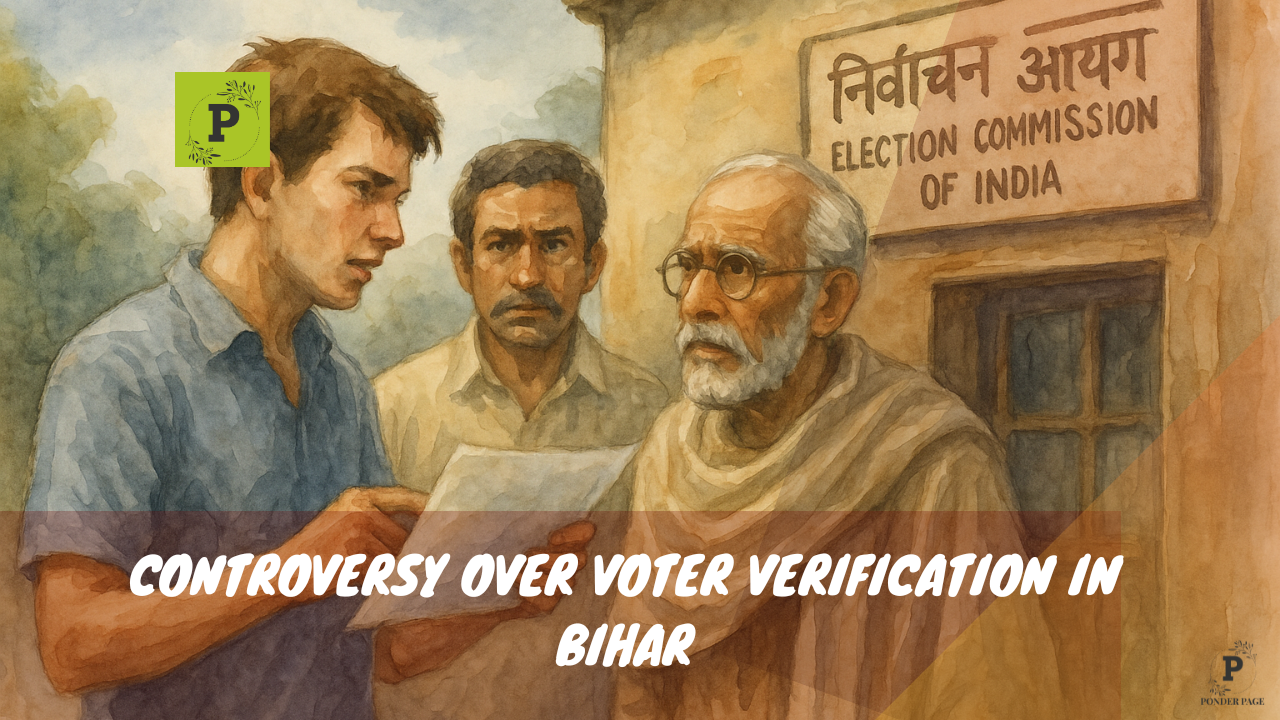
Controversy Over Voter Verification in Bihar: Over the past year, the Supreme Court has actively intervened to safeguard democratic processes, be it striking down the controversial Electoral Bonds or scrutinizing the conduct of the Election Commission during crucial times. The latest flashpoint: a Special Intensive Revision (SIR) of the electoral rolls underway in Bihar.
(You can now subscribe to our Ponder Page WhatsApp channel)

Table of Contents
What is the Special Intensive Revision and Why Is It Important?
The Special Intensive Revision is a mechanism allowed under Section 21 of the Representation of People Act. It empowers the Election Commission to revise and verify electoral rolls, especially in cases where large-scale migration, duplication, or outdated entries are suspected. This process was last carried out in 2003 and is now being revived in Bihar. While the intention may seem procedural, the method, timing, and political context have raised serious concerns.
Why Now? Why Only Bihar?
The Lok Sabha elections earlier concluded smoothly in Bihar, with no major discrepancies or complaints raised. So, it’s perplexing why this massive verification exercise is being carried out now. The Supreme Court has also asked why only Bihar has been chosen for such a special revision. Why is the process being launched at a time when many parts of the state are flooded, and just after a national election?
These questions have led many observers to suspect that this is not just a bureaucratic exercise, but possibly a politically motivated move with deeper implications for the democratic process.
The Document Dilemma: Who Gets to Vote?
The Election Commission has listed several documents necessary for voter verification. However, surprisingly, Aadhaar cards, voter ID cards, driving licenses, and ration cards—documents that most citizens already possess—are not included in this list.

This exclusion becomes even more confusing considering that these same documents are routinely used for acquiring caste certificates, opening bank accounts, linking PAN numbers, and other official tasks. The Supreme Court has questioned this inconsistency. If Aadhaar is good enough for essential financial and administrative functions, why is it not accepted as proof for voter registration?
Citizenship vs. Voting Rights: A Dangerous Conflation
A major issue raised by petitioners is the conflation of voter verification with a test of citizenship. According to them, the Election Commission is stepping beyond its mandate. Determining citizenship is the responsibility of the Ministry of Home Affairs—not of the Election Commission.
The current process puts this enormous responsibility in the hands of Booth Level Officers (BLOs), who may not be trained or equipped to handle it objectively. Worse, if a BLO is having a bad day or acts with bias, they can declare someone ineligible to vote. This could result in individuals being forced to approach the courts to prove they are citizens of the country they were born and raised in.
Who Will Be Disenfranchised? The Human Cost
Bihar has a large population of migrant workers and students who live outside the state for work or education. Expecting them to return within a short period, bringing with them a complex set of documents—birth certificates, details of place of birth, and even their parents’ place and date of birth—is practically impossible.
This verification exercise is particularly burdensome for marginalized communities such as Dalits, tribal groups, extremely backward classes, and those who are illiterate or live in remote villages. These groups typically support parties like the JDU, RJD, or Congress. On the other hand, urban middle-class voters—who generally align with the BJP—have better access to documents and information. This discrepancy has fueled accusations that the exercise may be designed to reduce the voter base of certain political alliances.
Is This Democracy or Bureaucratic Harassment?
In earlier years, voter list corrections were conducted in a consultative and citizen-friendly manner. Electoral officers visited homes, verified addresses, and made corrections on the spot. Now, the burden has shifted completely to the voter. It’s no longer the state reaching out to the citizen—it’s the citizen chasing the state.
Justices Sudhanshu Dhulia and Joymalya Bagchi have openly questioned whether the Election Commission’s approach is truly inclusive. They have emphasized that the role of the EC is to facilitate the right to vote, not to suppress it.
Are Political Motives at Play?
Voices from the opposition and political strategists such as Prashant Kishore have claimed that this entire exercise could be a calculated move to reduce the voter base of the Mahagathbandhan. By making the process cumbersome and inaccessible, sections of the population that traditionally vote for Congress, JDU, and allied parties might be sidelined.
Historically, elections were tampered with through booth capturing. Today, many believe, the system itself is being weaponized to capture the election before it even happens.
Election Commission’s Response: Too Little, Too Late?
Faced with rising criticism, the Election Commission has issued newspaper advertisements in Patna suggesting that if a citizen lacks documents, the Electoral Registration Officer (ERO) may still assist. The EROs are now being given the authority to verify claims using local inquiries and additional evidence.
While this may sound reassuring, the scale of the task is enormous. With three crore voters to verify, how can EROs ensure fair and impartial decisions? The risk of arbitrary or politically biased decision-making becomes extremely high.
Supreme Court’s Delicate Intervention
To avoid creating a constitutional crisis, the Supreme Court has not stayed the process but has insisted on transparency and flexibility. The Court has suggested that Aadhaar, voter ID, and ration card be accepted along with the eleven other documents. If the EC has objections, it must explain its reasoning in writing.
Justice Bagchi also noted how the Election Commission had, over the decades, expanded voter rolls using inclusive practices without turning the process into a test of citizenship. He reminded the EC that elections in India have always been conducted without burdening the voter.
What Should Be Done Now? A Path Forward
Many experts suggest that the timeline for the SIR needs to be extended significantly. Completing this process in a few weeks is not feasible. A more realistic timeframe—such as three to six months—would allow voters the time and space to gather documents, correct errors, and participate without panic.
Moreover, commonly held documents like Aadhaar and voter ID must be accepted formally. The process must be consultative, inclusive, and respectful of the fundamental right to vote.


Controversy Over Voter Verification in Bihar: The Stakes Are High
The right to vote is one of the most fundamental democratic rights in any republic. It ranks just below the right to life. Stripping citizens of this right through confusing documentation and hurried procedures is not only unjust—it is undemocratic.
The Supreme Court has wisely intervened to keep the process from turning into a crisis. But vigilance must come from citizens, journalists, activists, and political observers alike.
If people are excluded because of procedural flaws or selective enforcement, it is not just Bihar that suffers—it is India’s democracy itself.
What are your thoughts on this article? Let us know in the comments below.
If you enjoyed this article, be sure to subscribe for more engaging content in the future! Stay updated on the latest developments and discussions by clicking the subscribe button above. Thank you for your support!
📢 Dive into the latest discussions on social & trending topics!
🌍💬 Subscribe to Ponder Page for thought-provoking articles and interviews that dissect current issues. Don’t miss out on insightful content—hit that like & subscribe button now!



Leave a Reply