
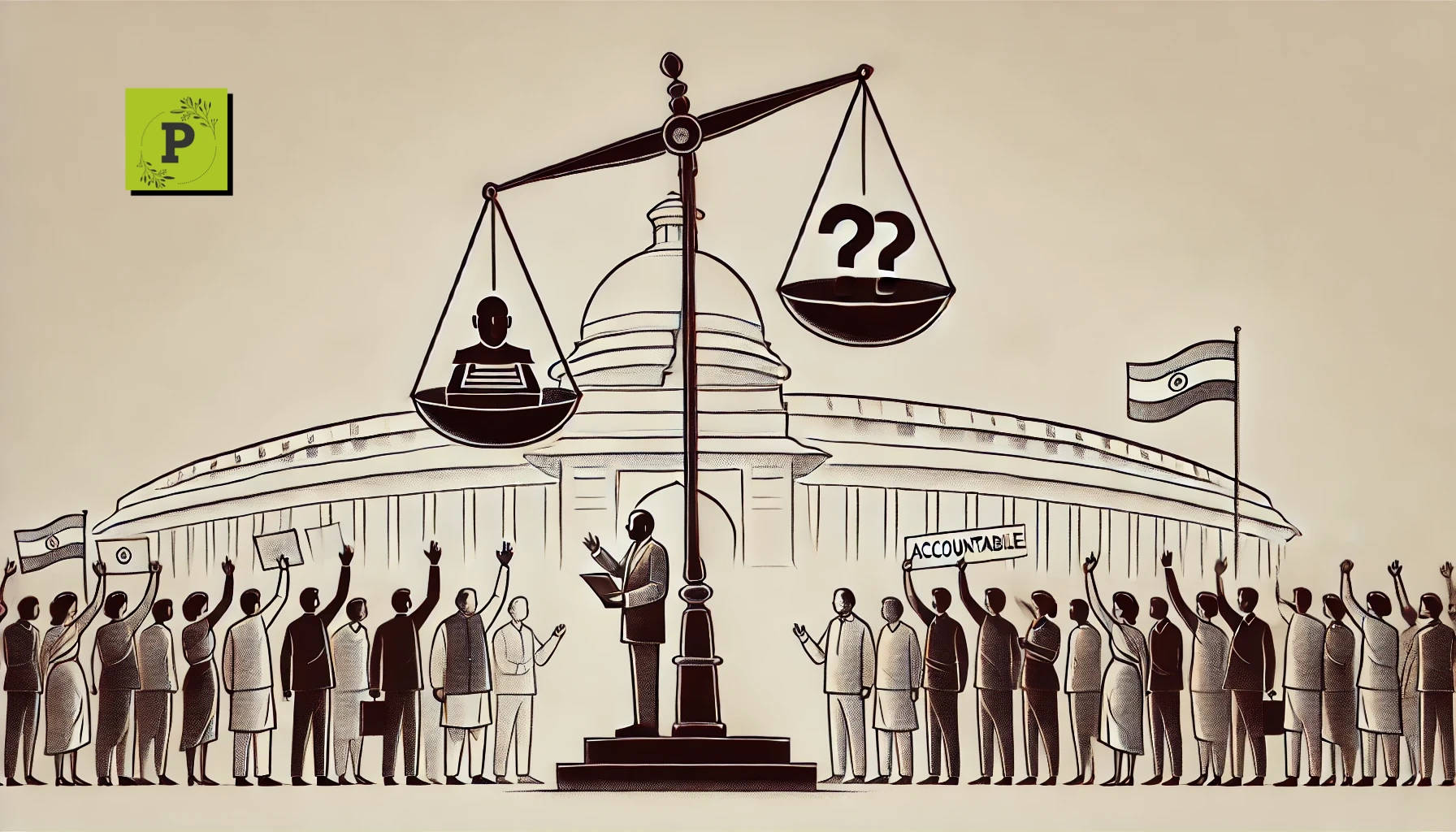
Can You Sue a Political Party for Not Fulfilling Promises? Election campaigns in India are often driven by elaborate promises made by political parties and their leaders through manifestos, speeches, and other forms of communication. These promises, ranging from infrastructure development to economic reforms and social welfare initiatives, are pivotal in shaping public opinion and influencing voting behavior. But what happens when these promises are not fulfilled? Can citizens hold political parties and their leaders legally accountable for failing to deliver on their commitments? Let’s explore.
(You can now subscribe to our Ponder Page WhatsApp channel)

Table of Contents
The Nature of Election Promises
To understand whether political promises can lead to legal action, it’s essential to recognize the nature of these commitments. Manifestos released by political parties are essentially declarations of intent, outlining what they aim to achieve if elected to power. However, these promises are not legally binding contracts but are considered more aspirational than obligatory.
Election promises often involve complex factors, including economic constraints, bureaucratic hurdles, and changing circumstances, which can impact a party’s ability to deliver. This raises the question: can the electorate sue a party or its leaders for breach of trust or non-fulfillment of promises?
Legal Framework in India
1. Constitutional and Legal Boundaries
India’s legal system does not explicitly provide a mechanism for suing political parties for failing to fulfill their manifestos. The Representation of the People Act, 1951, governs electoral processes in India, but it does not impose penalties on political parties for unfulfilled promises. Similarly, the Indian Penal Code (IPC) does not recognize the non-fulfillment of election promises as a criminal offense.
2. Supreme Court’s Stance
The Supreme Court of India has deliberated on the issue of election promises in several landmark cases. In 2013, in the case of S. Subramaniam Balaji v. Government of Tamil Nadu and Others, the Court addressed the legality of promises made in election manifestos. While the Court acknowledged that such promises could distort the level playing field in elections, it stopped short of declaring them illegal. Instead, the Court recommended that the Election Commission of India (ECI) frame guidelines to regulate manifestos, emphasizing transparency and accountability.
The ECI subsequently introduced a model code of conduct, which includes provisions for manifestos, requiring political parties to explain the rationale behind their promises and the means of funding them. However, these guidelines are advisory and lack enforceability.
3. Consumer Protection and Breach of Trust
Some citizens have attempted to frame election promises as a breach of trust or deficiency in service under the Consumer Protection Act. However, courts have consistently ruled that political promises do not fall under the purview of consumer rights, as there is no direct service-provider relationship between voters and political parties. Similarly, claims of criminal breach of trust under the IPC have been dismissed due to the absence of a fiduciary relationship.
Obstacles to Legal Recourse
- Non-Binding Nature of Promises: Election manifestos are viewed as policy documents rather than binding agreements, making it challenging to establish a legal obligation.
- Ambiguity in Promises: Many promises are framed in vague or conditional terms, making it difficult to measure non-fulfillment objectively.
- Separation of Powers: Courts are cautious about intervening in political and legislative matters, respecting the separation of powers between the judiciary, legislature, and executive.
- Practical Challenges: Proving intent to deceive or deliberate non-fulfillment requires substantial evidence, which is often difficult to obtain.
Emerging Trends and Public Sentiment
While direct legal action against political parties remains limited, public sentiment is increasingly favoring greater accountability. Citizens and civil society organizations are leveraging tools like social media, public interest litigations (PILs), and right-to-information (RTI) applications to demand transparency and track the implementation of electoral promises. Media scrutiny and public debates also play a critical role in holding political parties accountable.
International Perspectives
In some democracies, mechanisms exist to enhance the accountability of political parties. For instance, in countries like the UK and Australia, election promises are subjected to rigorous scrutiny by independent bodies, and misleading claims can result in reputational damage. While such models are not directly applicable to India, they provide valuable lessons on fostering a culture of accountability.

The Way Forward
To bridge the gap between promises and performance, several measures can be considered:
- Legislative Reforms: Introducing laws to make manifestos more accountable, with provisions for penalties in cases of blatant falsehoods or deliberate non-fulfillment.
- Strengthening the Election Commission: Empowering the ECI to enforce stricter guidelines on manifestos and ensure compliance through audits and reviews.
- Public Awareness: Educating voters about their rights and encouraging them to question and evaluate promises critically.
- Voluntary Accountability: Encouraging political parties to adopt internal mechanisms for tracking and reporting the status of their commitments.


Can You Sue a Political Party for Not Fulfilling Promises? In Short!
While the legal framework in India currently does not permit suing political parties or their leaders for failing to fulfill their promises, there is growing demand for greater accountability and transparency in the political process. Strengthening existing mechanisms and fostering a culture of responsible governance can bridge the trust deficit between voters and their representatives. Ultimately, an informed and vigilant electorate is the strongest force for ensuring that election promises translate into tangible outcomes.
What are your thoughts on this article? Let us know in the comments below. If you enjoyed this article, be sure to subscribe for more engaging content in the future! Stay updated on the latest developments and discussions by clicking the subscribe button above. Thank you for your support!
📢 Dive into the latest discussions on social & trending topics! 🌍💬 Subscribe to Ponder Page for thought-provoking articles and interviews that dissect current issues. Don’t miss out on insightful content—hit that like & subscribe button now!





Leave a Reply