
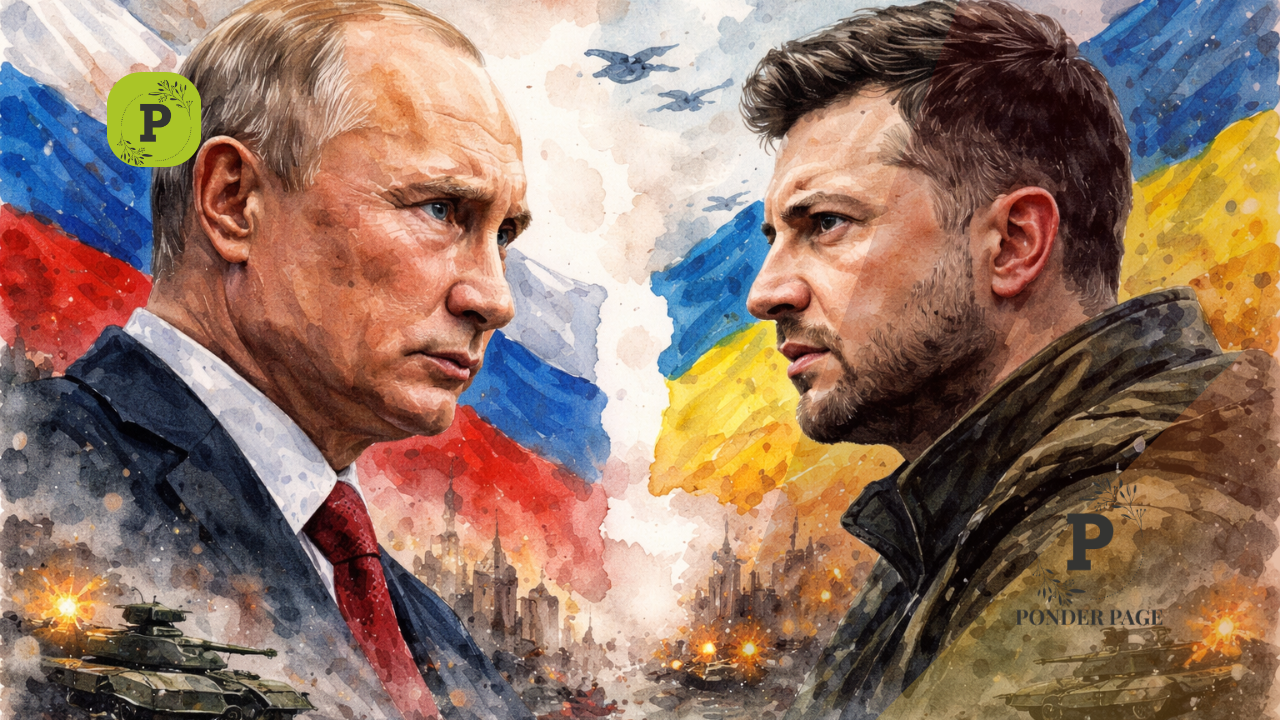
Why Is Russia at War with Ukraine? Before 2014, the relationship between Ukraine and Russia appeared stable and cooperative on the surface. This apparent harmony existed largely because Ukraine’s political leadership at the time aligned closely with Moscow’s interests. The Ukrainian government functioned in a manner that suited Russian strategic and economic priorities, shaping policies that kept Ukraine firmly within Russia’s sphere of influence. During this period, Western powers such as the United States and European nations lacked the political leverage to significantly influence Ukraine’s internal direction.
(You can now subscribe to our Ponder Page WhatsApp channel)

Table of Contents
Internal Divisions Within Ukraine
Ukraine has long been divided along cultural, linguistic, and political lines. One section of the population primarily speaks Russian and traditionally supports pro-Russian leadership. This group benefited directly from policies that favored close ties with Moscow. Another section consists of native Ukrainian speakers who feel culturally and politically closer to Europe. These citizens repeatedly voiced concerns that their government was excessively aligned with Russia, creating an imbalance that favored Russian-speaking regions over others. This internal divide would later play a decisive role in reshaping the country’s political trajectory.
Viktor Yanukovych and the Turning Point
Between 2010 and 2014, Ukraine was led by President Viktor Yanukovych, widely regarded as a pro-Russian leader. A defining moment came when he was invited to a European Union meeting and offered a free trade agreement. His decision to reject the offer and walk away triggered widespread outrage within Ukraine. Many citizens saw this move as a denial of Ukraine’s European aspirations.
Mass protests erupted in November 2013 and continued until February 2014. These demonstrations escalated to such an extent that Yanukovych was forced to flee the country to save his life, eventually seeking refuge in Russia. This event fundamentally altered Ukraine’s political landscape.
A Shift in Political Thinking After 2014
Following Yanukovych’s departure, subsequent Ukrainian leaders clearly understood that excessive dependence on Russia could threaten their hold on power. Public sentiment had shifted decisively. A useful comparison can be drawn with India – any Indian government openly praising Pakistan would struggle to survive politically. Ukraine faced a similar reality.
From this point onward, Ukraine faced two clear choices. It could continue operating under Russia’s shadow, or it could align itself more closely with European nations. Ukrainian political parties increasingly recognized that the majority of the population favored integration with Europe. As a result, after 2014, Ukraine gradually pivoted away from Russia and toward Western alliances.
Russia’s Economic Stakes and Energy Politics
Russia watched this shift with growing discomfort. One major reason was energy. Russia is one of Europe’s largest suppliers of natural gas, providing nearly thirty percent of Europe’s total supply. This gas is transported through pipelines that pass through several countries, including Ukraine. Transit countries are entitled to substantial fees, making Ukraine strategically important.
Until 2013, Ukraine cooperated on Russia’s terms. Afterward, Ukraine began demanding significantly higher transit fees, amounting to billions annually. Although Ukraine had been Russia’s largest economic partner until 2014, relations deteriorated rapidly once Kyiv began asserting its economic and political independence.
Rejection of the Eurasian Economic Union
Russia attempted to counter Ukraine’s westward movement by encouraging it to join the Eurasian Economic Union, a free trade bloc designed to consolidate Russian influence in the region. Ukraine declined this offer as well. Each step Ukraine took toward Europe increased Russia’s strategic anxiety and reduced Moscow’s leverage.
NATO and the Core Strategic Conflict
The real crisis emerged when Ukraine showed serious interest in joining NATO. The North Atlantic Treaty Organization was formed in 1949 after World War II through an agreement stating that an attack on one member would be treated as an attack on all. Member states host joint military exercises, missile installations, and security infrastructure.
Although framed as a defensive alliance, NATO was originally established to counter the Soviet Union. Over time, its membership expanded from eleven countries to thirty-two. Russia remained relatively silent while NATO expanded in Western Europe. However, Moscow grew increasingly alarmed when NATO began incorporating Eastern European countries closer to Russian borders.
From Russia’s perspective, NATO expansion meant two serious threats. First, the number of countries openly opposed to Russia was increasing. Second, American military assets and missile systems were steadily moving closer to Russian territory. Countries such as Estonia, Latvia, and Poland already bordered Russia. If Ukraine were to join NATO, the distance for a potential missile strike against Russia would be reduced to mere minutes.
Border Proximity and Strategic Parallels
Military strategy in geopolitics places enormous importance on proximity. If Russia were to establish military bases in Mexico, Cuba, or Canada, the United States would not tolerate it. Russia argued that NATO’s actions mirrored this very scenario. Moscow repeatedly questioned why Western powers were transforming historically neutral or friendly nations into strategic adversaries.
Ukraine itself did not even fully meet NATO’s eligibility criteria, which require the absence of active border disputes. Despite this, NATO signaled willingness to accommodate Ukraine, further escalating tensions.
Donetsk, Luhansk, and the Escalation
Regions such as Donetsk and Luhansk already had active separatist movements dominated by pro-Russian populations. These areas operated largely in alignment with Russian interests. When Russia prepared for direct military action against Ukraine, it first recognized these regions as independent and sent troops under the label of peacekeeping forces.
Russia’s Demands and the Breakdown of Diplomacy
Russia repeatedly warned the United States and NATO that it would not wait indefinitely. In January, Russia’s foreign minister clearly stated that Moscow expected concrete security guarantees. Russia placed three primary demands on the table: an end to NATO’s military activity in Eastern Europe, a formal assurance that Ukraine would never join NATO, and the removal of U.S. nuclear weapons stationed in Europe.
These demands were rejected. Notably, none of them were directed at Ukraine itself. They were aimed squarely at the United States and NATO, reinforcing the argument that Ukraine was a strategic pawn in a larger power struggle.
Shared Responsibility for the Conflict
The unfolding tragedy cannot be attributed to one side alone. While Russia bears responsibility for its actions, the role of Western powers cannot be ignored. History shows that offering security assurances and then withdrawing support when conditions worsen has happened before. The consequences of this rivalry have cost millions of lives across decades.
Russia maintains that its objective is not territorial conquest but demilitarization. By establishing control over Ukraine’s political direction, Moscow believes it can permanently neutralize the NATO threat along its borders.

India’s Position and Strategic Neutrality
The United States has consistently pressured India to issue strong statements against Russia. However, India operates based on long-term national interest rather than external expectations. India has maintained a cautious stance, calling for peace and dialogue without directly condemning Russia.
Criticizing Russia at this moment would effectively align India against a long-standing strategic partner. Such a move would not end the war but could push Russia closer to China and Pakistan, altering regional power balances to India’s disadvantage.


Why Is Russia at War with Ukraine? Harsh Realities of Global Power Politics
Geopolitics does not function on emotion or moral arguments alone. Ukraine’s leadership, influenced by external encouragement, placed its population in grave danger. Strong nations impose their will, while weaker ones often pay the price. Ukraine today, and potentially Taiwan tomorrow, reflect this reality.
Wars eventually end. Leaders shake hands again. Agreements are signed. But the lives lost, families destroyed, and futures erased cannot be restored. That is the enduring cost of global power struggles, borne not by policymakers, but by ordinary people caught in between.
What are your thoughts on this article? Let us know in the comments below. If you enjoyed this article, be sure to subscribe for more engaging content in the future! Stay updated on the latest developments and discussions by clicking the subscribe button above. Thank you for your support!
📢 Dive into the latest discussions on social & trending topics! 🌍💬 Subscribe to Ponder Page for thought-provoking articles and interviews that dissect current issues. Don’t miss out on insightful content—hit that like & subscribe button now!


Leave a Reply