
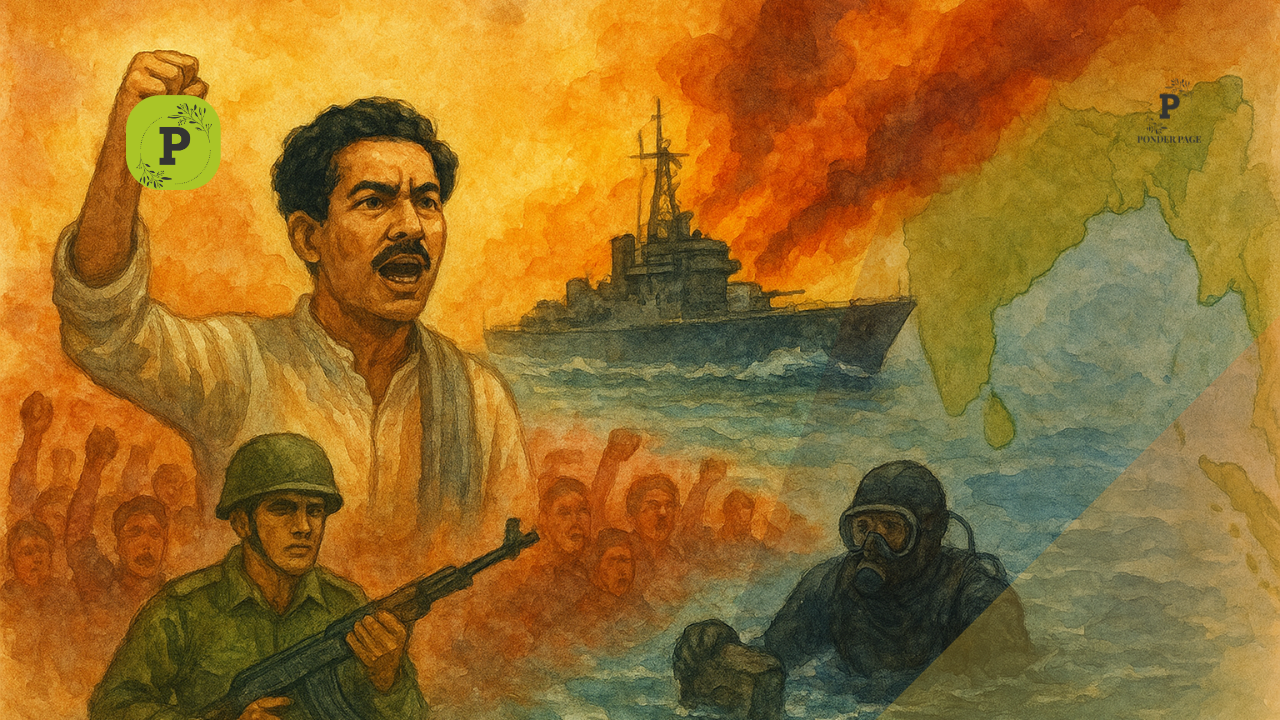
The Secret Mission That Changed the 1971 India-Pakistan War: The year 1971 is etched into memory for many reasons, but none more urgent than the humanitarian catastrophe that unfolded in what was then East Pakistan. What began as a struggle over language and political rights turned into mass violence, a refugee crisis that overwhelmed a neighboring country, and a carefully planned military and covert response that changed the map of South Asia.
(You can now subscribe to our Ponder Page WhatsApp channel)

Table of Contents
Background — Two wings, one country, rising tensions
In 1971 Pakistan existed in two geographically separated wings: West Pakistan (today’s Pakistan) and East Pakistan (today’s Bangladesh).
Despite being part of the same country, the people of East Pakistan felt increasingly marginalized by the political leadership in West Pakistan. Cultural and linguistic discrimination – notably against Bengali language and identity – sparked widespread protests.
The situation escalated when the Pakistani military launched a brutal crackdown on March 25, 1971, attempting to crush dissent. The repression triggered a wave of fear and violence across the eastern wing.
The refugee flood — an invisible war at the border
Once the crackdown began, civilians started fleeing across the border into India. The numbers were staggering. At the peak, more than 50,000 people crossed into India every day. Refugee camps had to be set up all along the border, in makeshift fashion and under enormous pressure. Within weeks the figure swelled to well over nine million people seeking shelter. For India this was more than a humanitarian emergency – it became a social, economic and demographic concern.
The cost was immense. Records from the period speak of a burden on the Indian government amounting to hundreds of millions; providing food, shelter, medical help and security for such a massive influx strained resources.
At one point nearly four percent of the central government’s budget was being spent to manage the refugee situation. The prospect of long-term demographic change in border regions added a political dimension to the crisis.
India’s dilemma and preparations
India explored diplomatic avenues, including raising the issue at the United Nations, but progress was limited. By April 1971 the situation had hardened. Prime Minister Indira Gandhi convened the chiefs of the Army, Navy and Air Force to consider options. The military leaders advised caution: they believed that if hostilities were to be engaged, a later date – December 1971 – would provide a higher chance of success and reduce casualties, because the armed forces would then be better prepared.
Given that window of preparation, India adopted a two-track approach. On the one hand, it managed the refugee influx and international diplomacy; on the other, it quietly planned measures to weaken Pakistan’s ability to sustain its operations in East Pakistan. The idea was to disrupt supply lines and make it difficult for Pakistan to reinforce or resupply its forces across the long distance separating the two wings.
Cutting supply lines — airspace closed and the maritime angle
India closed its airspace to Pakistan on April 1, 1971. That eliminated one of the main routes for moving troops and material. The remaining route for Pakistan’s military supplies was by sea – a long maritime corridor used to ferry arms and ammunition to the eastern wing.
The Indian Navy saw an opportunity to cripple Pakistan’s supply line, but a direct naval attack would have been considered an overt act of war. So, a different strategy was devised. Along the Bay of Bengal, in West Bengal, the Indian establishment set up a covert training camp. The site – chosen for secrecy – would train local guerrillas and freedom fighters to carry out sabotage operations against ships carrying military supplies.
Operation X and the Mukti Bahini — covert action at sea
A secret program was created to train members of the Mukti Bahini (the Bengali liberation forces) in underwater sabotage. Experienced officers led small teams who taught night navigation, underwater swimming, and how to attach magnetic limpet mines – devices that could be affixed to the hulls of vessels and detonated remotely or on timers.
The plan was simple and daring: trained commandos would infiltrate by night, attach mines to Pakistani supply ships, and return undetected. To coordinate the strikes, a radio signal was used – two predetermined songs broadcast at a specific time would act as the trigger. That signal came on the night of August 15, 1971.
What followed in the early hours was a series of explosions along the shipping routes. Between August 15 and 16, significant damage was inflicted on several merchant and military vessels. Names commonly associated with the losses include ships such as M.V. Al Abbas and M.V. Harmos, and estimates put the amount of arms and ammunition destroyed at around 19,000 tons – though figures vary between sources. In all, more than a hundred vessels were reported damaged or destroyed in these mysterious blasts.
The wider reaction — confusion, escalation, and caution
Pakistan was alarmed and puzzled. The attacks were precise and left little trace of how they had been carried out, leading Pakistan to suspect a coordinated operation rather than random guerrilla action. International dynamics complicated matters further. The United States, which had strategic ties to Pakistan, kept a close watch and used intelligence assets to track regional developments. As Pakistan moved some of its forces and naval assets into more forward positions – fearing further attacks – the Indian Navy put its own forces on alert, mindful of the possibility of a retaliatory strike.
Impact and aftermath
Operation X, whether one labels it covert action or calculated resistance, had a significant effect. It disrupted crucial supply lines, strained Pakistan’s capacity to sustain military operations in the east, and contributed to the overall pressure on the Pakistani establishment. These events formed part of the larger mosaic that culminated later that year in full-scale conflict and, ultimately, the creation of an independent Bangladesh.
Perhaps most poignantly, the 1971 crisis reminds us that political decisions have human consequences. Millions were displaced, countless lives were lost, and communities were forever altered. Yet from that turmoil emerged a determined liberation movement whose fighters and supporters took extraordinary risks.


The Secret Mission That Changed the 1971 India-Pakistan War: How a Humanitarian Crisis Became a Turning Point in South Asia
The story of 1971 is difficult and complex. It combines humanitarian urgency, clever tactical planning, and the messy realities of international politics. The refugee crisis forced neighbours to respond with compassion and strategy; the covert maritime campaign demonstrated the lengths to which a nation would go to protect its interests and support people fighting for their rights. Understanding this chapter requires looking beyond battle lines to the human stories of displacement, courage and the desire for self-determination that drove the events of that pivotal year.
What are your thoughts on this article? Let us know in the comments below. If you enjoyed this article, be sure to subscribe for more engaging content in the future! Stay updated on the latest developments and discussions by clicking the subscribe button above. Thank you for your support!
📢 Dive into the latest discussions on social & trending topics! 🌍💬 Subscribe to Ponder Page for thought-provoking articles and interviews that dissect current issues. Don’t miss out on insightful content—hit that like & subscribe button now!





Leave a Reply