
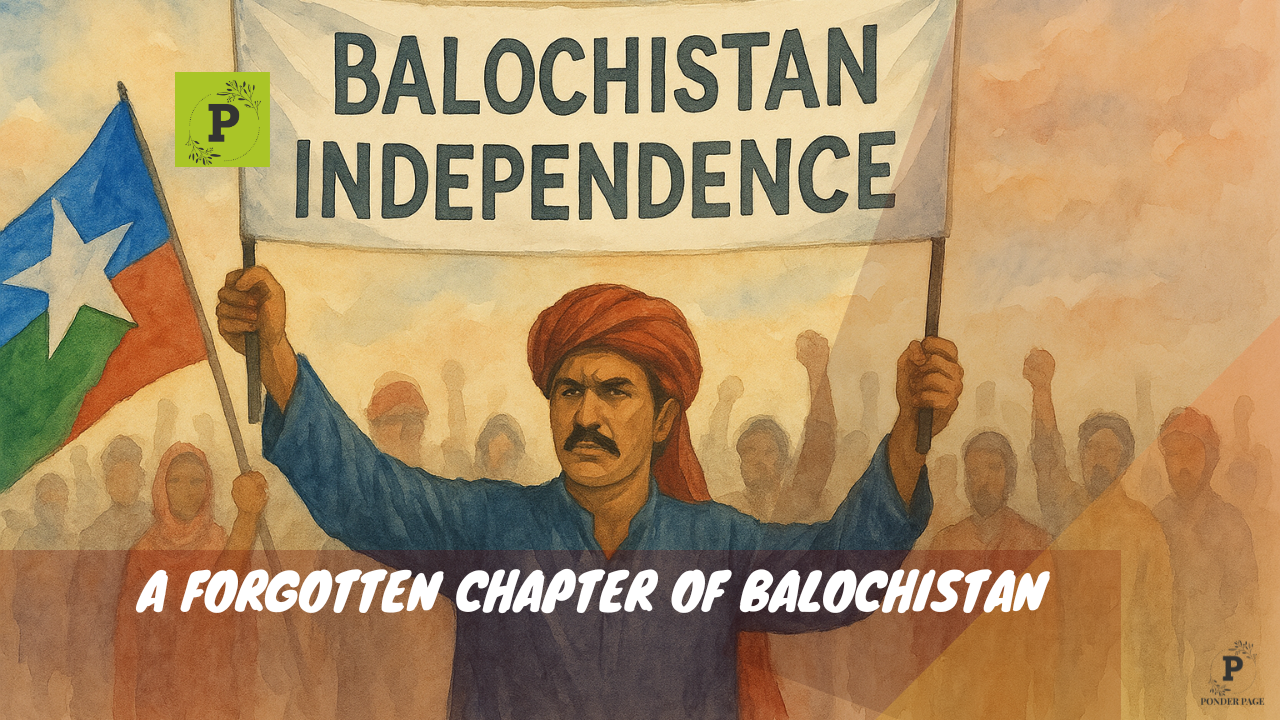
A Forgotten Chapter of Balochistan: The story of Kalat’s accession to Pakistan is often overshadowed by the narratives of other princely states during the subcontinent’s partition. Yet, it holds crucial insights into how geopolitics, military maneuvering, and broken promises reshaped the future of an entire region—Balochistan.
(You can now subscribe to our Ponder Page WhatsApp channel)

Table of Contents
The Announcement of Independence
On 12th September 1947, shortly after the British left India, the Khan of Kalat, Mir Ahmad Yar Khan, issued a declaration of independence for the Kalat State. This announcement was based on the historical sovereignty Kalat had maintained under treaties with the British.
However, the British response was quick and significant. They issued an official statement suggesting that while Kalat had declared independence, it was not capable of handling international responsibilities as a sovereign state. Though seemingly neutral, this statement laid the groundwork for Pakistan’s future claims and actions.
Pakistan’s Strategy Begins
Following the British statement, Pakistan intensified pressure on the Khan of Kalat to accede to Pakistan. Their strategy had two parallel tracks:
- Military Preparation
Pakistan began preparing its military forces for possible conflict, gradually deploying troops around Kalat. - Political Intrigue
Pakistan initiated negotiations with the leaders of three regions—Makran, Las Bela, and Kharan. These regions were historically allied with Kalat but were now being courted individually by Muhammad Ali Jinnah’s administration.
The Khan Seeks Allies
Disturbed by Pakistan’s growing pressure, the Khan of Kalat sought support from the British, but they refused to intervene. He then approached Afghanistan and even India, but both nations declined to offer any assistance. The Khan found himself increasingly isolated.
Pakistan’s Deal with Tribal Leaders
In early January 1948, Pakistan struck deals with the leaders of Makran, Las Bela, and Kharan. The terms offered included financial support, political power (by making them heads of states under Pakistani administration), and assurances that their cultural identities would remain untouched.

On 17th March 1948, these leaders formally acceded their territories to Pakistan. As a result, the Kalat State was surrounded on all sides, making its isolation both political and geographical.
The Invasion of Kalat
Just ten days later, on 27th March 1948, Major General Mohammad Akbar Khan led the Pakistan Army into Kalat. Simultaneously, Pakistan Navy warships were deployed at the ports of Pasni and Jiwani. The military pressure proved overwhelming.

The Khan of Kalat was taken to Karachi, where he was compelled to sign the instrument of accession. This document officially merged Kalat into Pakistan, and the entire region was later reorganized and named Balochistan.
Resistance and the Start of Armed Rebellion
While Pakistan celebrated this geopolitical success, dissent brewed within Kalat’s royal family. The Khan’s brother, Prince Abdul Karim, was furious at what he saw as a betrayal.
In April 1948, Abdul Karim gathered a group of 100–150 fighters and formed the Baloch National Liberation Committee. Launching a guerrilla warfare campaign from the hills of Kharan and Noshki near the Afghan border, he challenged the Pakistan Army’s presence in the region.
Though small in number, Abdul Karim’s forces knew the terrain intimately and used hit-and-run tactics, which made it extremely difficult for Pakistan’s military to suppress the rebellion. These early resistance efforts sowed the seeds for long-term unrest in Balochistan.
A Forgotten Chapter of Balochistan: The Forced Accession of Kalat
The story of Kalat’s forced accession reveals how fragile promises and power politics can redraw maps and alter the fate of entire peoples. Though Kalat was eventually merged into Pakistan, the scars of those decisions remain visible in the ongoing tensions and insurgencies in Balochistan today.
This chapter is not just about borders and treaties—it is about sovereignty, betrayal, and a community’s enduring struggle for recognition. Understanding this history is crucial for anyone who wants to grasp the deeper layers of South Asia’s post-colonial evolution.


What are your thoughts on this article? Let us know in the comments below. If you enjoyed this article, be sure to subscribe for more engaging content in the future! Stay updated on the latest developments and discussions by clicking the subscribe button above. Thank you for your support!
📢 Dive into the latest discussions on social & trending topics!
🌍💬 Subscribe to Ponder Page for thought-provoking articles and interviews that dissect current issues. Don’t miss out on insightful content—hit that like & subscribe button now!





Leave a Reply